

6 tips for building a better creative practice
At the beginning of every January you make the resolution.
”This will be the year I finally take time for me. For my textile practice. For my creativity.”
And you start off with a renewed sense of excitement. You’re itching to pick up a needle and thread and get started on a new project. Maybe you even make the first marks. But then what?
All too often old insecurities rear their unwelcome heads.
Because perhaps it’s been a long time since you made anything. You’ve lost confidence in your ability. Your process feels confused. And you have no clear pathway forward for bringing your artistic vision to reality. And before you know it that awful feeling of “I’m just not good enough” becomes overwhelming.
If this sounds like your story, you’re definitely not alone. Everyday we receive emails from people just like you. People who are passionate about embroidery and textiles. But are struggling to fulfil their creative potential.
The good news is there is a way for this year to be different. In this article we’ll offer some simple tactics to ensure that your inner critic doesn’t win this time.
Identifying your creative demons
The first step to a more focused, productive and fulfilling practice in the year ahead is to identify what’s stopping you. Or at least what you think is stopping you.
Often (and this may sound harsh) the excuses you make for not making a commitment to your creativity are really just a mechanism. A mechanism to deal with fear. After all it’s easy not to fail if you don’t try.
Excuses come in all shapes and sizes. Have you ever told yourself:
- I just don’t have natural talent?
- I have no idea how to start?
- I don’t have the discipline it takes?
Now before you start beating yourself up for being a scaredy-cat excuse-maker, know that you’re in good company. Some of the world’s most celebrated textile artists, who to the outside world seem to have it all figured out, have battled with exactly the same demons as you. I’m the king of excuses myself! So let’s tackle this together.
I just don’t have natural talent
Perhaps you’ve always loved art and textiles but just never felt you had an innate ability.
You long to speak through your materials in a voice that feels fresh, clear and strong and yet everything you make feels messy, overly simplistic, confused or like a copy of somebody else’s work. You don’t have an individual voice. Or a worthy visual vocabulary.
Or maybe you’ve taken textile workshops and embroidery classes but ended up comparing yourself negatively to the other students. How do they manage to take a brief and fly with it? Whilst you’re stuck on the starting block.
And so it’s easier not to try. You tell yourself you’re just not cut out for it. You’d prefer to just be an admirer of ‘real’ artists instead.
Tip number one: Aim for growth, not perfection
Not everything you make will be a masterpiece. Every artist needs to fail before they succeed. And remember, success is subjective.
You might not love your first effort, or even your second or third. And that’s ok. As long as you’re learning and growing.
Try to make something. Anything. Then ask yourself what you might do differently next time. What do you like? What could be better?
And then make something else.
But remember, every piece you make is just one tiny step on a much bigger creative journey.
Tip number two: Surround yourself with positivity
Ever considered the workshops and classes you’ve taken just weren’t the right fit for you? You might need clearer guidance. Or gentler encouragement.
Sometimes deep routed negative beliefs about your ‘talent’ can be very tough to shake.
Pippa Andrews for example, told us:
“Growing up, there was a lot of resistance to my artistic inclinations from my parents. I also had a difficult relationship with my sewing teacher who publicly tore out my crooked machine stitched seams in front of the class. I felt so humiliated that I never wanted to sew again”.
But years later, after a career in journalism, Pippa felt herself being drawn back to embroidery. She sought out artists who shared her passion and nurtured her creativity; Jan Beaney, Jean Littlejohn and Louise Baldwin were “marvellous and generous” mentors and helped her expand her vision.
Surrounding yourself with likeminded, creative people can have a big impact on your confidence. How can you find your own tribe? Join a local embroidery group? Or an online community?
I have no idea how to start
Maybe you have a hundred amazing ideas but absolutely no direction. No clear idea how to even begin making the first marks. How do you settle on the best pathway forward?
You’re overwhelmed by the possibilities. Stifled by infinite choice.
Setting goals and making plans sounds like a sensible way of distilling ideas. But all too often the goals we set are unrealistic and the plans too far-reaching.
Perhaps it’s time to think a little more ‘in the now’. To go back to basics.
Tip number three: Start by playing
What we’ve learned from over 500 interviews with established textile artists is that most of them invest time in experimentation first and worry about the outcome later. Jette Clover, for example, starts every day by making a small paper collage. Her discoveries eventually infiltrate her work but that’s not the endgame.
And Janie Parten, a past student of our online textile art course Exploring Texture and Pattern with Sue Stone, which is all about experimenting with simple textile techniques, told us with each new sample she created on the course she could feel her artistic confidence growing. As she gradually immersed herself in a playful process she became less judgemental of her abilities and a stronger visual identity began to emerge in her work.
Why not start by spending time with your tools and materials each day with no larger goal than to have some fun? Eventually you’ll crave more structure and start to make a larger plan. That plan may even reveal itself in a more organic way than you expected when you invest in ‘play’.
Tip number four: Start with one thing
Textile art holds an abundance of opportunities for artistic expression. It’s an endlessly exciting and versatile medium. The internet is full of images of awe inspiring art being made by innovative practitioners.
But if you peel back the layers, you may be surprised by just how simple the approach of those practitioners actually is.
Very often the most striking textile art is made using well-worn techniques in personal and inventive ways.
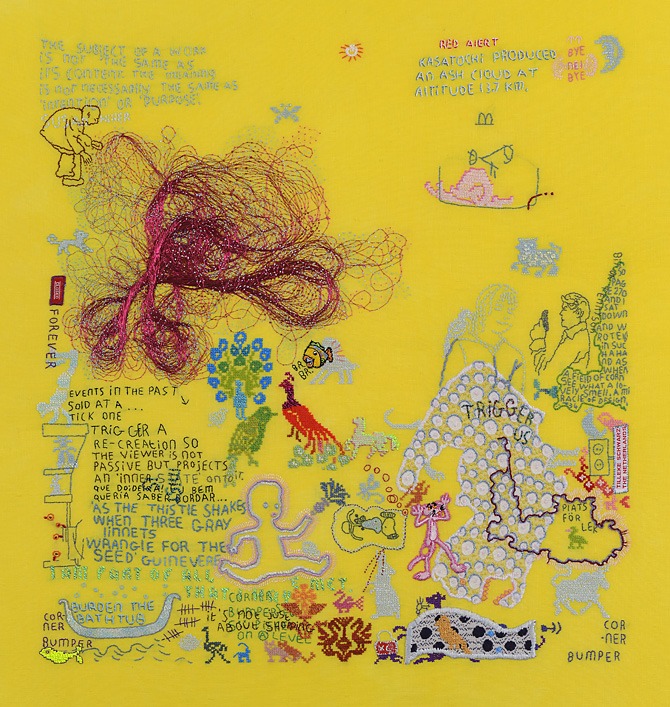
Tilleke Schwarz creates pieces that are instantly recognisable. And yet she uses a fairly small repertoire of hand stitches: mainly couching, cross stitch and appliqué. It’s the way she uses these stitches that makes her work unique and innovative. With each new piece her visual vocabulary becomes stronger and more distinctive.
There’s a time for trying out new things; it can be great fun learning a new skill. But being seduced by every shiny new technique could mean you never go deep with anything. Never allow yourself the opportunity to truly ‘own’ your creative process.
So why not start by immersing yourself in one technique? Commit some time to pushing its boundaries. Unearthing its possibilities. Only when you ‘go deep’ will your own unique take on a technique start to reveal itself.
I don’t have the discipline it takes
If Malcolm Gladwell is to be believed, it takes 10,000 hours to become a master in any field. 10,000 hours!!! That’s a pretty overwhelming thought.
Because some days you just don’t feel creative, right?
And there’s so much else that needs your attention. The lawn needs mowing. There’s a pile of washing up to do. The cat sure as heck won’t feed itself!
Theories like Gladwell’s perpetuate the myth that if you don’t have an abundance of time, you can’t effectively nurture your creativity. So what’s the point!?
Building a practice does take discipline, there’s no doubt. As our friend and textile artist Jane Dunnewold tells us, creativity is like a muscle. To build it we must push and stretch its limitations regularly.
But regular practice doesn’t necessarily mean ‘full-time’. Let’s forget about mastery for a second and focus on what you can achieve now. In this moment. With the time you DO have available.
Tip number five: Make it manageable
Don’t try and do too many things all at once.
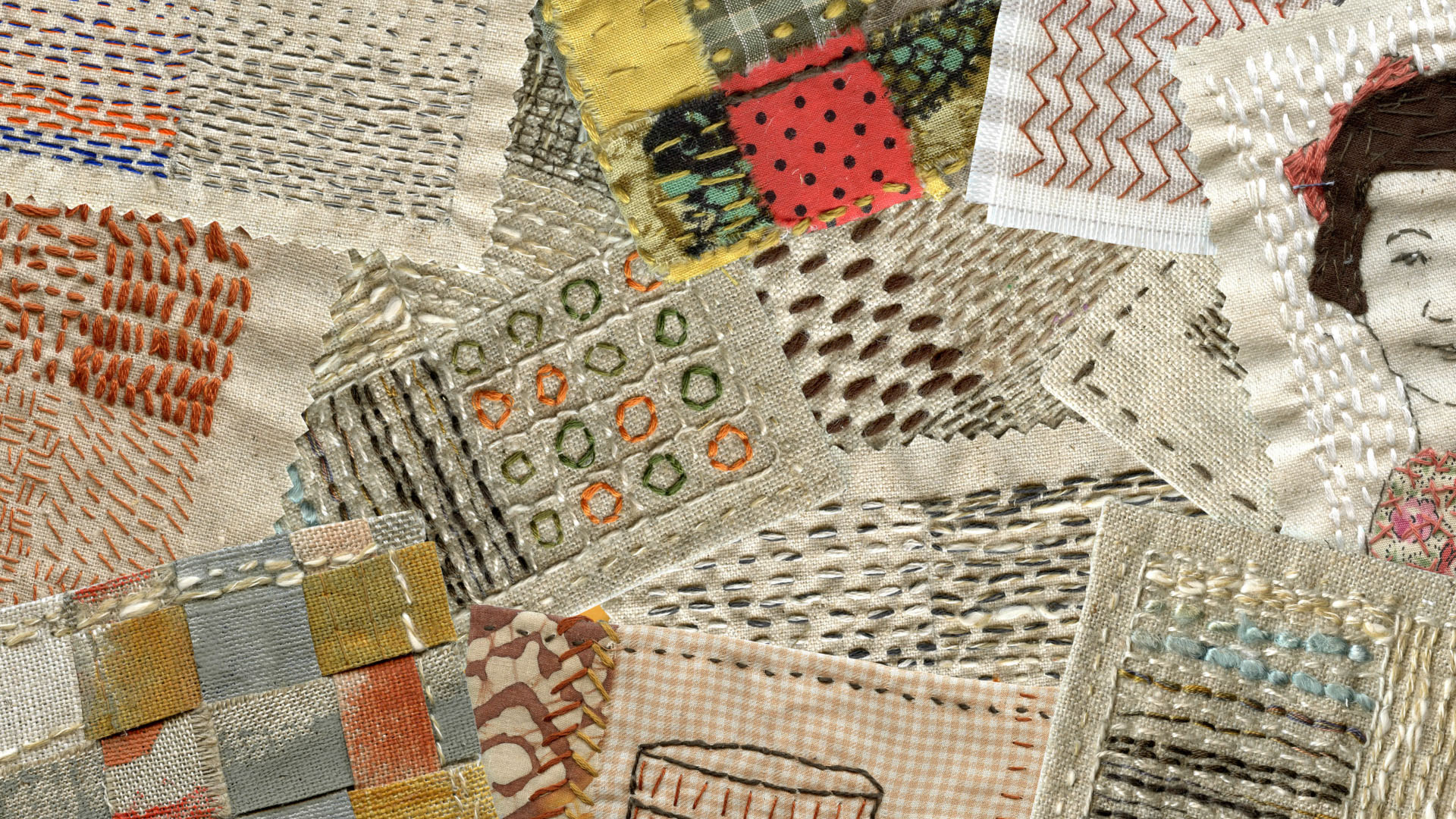
Set yourself small, specific creative tasks that can be carried out in a short amount of time. Find quick ways of exploring an idea or simple exercises to get going with a design. And even if you only complete that one small task, it’s been a good day. You started!
Before even contemplating a new full-scale piece Sue Stone (my mum) makes a series of small samples to try out ideas and experiment with her techniques. Some of these samples take less than 15 minutes to make! Could this be a way-in for you?
And 62 Group member Isobel Currie told us she breaks every project into tiny chunks. That way she always feels a sense of progression.
And with progression comes momentum.
Tip number six: Make it a priority
In between your dentist’s appointment and picking the kids up from school, do you have 45 minutes you can use to get creative in some way?
Grab your diary and mark out the chunks of time you can commit (or type it if you’re using an online calendar). Seeing it in black and white makes it official. Make a promise to yourself that you will do your very best to honour the commitment you’ve made to yourself and your creativity.
No matter how much time you feel able to commit around your own personal schedule, try and build some sense of consistency. Even if you only have one hour a week, pledging that one hour every single week will fuel your creative progress.
One final tip: Be kind to yourself
If things don’t go well on day one, forgive yourself. Beating yourself up for your lack of productivity/creativity/discipline can feed your inner critic and help cement or even inflate your negative self beliefs (which in turn feed the excuses you make).
Be conscious of those voices in your head. They’ll do everything within their power to stop you from building a regular creative practice. Question the validity of what they tell you. Find evidence to the contrary.
Remind yourself of a time you made something you were happy with. Give yourself a boost by reflecting on a past achievement. Allow yourself rewards for a job well done.
You are a unique and creative individual. Don’t deny yourself or the world your gift. This is the year!
How will you make 2018 a more creatively fulfilling year? Let us know your personal promise to yourself in the comments below. We love hearing from you!


Comments