

Nikki Parmenter isn’t afraid to stitch on unconventional surfaces. Many of her most striking artworks use clear PVC plastic sheets and other synthetic materials to create colourful layered compositions. Drawn to all things shiny, almost nothing is off limits.
Stories are equally important to Nikki’s work. Drawing inspiration from myths, legends and the natural world, she explores diverse subjects ranging from a swan’s travels to the Inuit tale of Sedna and the environmental threats facing the Great Barrier Reef. Through stitch and mixed media, she transforms these narratives into complex visual stories.
Large in scale and rich in detail, Nikki’s work is impossible to ignore. And her choice of materials is just as intriguing. Be sure to check out the surprising elements Nikki has incorporated into her work over the years. A dental harp toothpick is just the beginning.
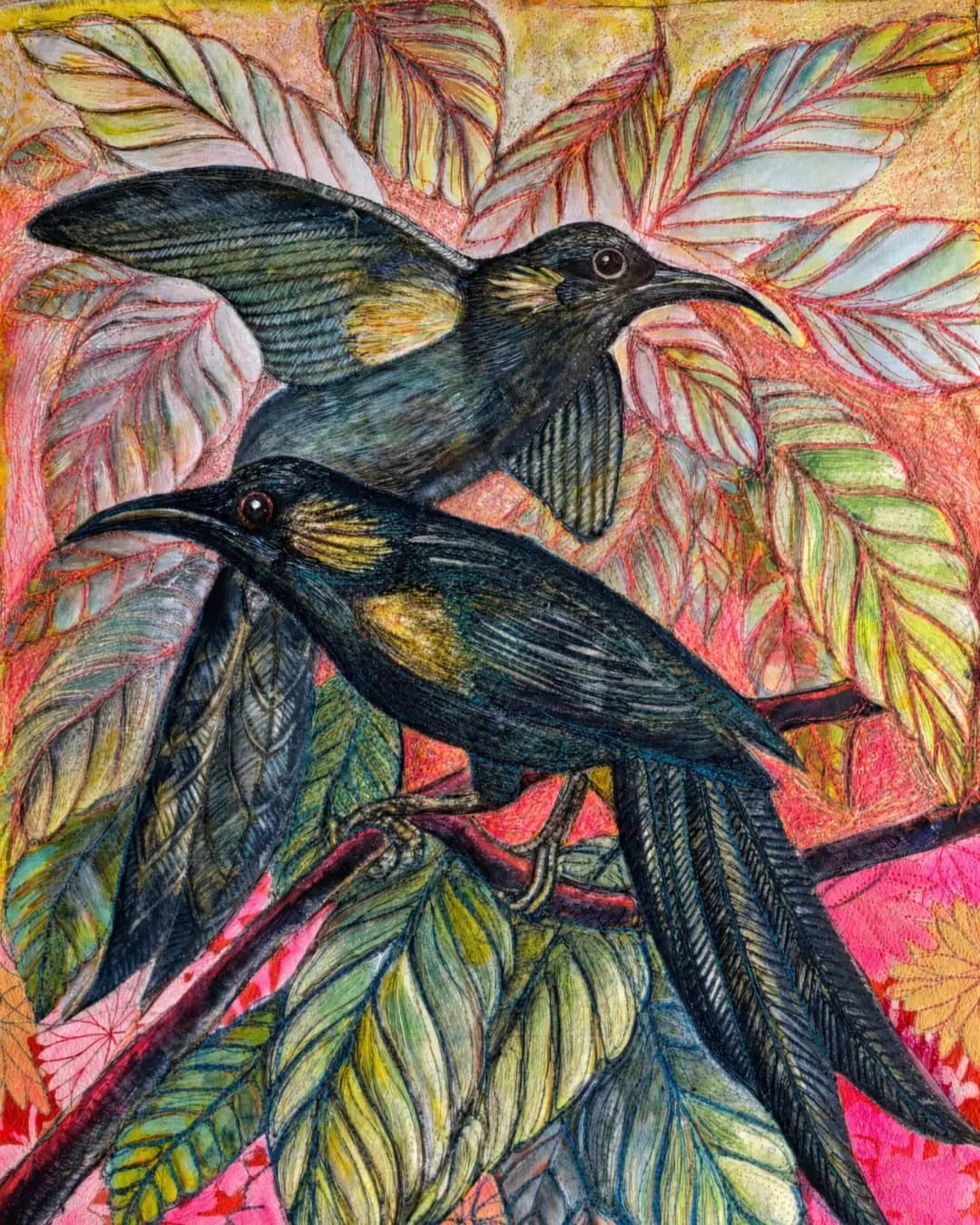
Finding my artistic voice
Nikki Parmenter: I trained as a fine artist, gaining a First Class BA Honours degree and an MA in painting from Manchester Polytechnic (now Manchester Metropolitan University). After that, I took a teacher training course that led me to teaching at secondary school level for 30 years.
Throughout my teaching career, it was important for me to continue with my own work.
I spent many years making pieces on paper using collage techniques, but I eventually became dissatisfied with working on a flat surface. Encouraged by my husband, who trained as a sculptor, I started to experiment with MDF wood to achieve a more robust structure.
I produced increasingly large artworks that became almost too heavy to lift. I also became unhappy with the wood’s rigid surface, so I changed direction again.
Two books were particularly inspirational in making that shift: Paper, Metal and Stitch by Maggie Grey and Jane Wild, and Fusing Fabrics by Margaret Beale. Each book’s techniques and materials opened a whole new world of possibilities.
“I believe ‘bigger is better’ with my art, and I strive to make an impact.”
Nikki Parmenter, Textile artist
Layers & narratives
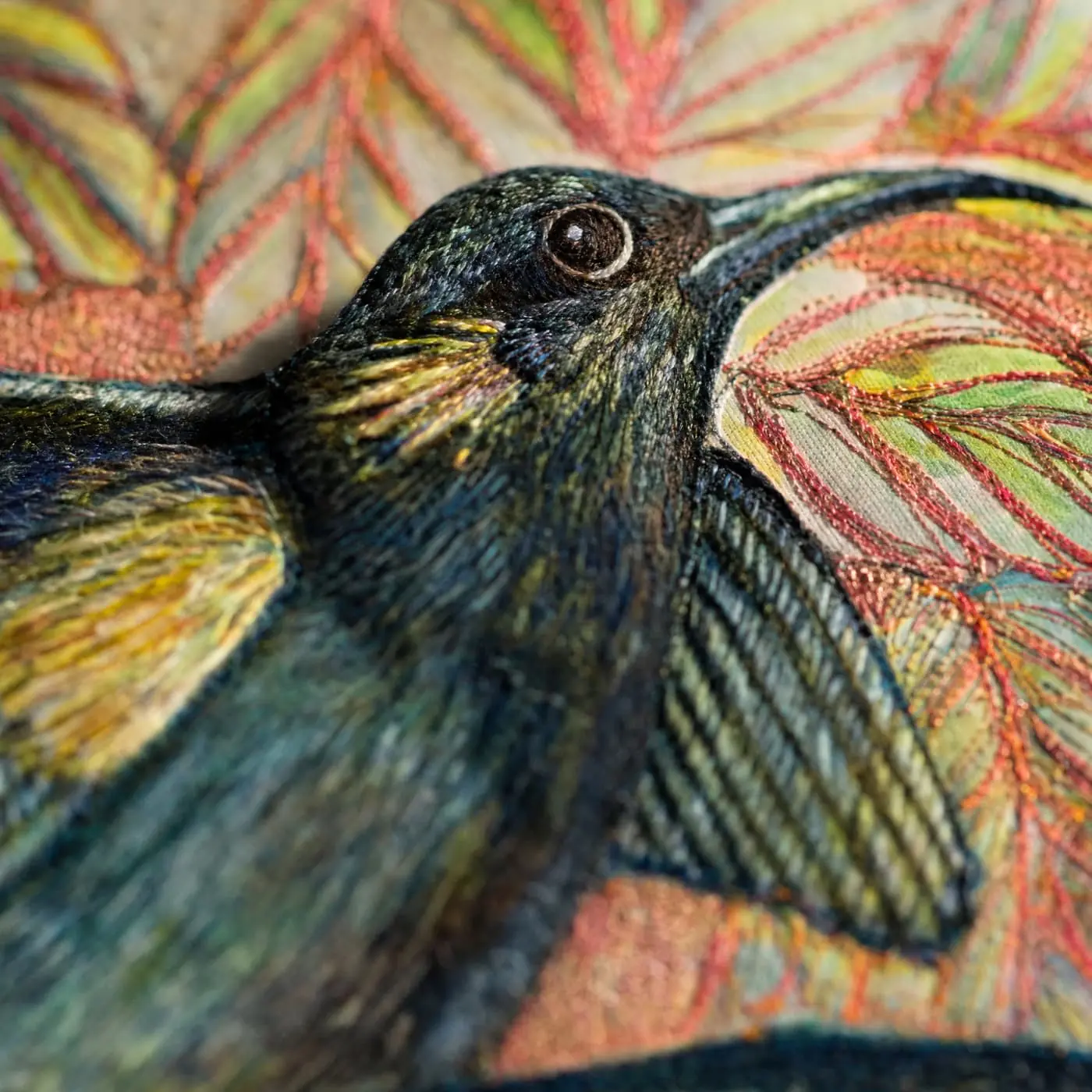
Two vital elements form the backbone of my work: drawing and a strong narrative element. My fine art background means I’m comfortable with drawing, and it’s important each of my works has a context that goes beyond the superficial appearance.
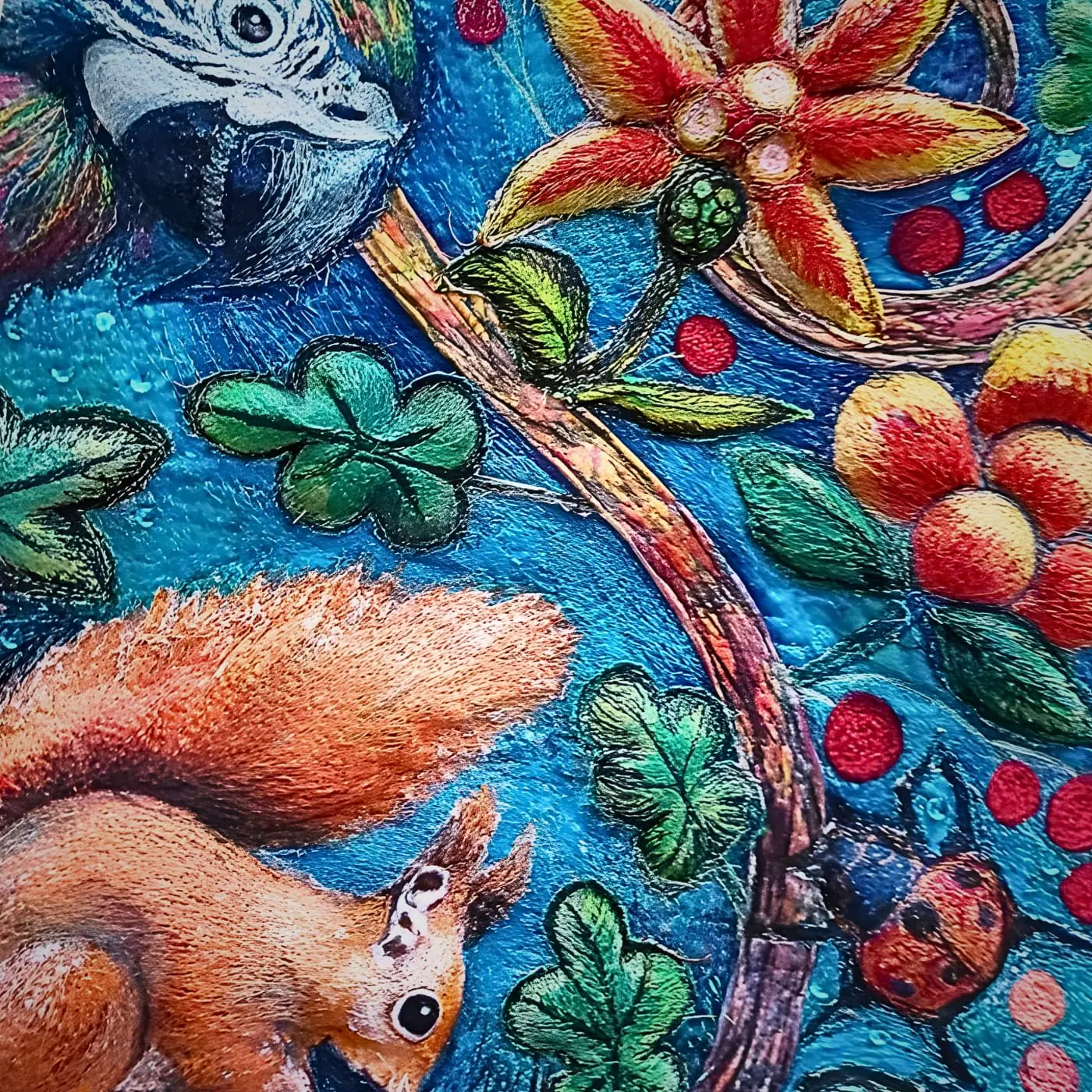
My work always involves layering fabrics, plastics and other materials, then embellishing with stitch. I’ve also devised ways to transfer images onto fabric, which results in figurative, narrative pieces.
I’m very ambitious regarding scale, and I enjoy the reactions of viewers.
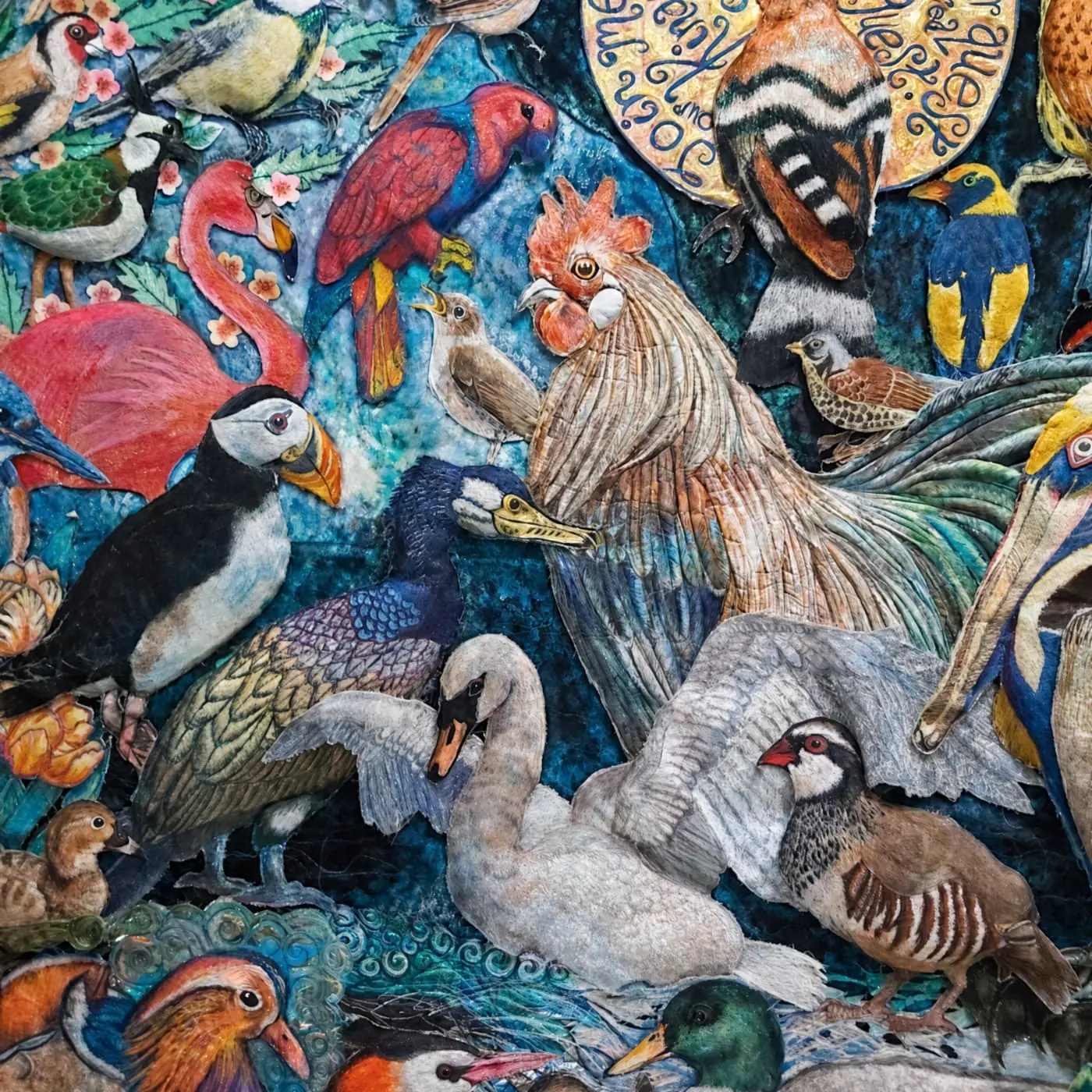
I love to try to fill an exhibition space. The Conference of Birds is a good example. The hanging space was eight feet high (2.4m), so I chose dimensions of eight feet by four feet.
Storytelling & symbolism
I’m inspired by a variety of subjects, including mythology, symbolism, different cultures, history, religion, storytelling and literature. I was drawn to these subjects in the 90s via an interest in Indian art. I loved the heavily embellished artefacts and vibrant colours.
In terms of the natural world, I’m fascinated with the vast variety of shapes, colours, and textures of animals, plants and birds. I enjoy looking at these creatures and learning the symbolism, history and stories attached to them.
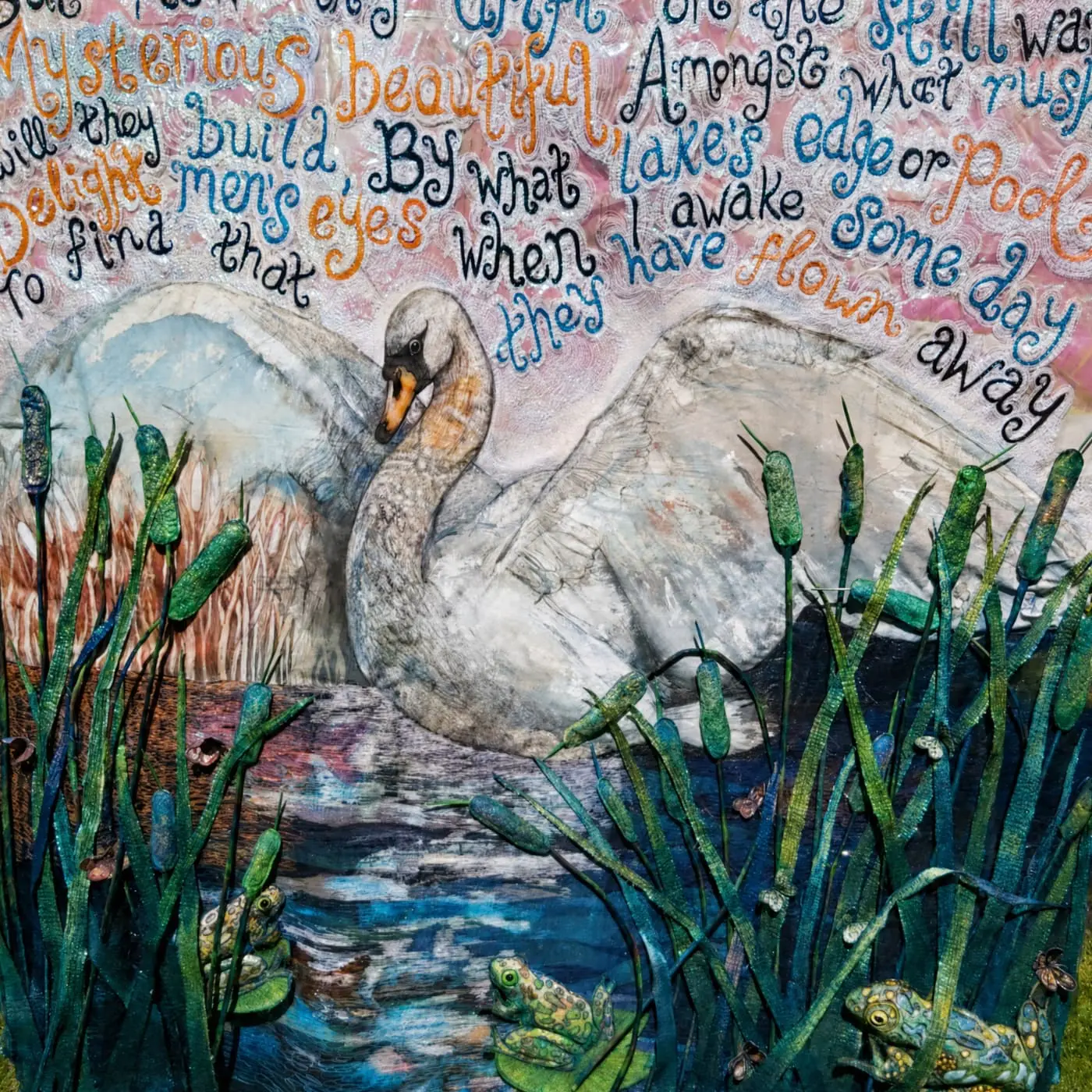
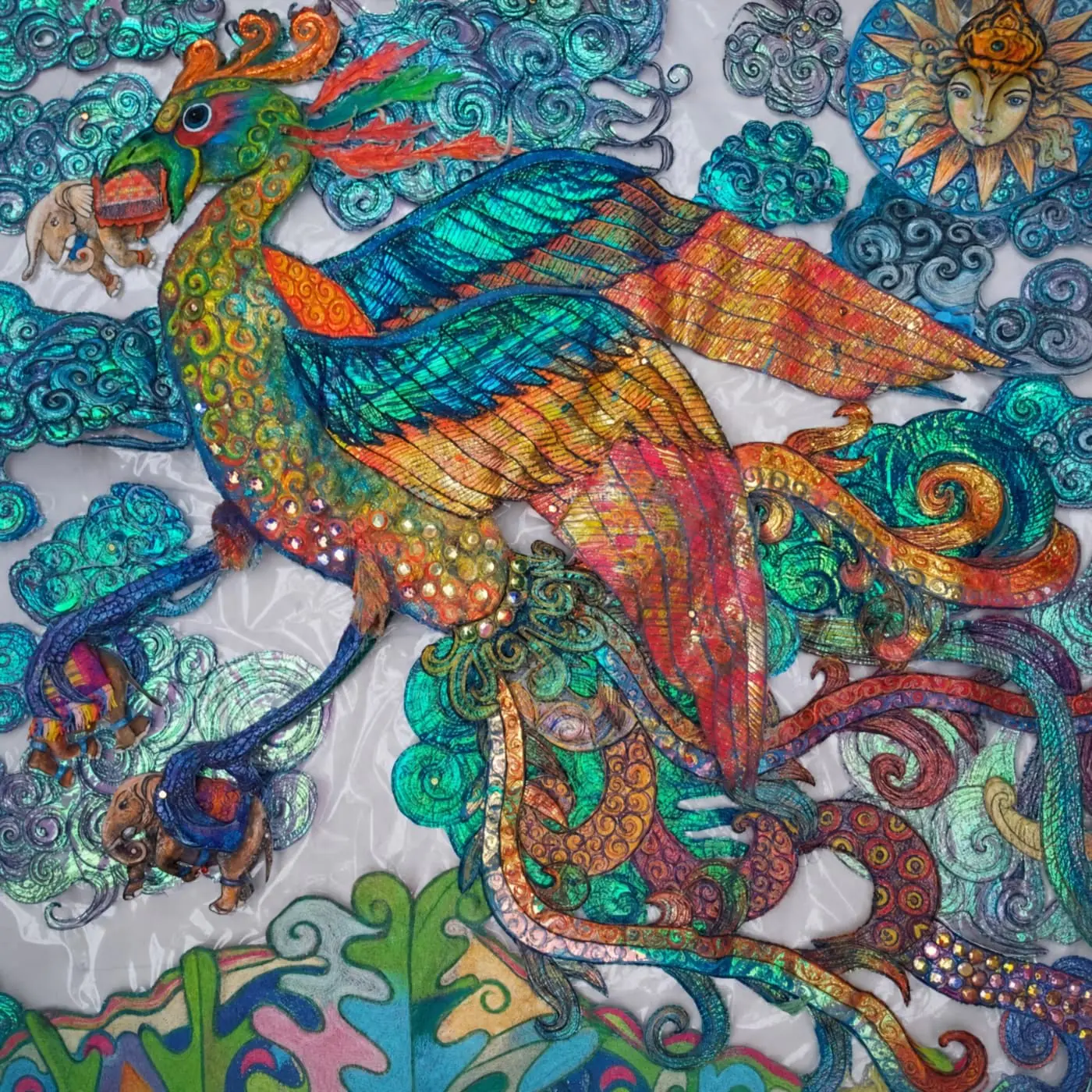
The Wild Swan triptych, for example, follows a swan’s journey from W.B. Yeats’ 1917 poem The Wild Swans at Coole into the 12th century epic poem The Conference of the Birds. Its final destination is the discovery of a mythical bird found in Persian mythology called The Simorgh.
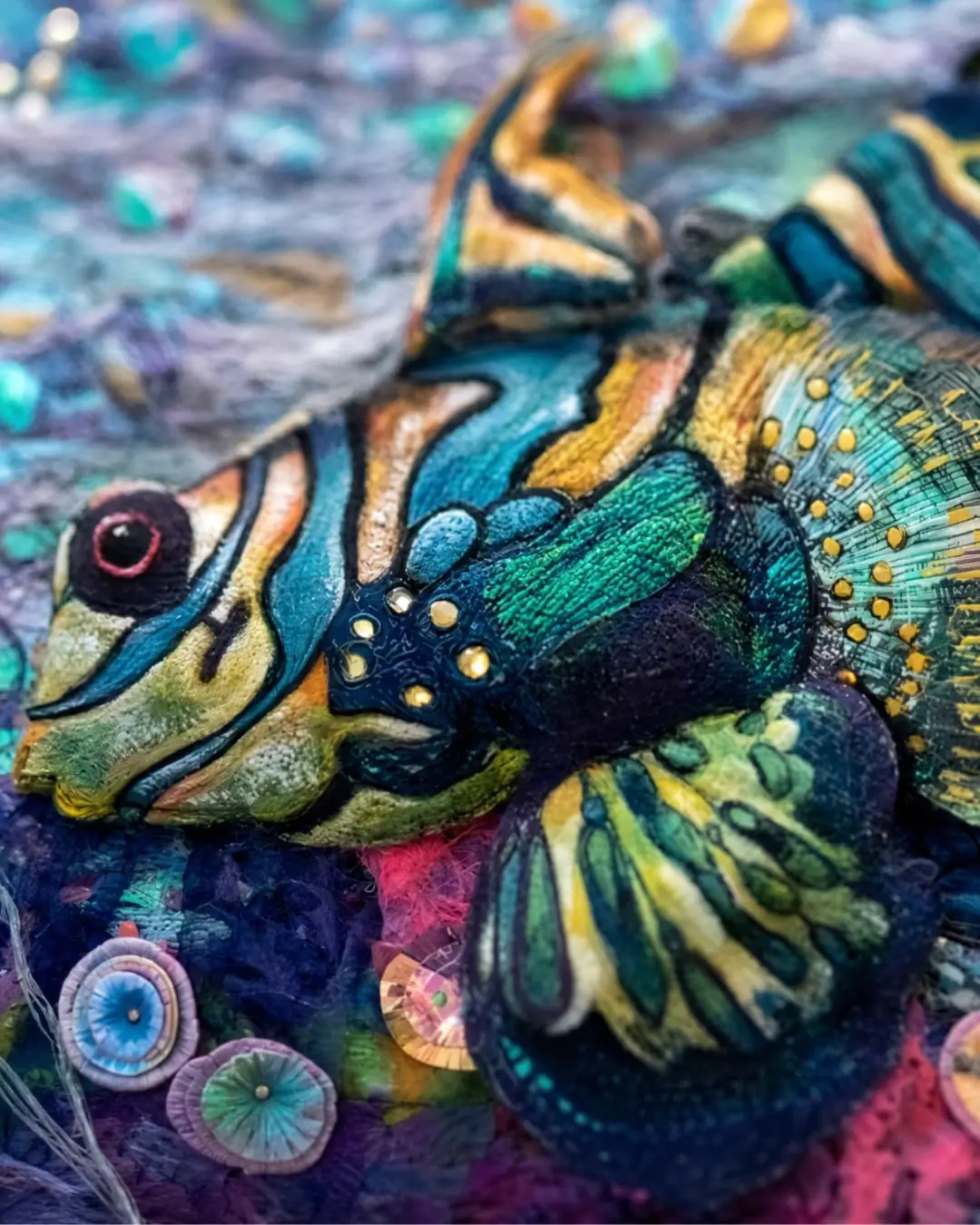
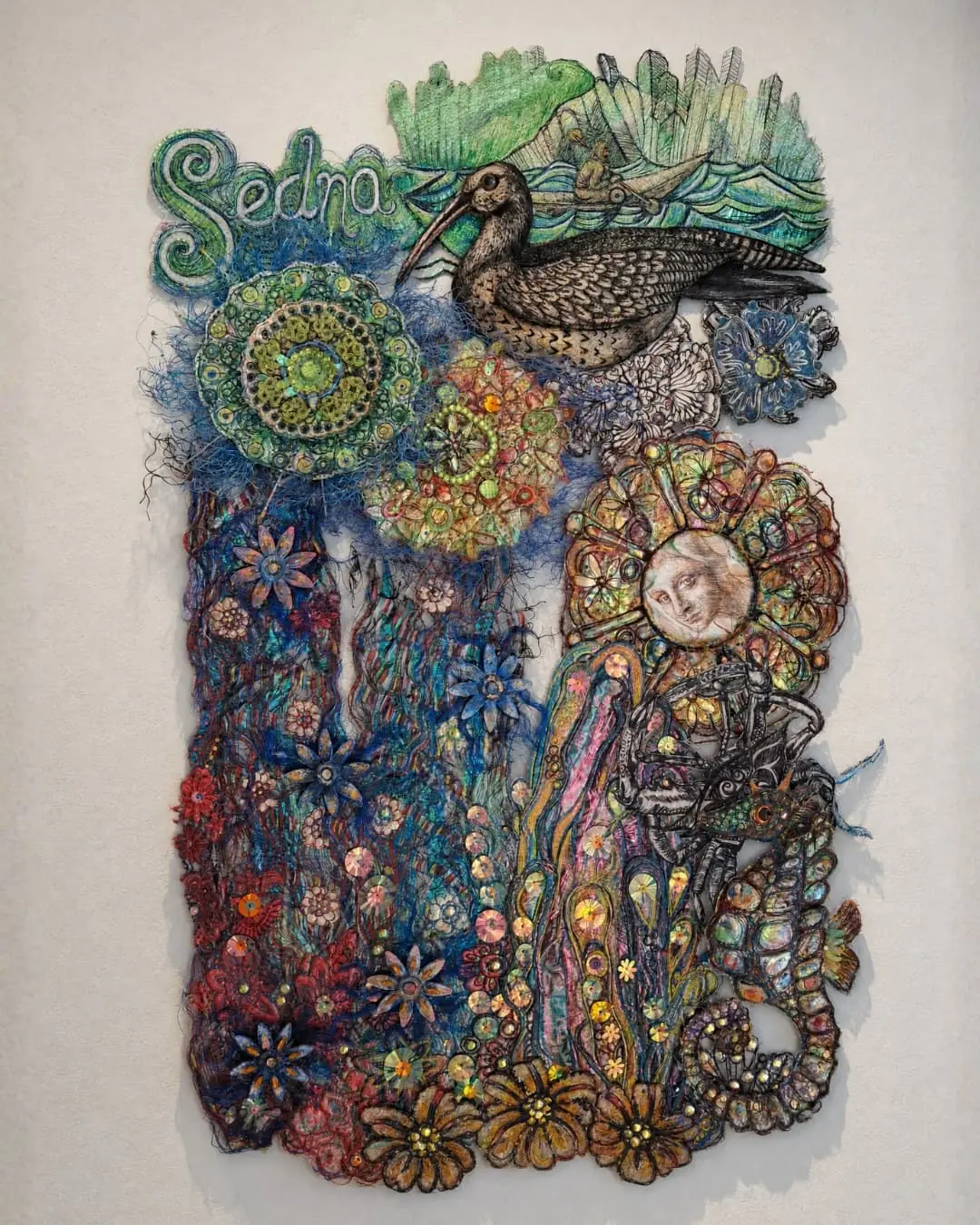
Another piece, Sedna, was inspired by a somewhat gruesome Inuit myth. There are several versions of the story, but in this version, Sedna was given in marriage to a hunter who lived on an island and who could transform into a giant bird. When her father attempted to rescue her, the hunter conjured a fierce storm.
As Sedna fell from the kayak, her father severed her fingers to prevent her from climbing back aboard. She sank beneath the waves, her fingers becoming sea creatures and coral, and she transformed into the Sea Goddess.
Research & scribbles
My textile works evolve over time. I research a theme and thoroughly enjoy discovering new and exciting images to include. I’ll print those images and make lots of scribbly drawings to show my thought process, but I don’t use a sketch book.
Because some pieces can take several months or more to complete, it’s natural that my initial ideas transform and change.
Sometimes a completely different angle presents itself, and I love this creative diversion as it keeps the work fresh.
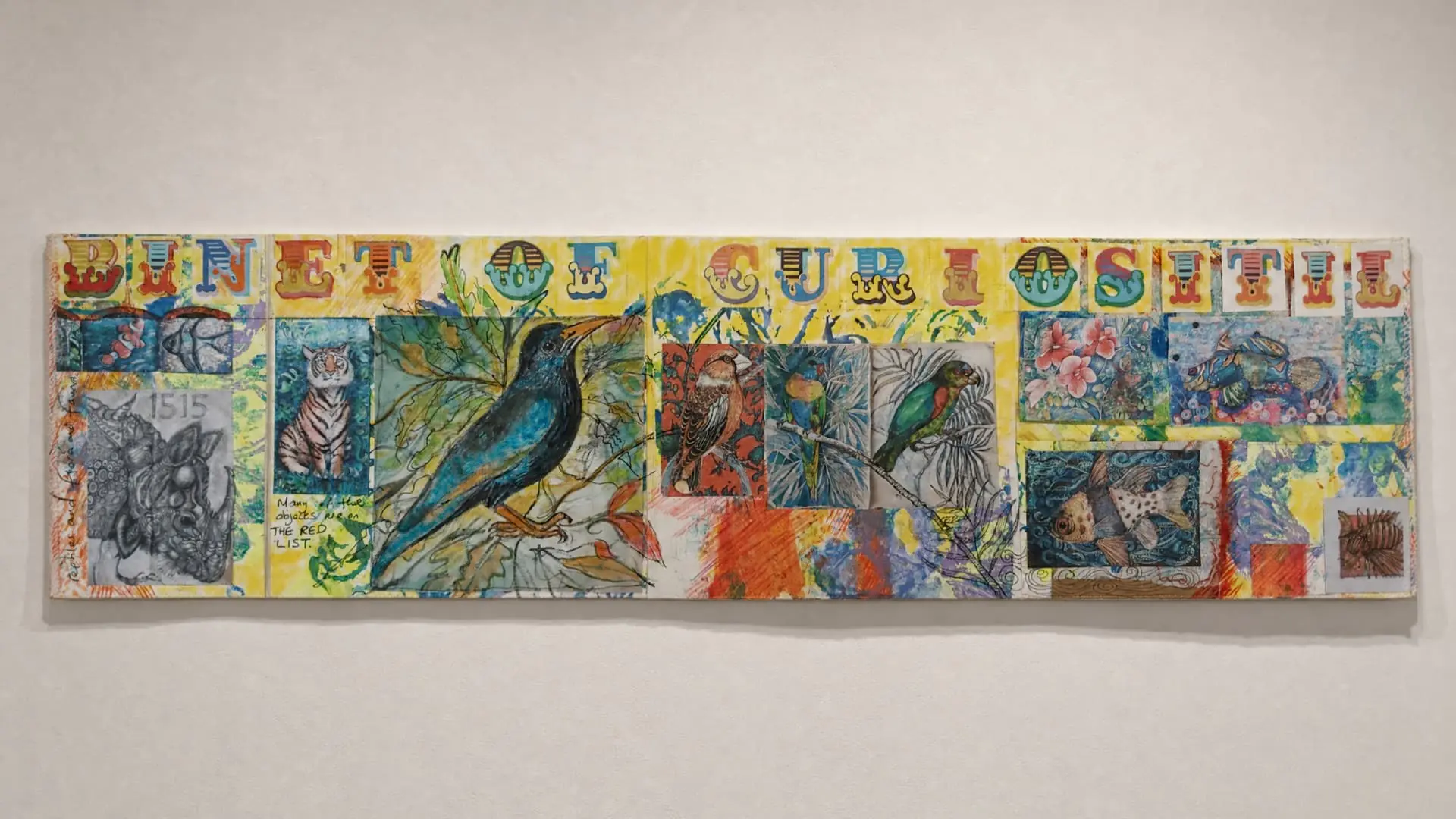
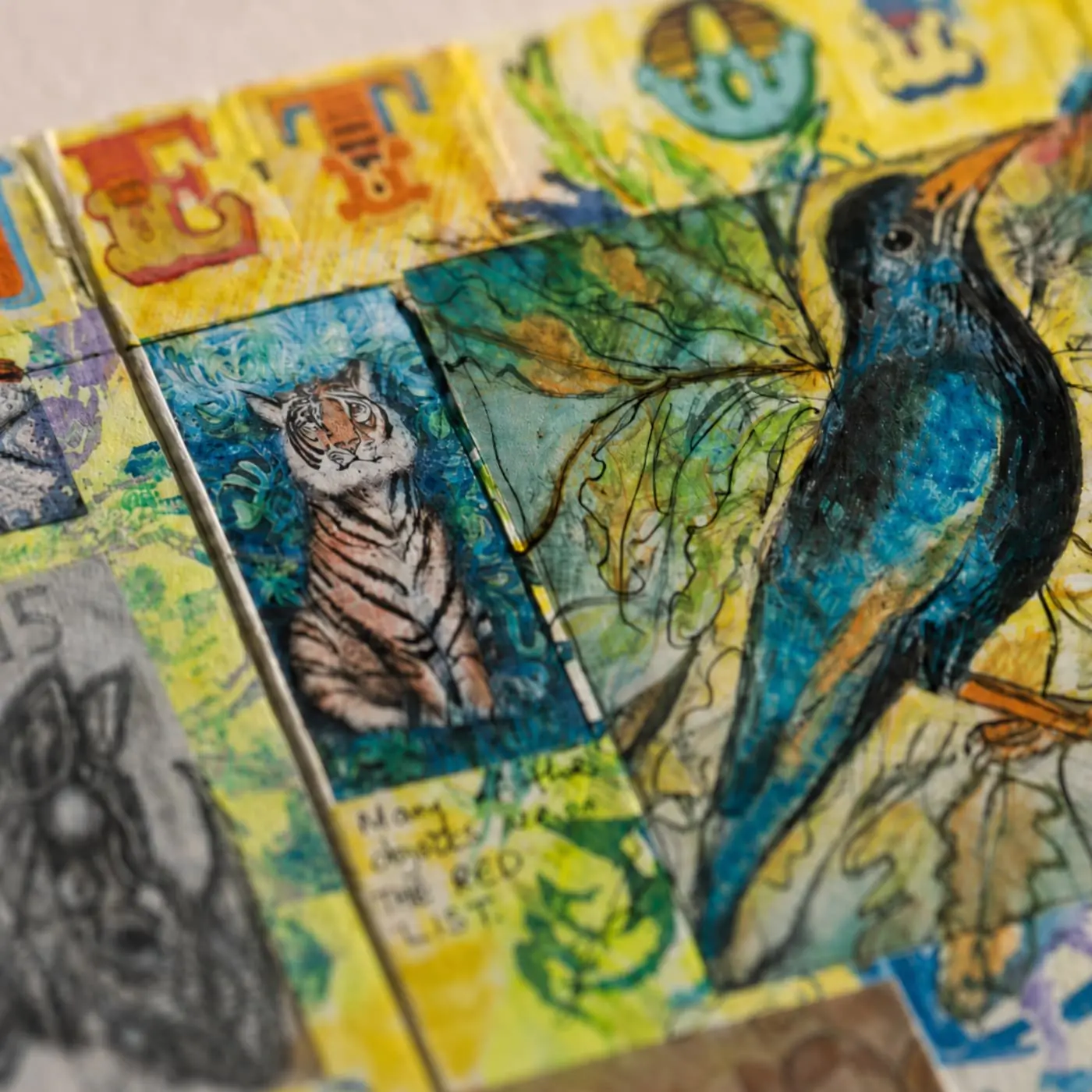
For example, the work Cabinet of Curiosities exploring nearly extinct or extinct creatures was initially going to have a Victorian-inspired look. But subsequently, I opted for a more modern, bright appearance.
If, however, I’m creating a large-scale bird or other subject, I’ll draw it out in detail and then trace the drawing onto PVC.
The shower curtain
I first started using plastic acetate sheets (often used on overhead projectors) over 15 years ago. I drew images on paper, photocopied them onto the acetate, then stitched the acetate to fabric and painted them with acrylics.
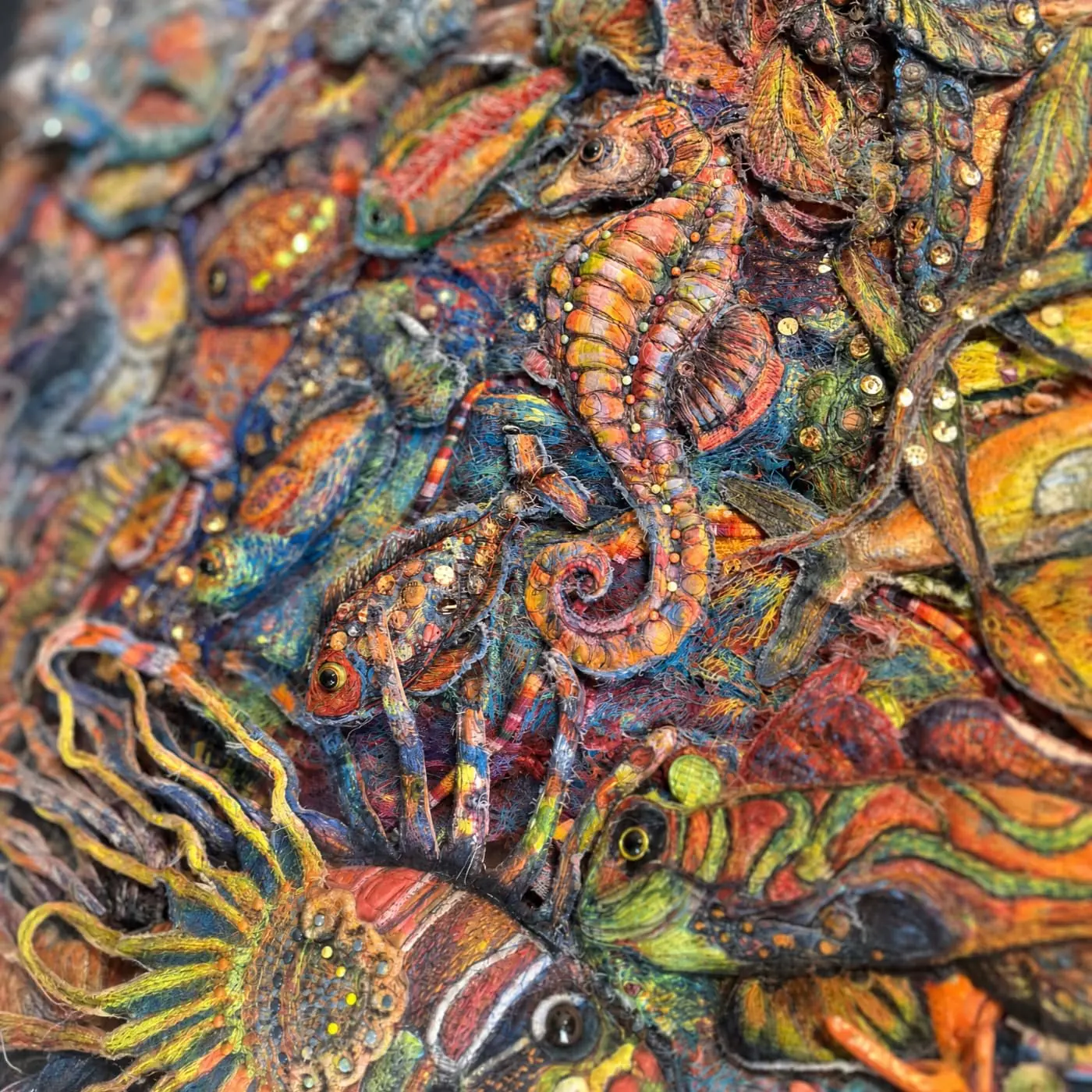
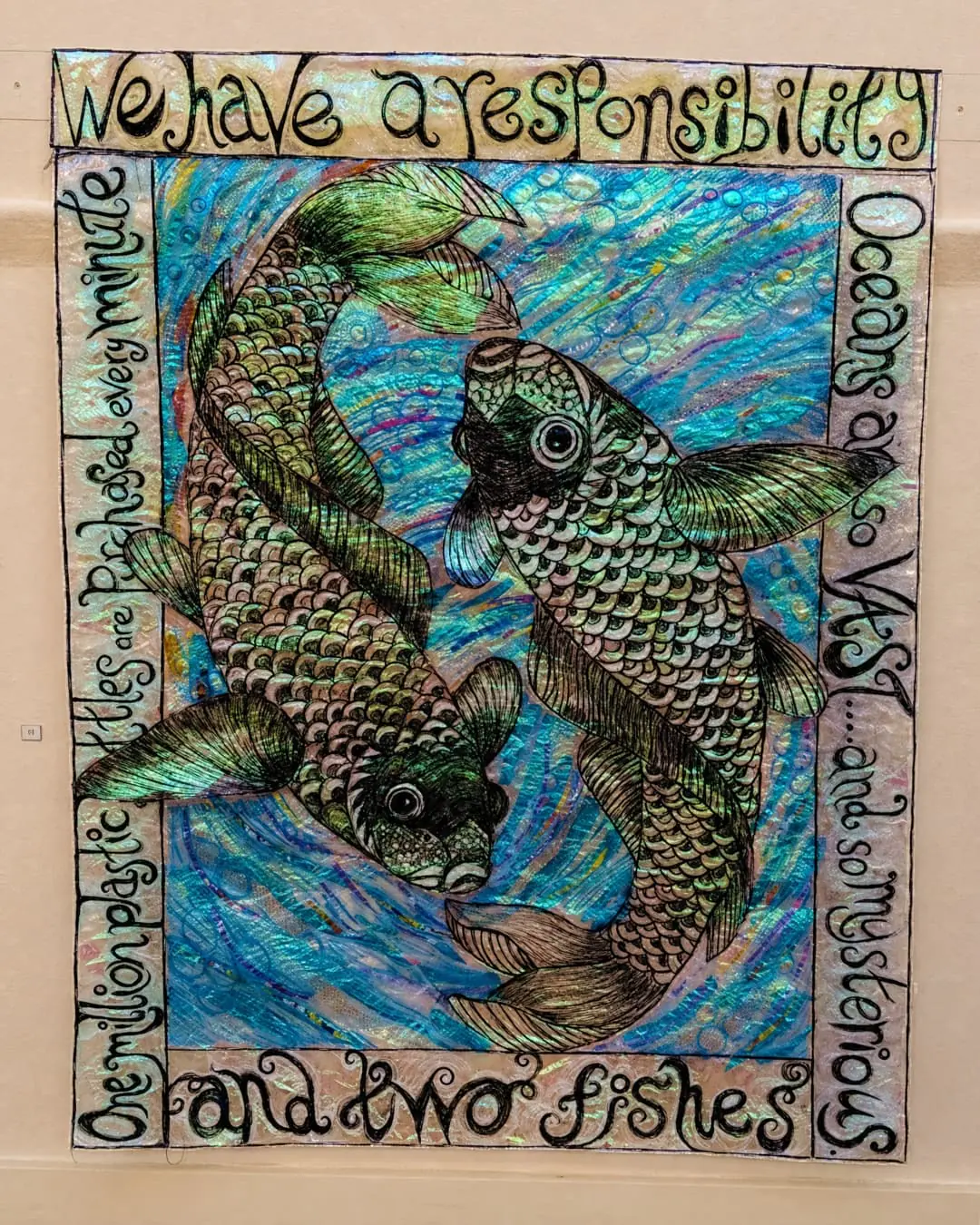
In 2018, I was working on a piece called Fade Out that was inspired by the notion of ‘fragility’. I researched the damage being done to the Great Barrier Reef by elements such as global warming and coral die back, and then I decided to incorporate real plastic pieces into the work.
At that time, I didn’t know PVC plastic sheeting could be purchased by the metre, so I bought a transparent shower curtain and used that! I also considered using plastic pockets, but they weren’t clear or strong enough.
I’ve used PVC sheeting in my art ever since.
Possibilities with PVC
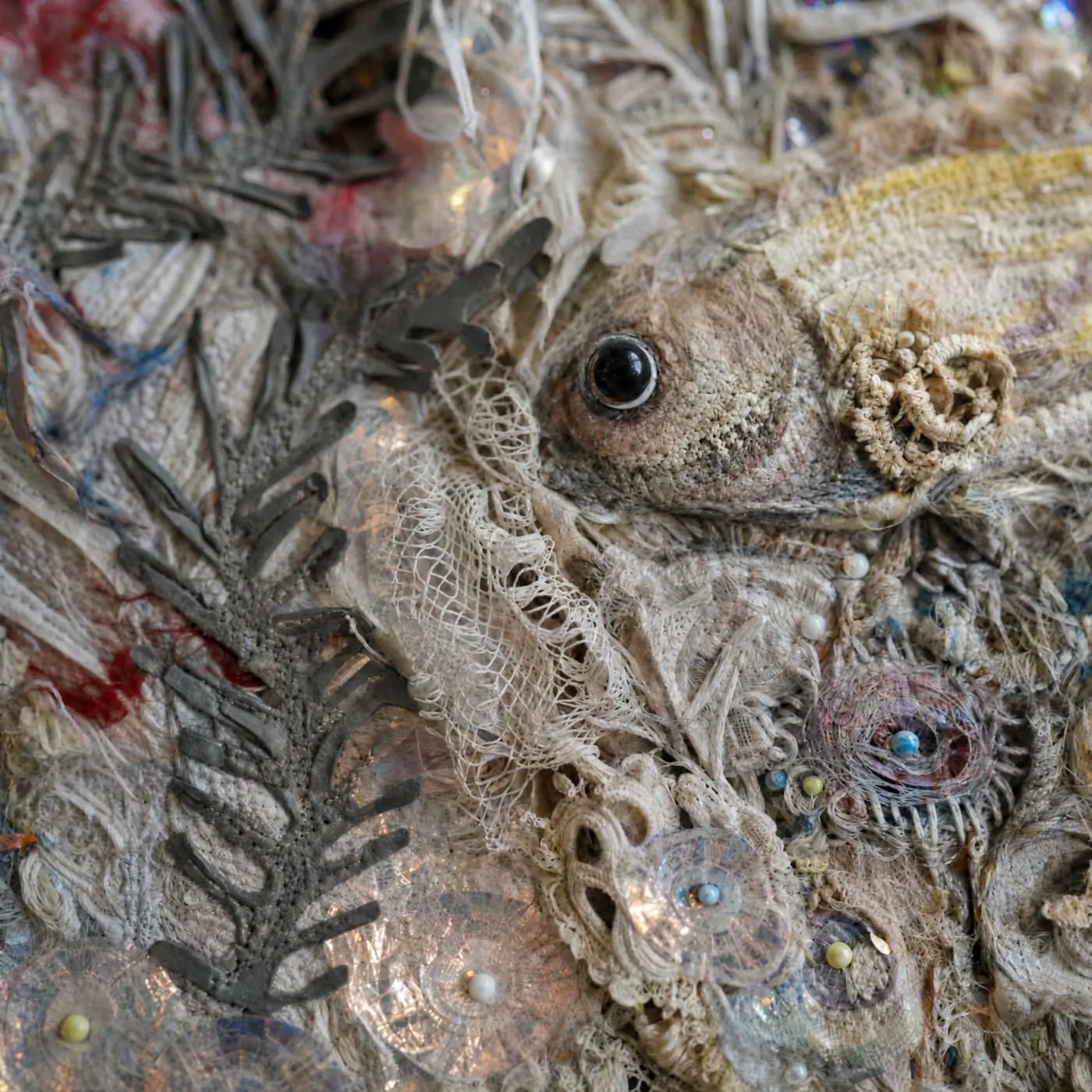
Clear PVC is an extremely versatile material, and I’m sure there are still more techniques and applications to be discovered. It can be presented as a traditional wall hanging, but it can also be moulded into shapes. And when hung against a window, it creates an interesting stained glass effect.
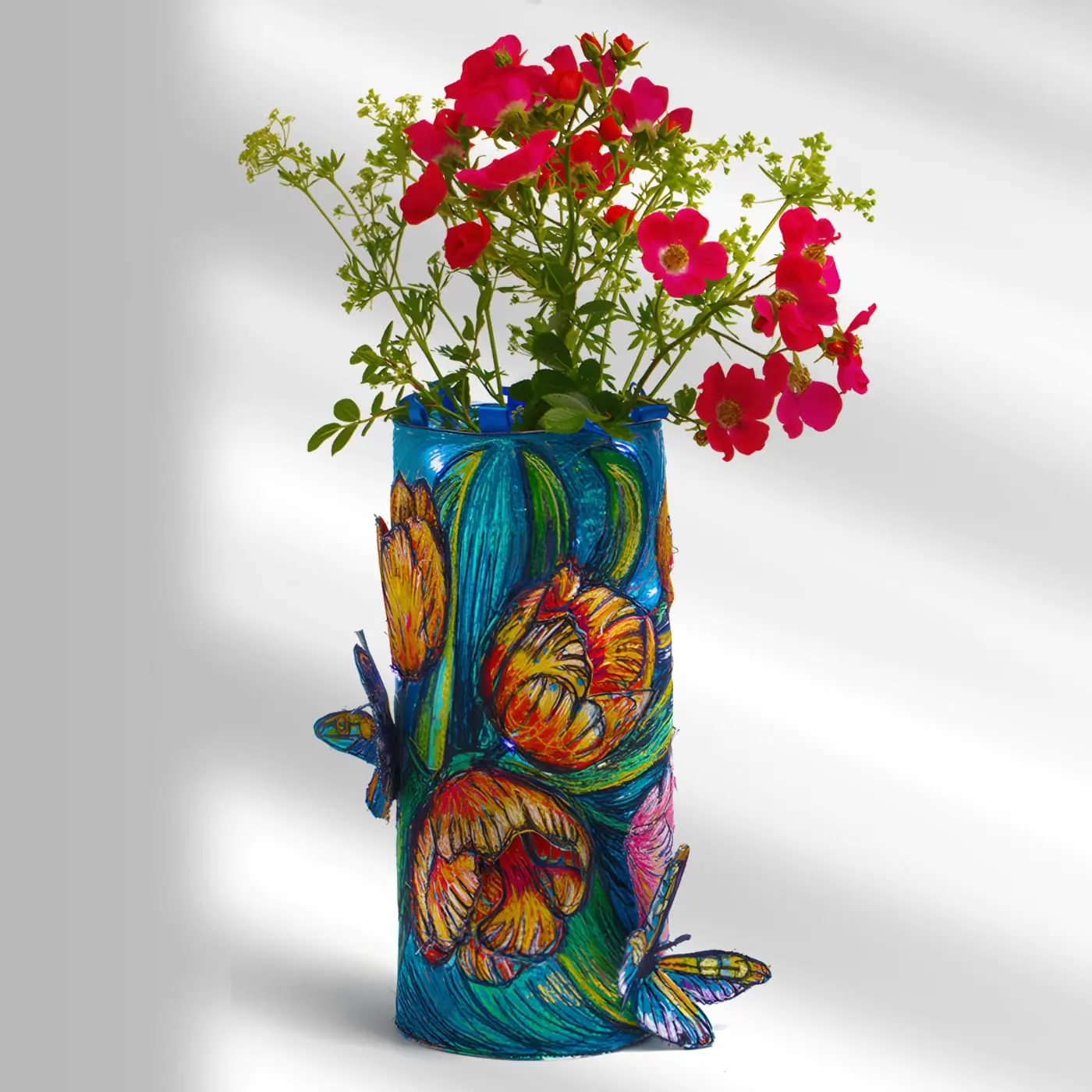
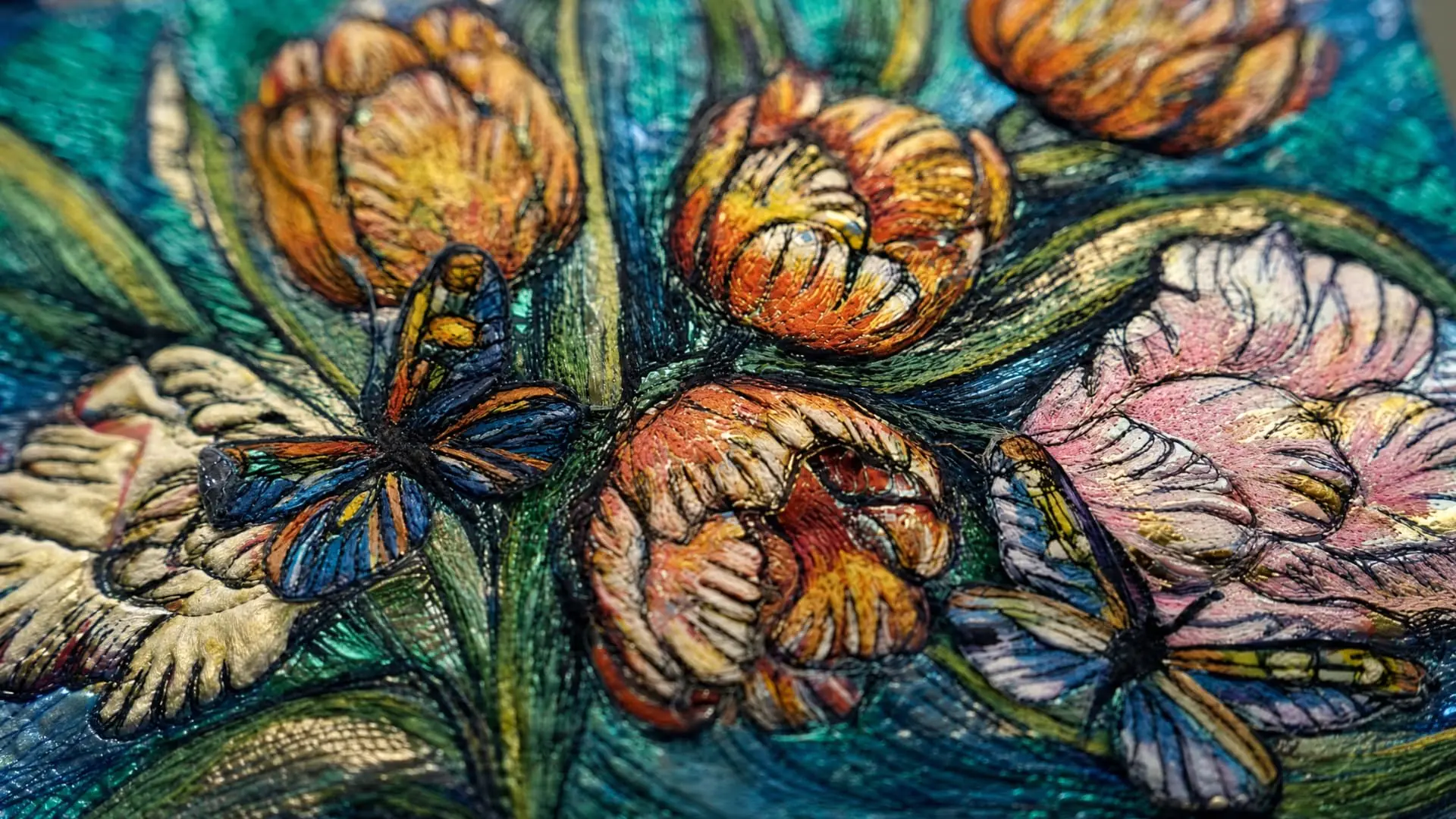
Tulipmania is a good example of how I created a 3D shape. I drew on and then stitched a panel using PVC, cellophane and gold papers. It occurred to me that it would be interesting to present the panel as a cylindrical form and use it as a vase when wrapped around a plastic bottle.
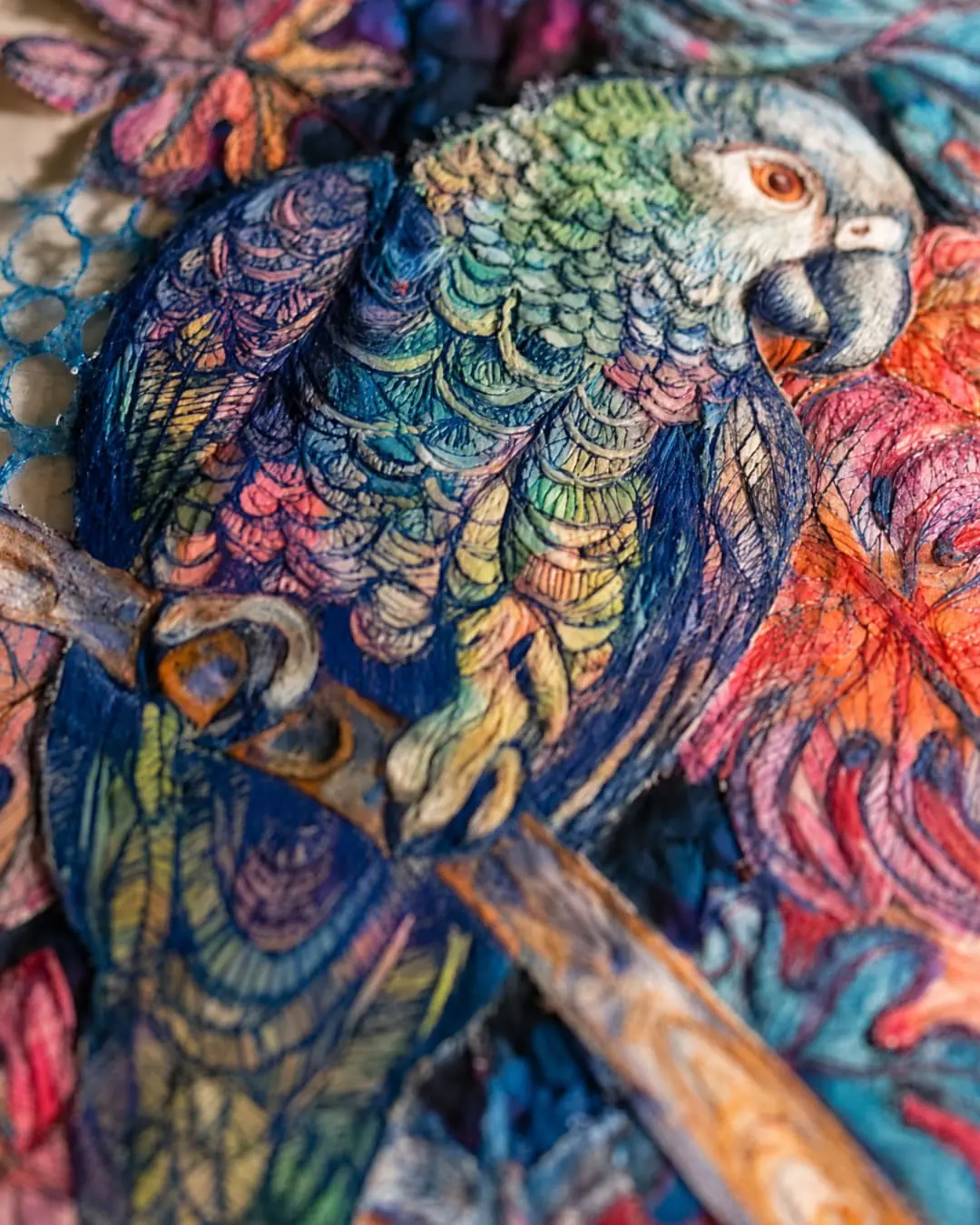
The grey parrot detail in my Wonder Room project also has a PVC background, from which I cut areas from the edges to create a stencil effect.
“Stitching through PVC is highly addictive!”
Nikki Parmenter, Textile artist
Easy to stitch
PVC is extremely easy to stitch through. I think it’s easier to sew through than a traditional fabric, and there’s no lint residue. I don’t need to adjust my sewing machine settings in any way. I rarely break any needles. I use jeans needles, and they usually wear out before I reach breaking point.
I use two sewing machines: a Bernina and a Janome (my sponsor). Both machines are basic, and although there are some ‘fancy’ stitch options, I only use a straight stitch. I’m not a fan of pre-designed images that can be robotically transferred onto fabric.
Coats Moon thread is my thread of choice, as it’s inexpensive. That’s important, as I use hundreds of metres of thread for each artwork. Moon also comes in a wide range of colours, including fluorescent threads. But I’ve never managed to conquer metallic threads.
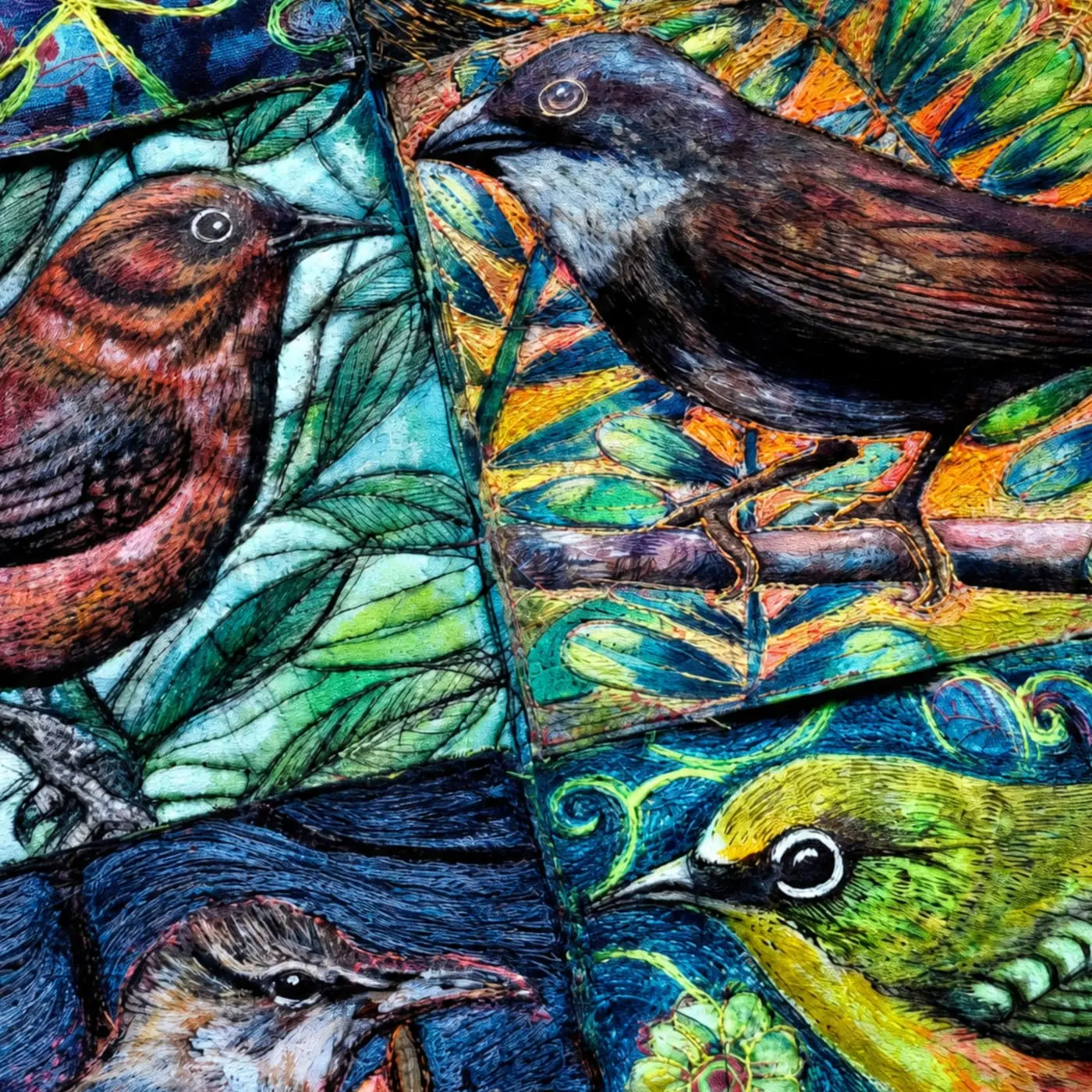
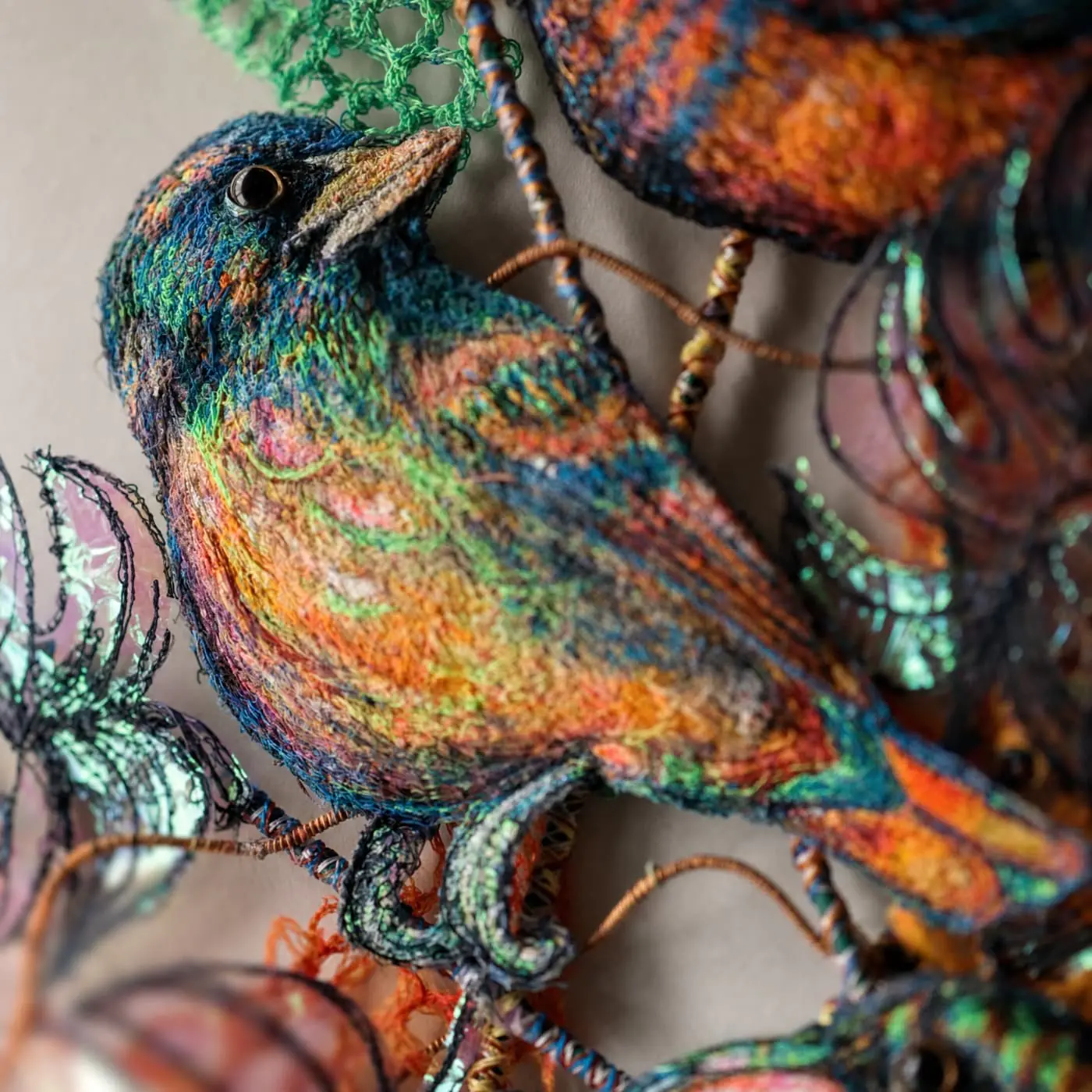
I’ll often add acrylic paint to my finished stitching as it adds shadow and variety.
Free motion fears
I’d had no formal training in textile art, and I had absolutely no idea how to thread a sewing machine, let alone use one. My only previous sewing experience was at high school when the most exciting thing I (or rather my mother) made was a pastel-coloured nightdress with broderie anglaise.
But this meant that I was free to experiment, except, of course, when the sewing machine went wrong. That’s another story!
When I purchased my first sewing machine in 2005, I took it out of the box, looked at it, and put it away again! It stayed there for three months before I plucked up the courage to try again. I surprised myself that I could make it work.
From there, I went from strength to strength, but I only used an ordinary sewing foot. My revelation came sometime later when I discovered the free machine embroidery foot. Unfortunately, my initial attempt was short lived with the needle breaking after about 30 seconds.
So, that technique was cast aside until I mustered the courage to try again. That’s when I became hooked! It was amazing to be able to sew circles, stitch around corners and make spirals.
“I think my lack of training was an advantage, as I wasn’t hindered by any rules.”
Nikki Parmenter, Textile artist
Iridescent vinyl
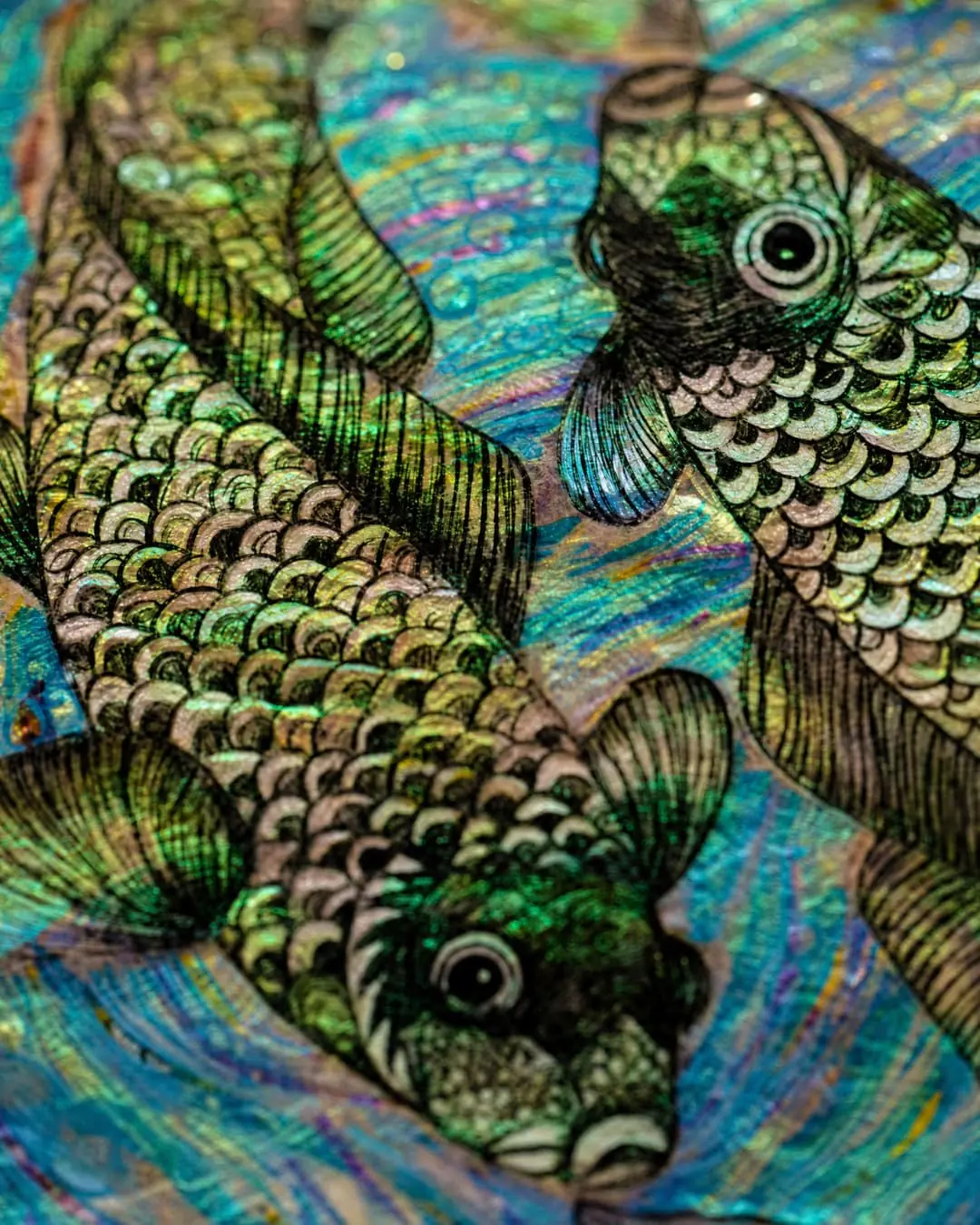
I am a lover of all things shiny, so I searched the word ‘iridescent’ on Amazon to see what would pop up. One of the suggestions was iridescent holographic self-adhesive vinyl that was primarily used for stencils.
It was amazing how the colours changed dramatically depending on the direction of lighting on the surface. Around that time, I was creating a work based on the stained-glass display at Chester Cathedral of St. Werburg and the Geese. The vinyl proved to be the perfect way to achieve the luminosity I was seeking. And like PVC, it was very easy to stitch through.
I drew the elements of the window on paper and then traced small sections at a time onto clear PVC. Having pinned the iridescent vinyl behind the PVC I free machine stitched it together.
I also enjoy using coloured cellophane in my work. I think it’s usually used for floral arrangements or gift wrapping. The type I use most shines either pink or green, depending on how the light falls on the surface.
Getting funky
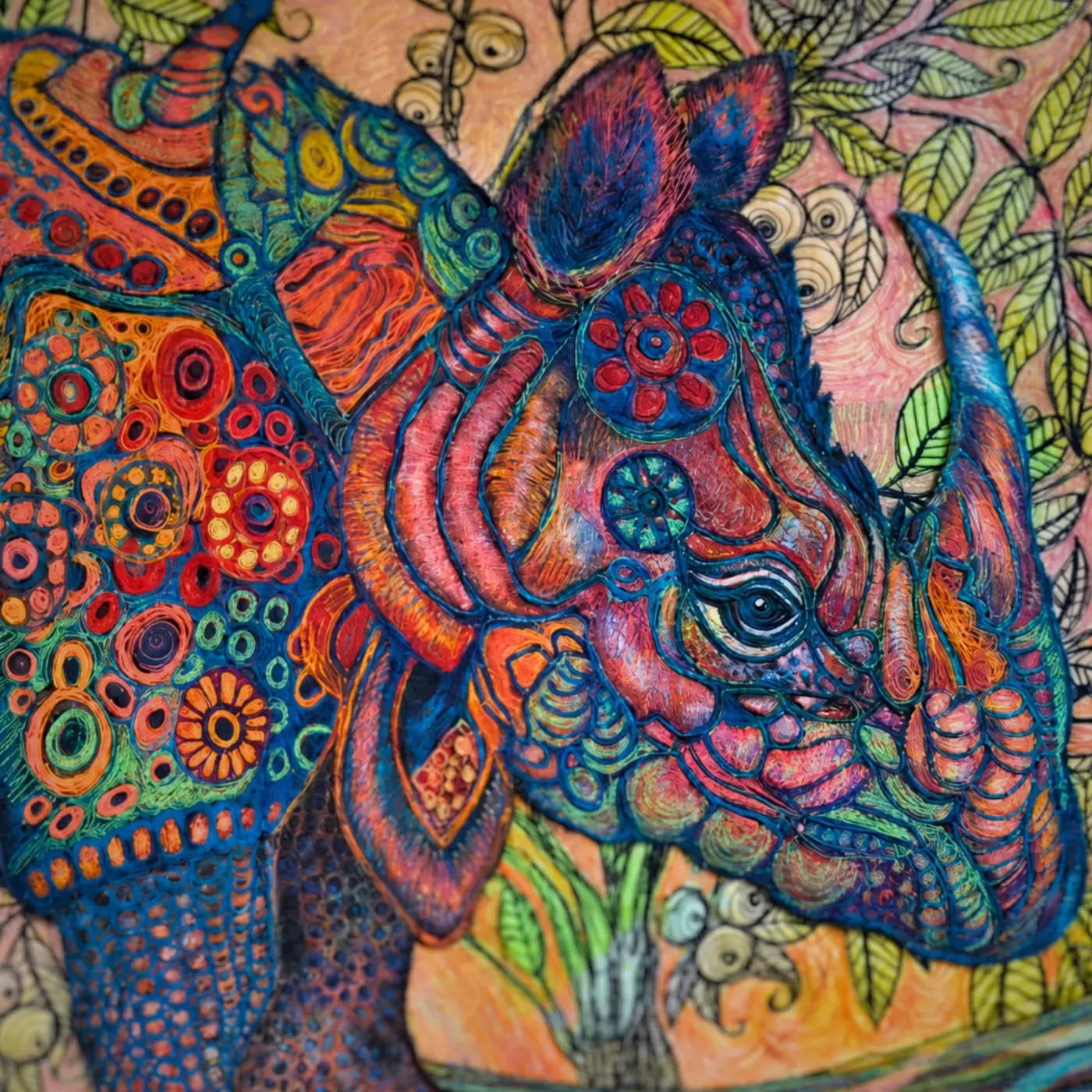
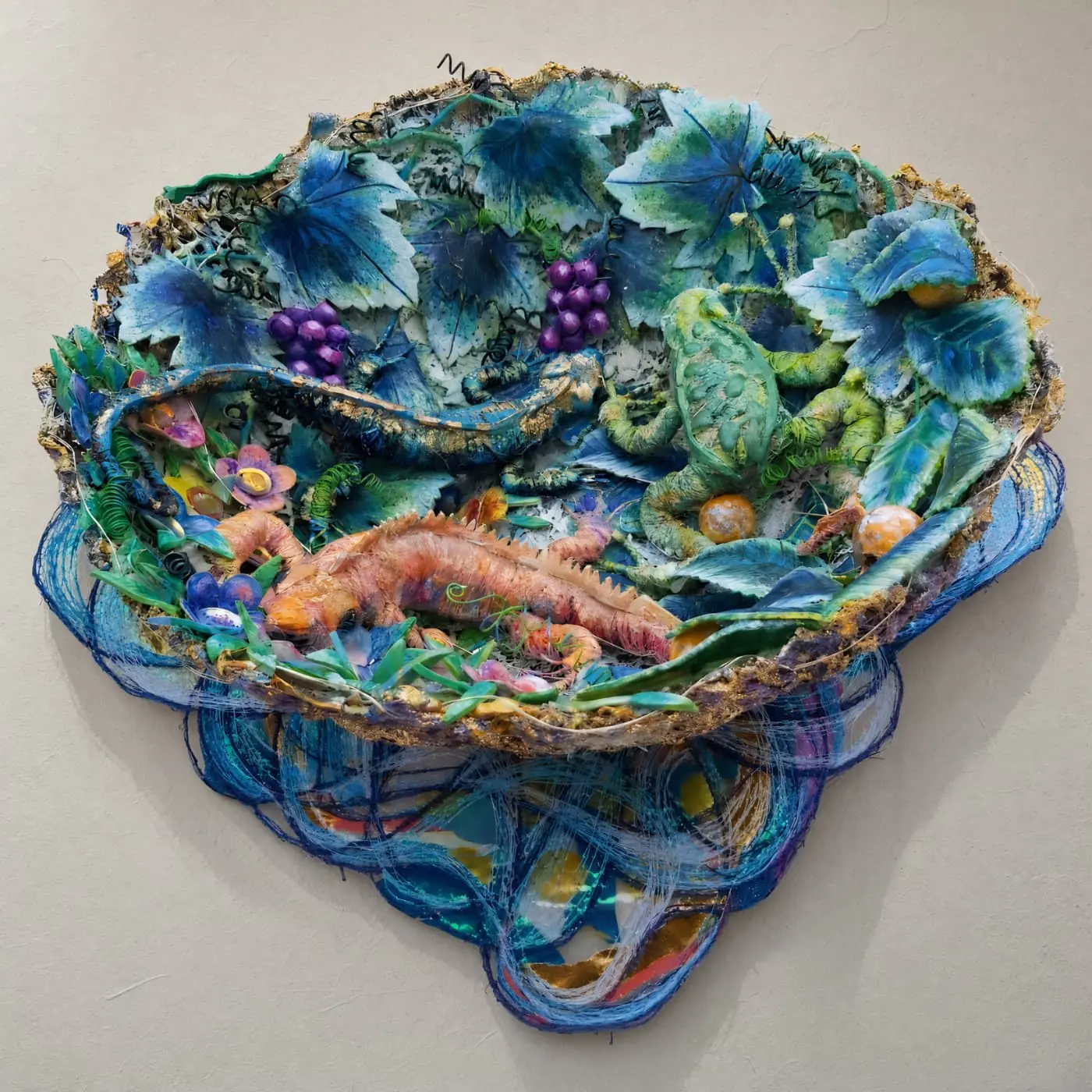
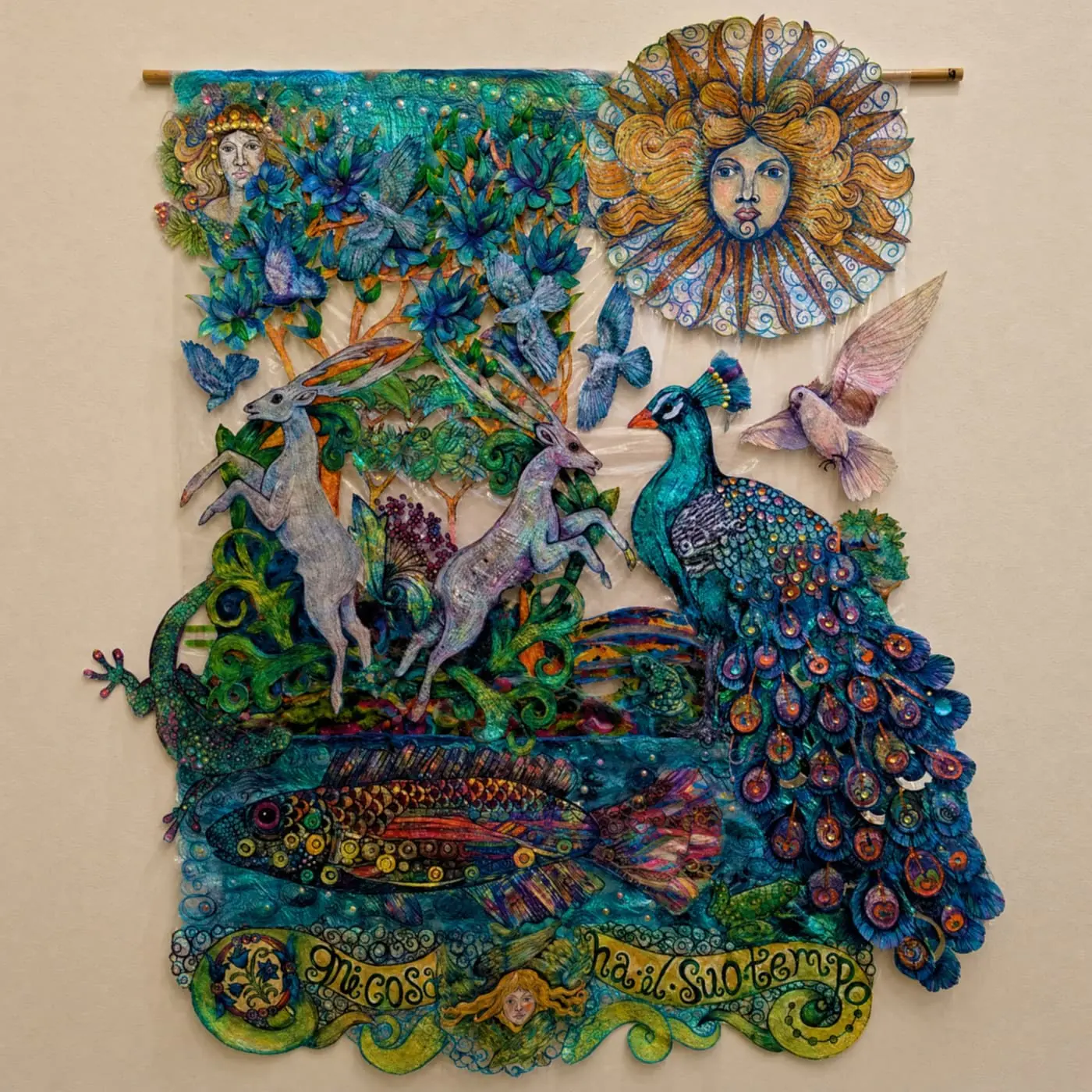
Funky foam, or neoprene foam, is a highly versatile craft material. I use it to make flowers, leaves, and other detailed elements in my work. It comes in a variety of colours and patterns.
It can be easily cut with scissors or a craft knife, and colour and detail can be added with acrylic paint. The goal is to transform the flat colour into a realistic, natural form. And because it’s soft, I can incise the veins of leaves or other detailed elements.
“Small, portable sections allow me to hand stitch if I’m away from home.”
Nikki Parmenter, Textile artist
Large-scale challenges
Every piece I make is composed of various separate elements. This allows me to work on relatively small sections at a time, and these are assembled together when each component is completed. The smaller sections are also portable, allowing me to hand stitch if I’m away from home. I always have several projects going on at one time.
Once I’m satisfied with the individual elements, I audition different compositions by laying the pieces in various arrangements on the floor, taking photographs along the way.
The most challenging aspect of my work is the physical aspect of handling such large-scale pieces.
The final assembly often involves a wrestling match between me, the fabric and the sewing machine as I try to attach different elements together. I have to roll up the piece and attempt to free up an area to stitch. Because of that, I take the time to plan the order in which to assemble the piece in the final stages.
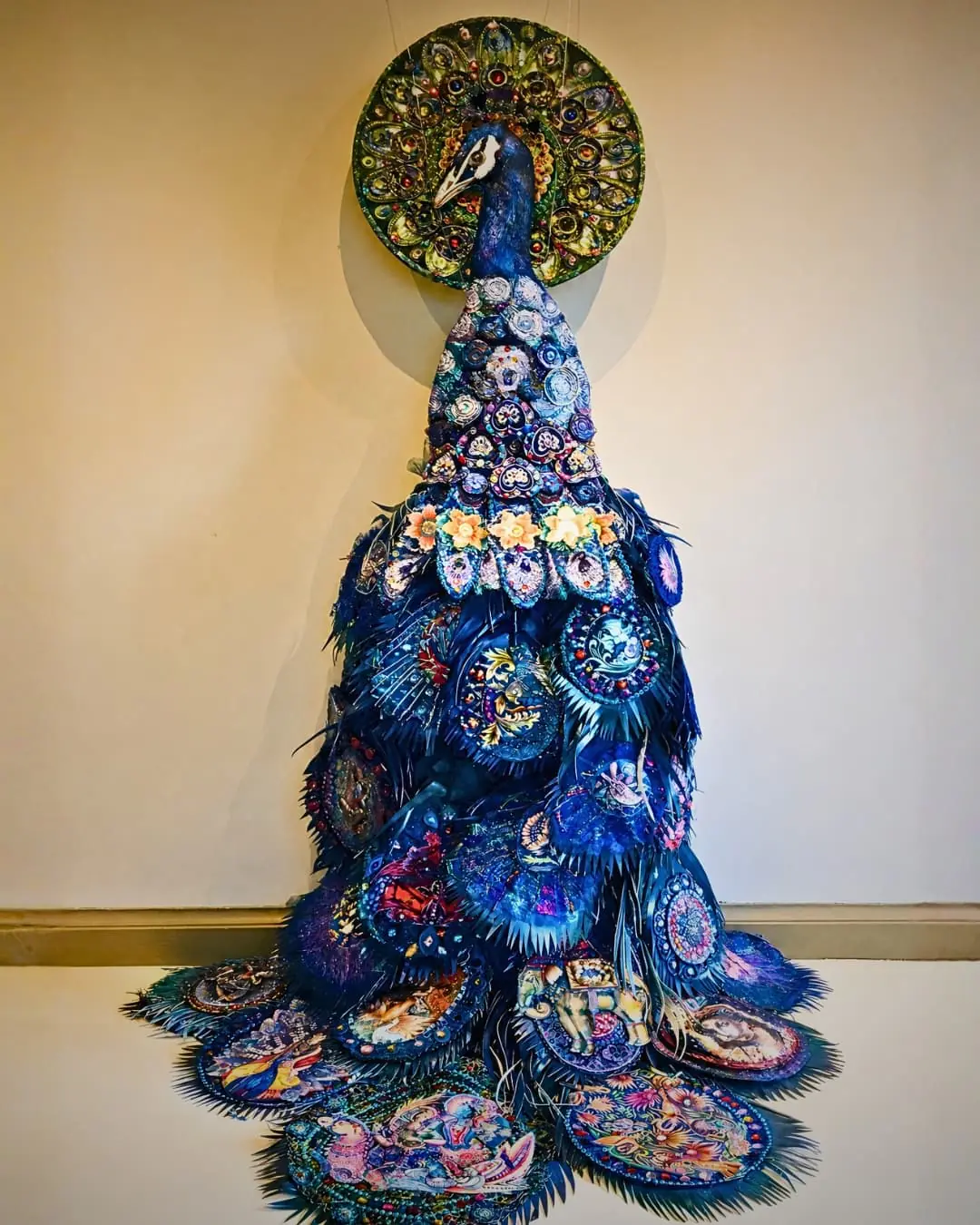
The Silk Peacock posed a real challenge in choosing materials for the blue parts of the feathers. Each of the 25 feathers has a central metal support that hooks onto a semi-circular piece at the top of the tail.
After much deliberation, I decided to use blue linoleum. We’d just had a new kitchen fitted and there was extra linoleum in the garage. I spent several hours sitting on the floor cutting through the tough lino to create my desired fringe effect.
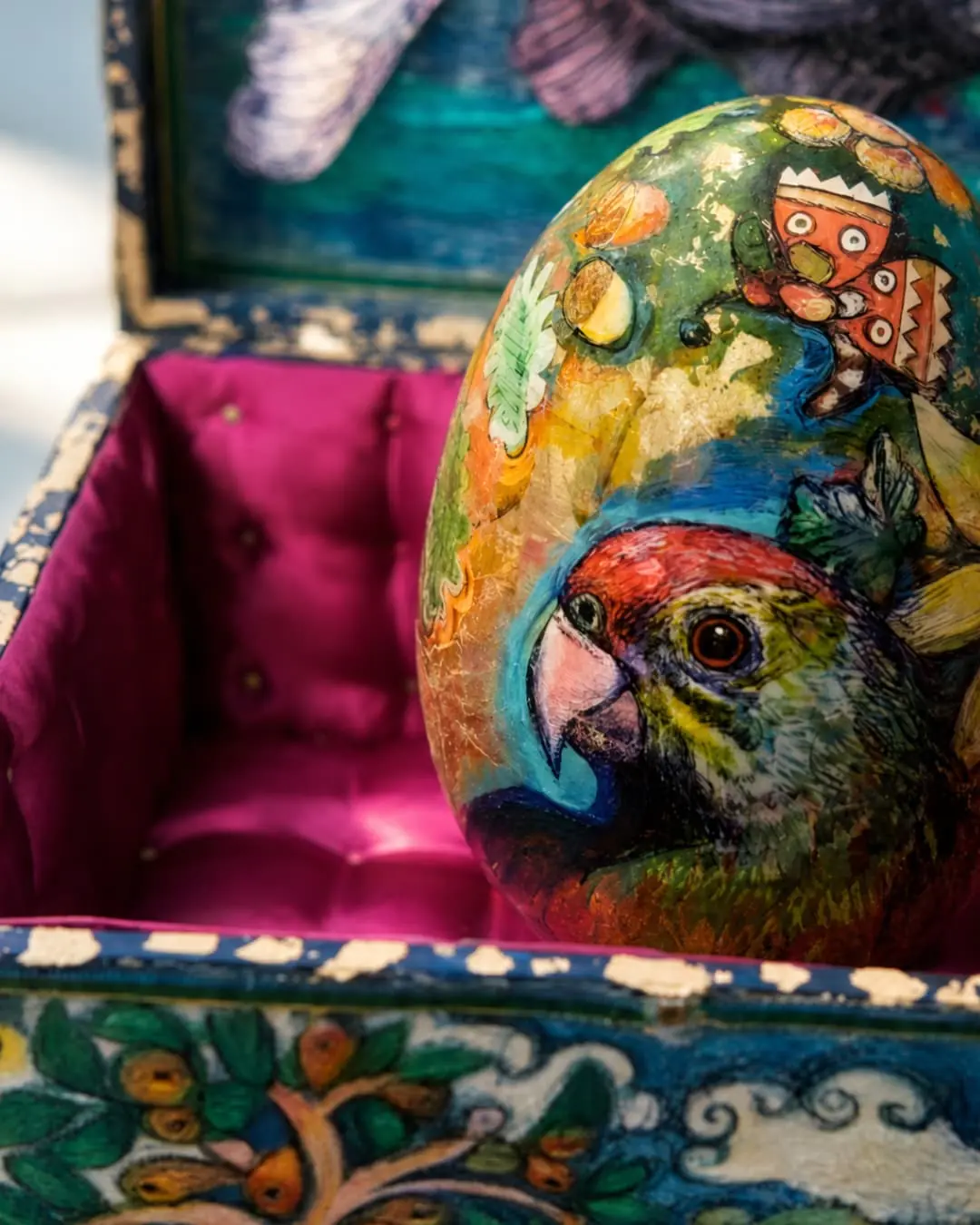
“Like many creative people, I’m prone to accumulating various materials and unusual items, and I use them in my work.”
Nikki Parmenter, Textile artist
Unexpected materials
I collect various materials, even when I have no idea what to do with them. Friends often offload their unwanted items, which I gladly receive. I occasionally find things in charity shops and DIY outlets, and I upcycle plastic bottles and cartons. You never know when something might be useful.
I like to incorporate these unexpected items into my work.
I’ve used curtain hooks, split pins, dental harp toothpicks, nylon rope, broken jewellery, cable ties, insulation pipes, drainpipes, hair ornaments, empty tomato puree tubes and other metallic elements.
I have boxes and bags of various materials housed in a number of places around my home. I’d love to have a bespoke studio, but space does not allow, so I use a spare bedroom and shelving in the study, as well as the kitchen table…
My primary work surface is the kitchen table, which is large enough to allow me to leave out my creative chaos. My husband and I eat our meals at the other end of the table! I’m grateful that he fully supports my textile work and appreciates its importance to me.
Flight fantastic
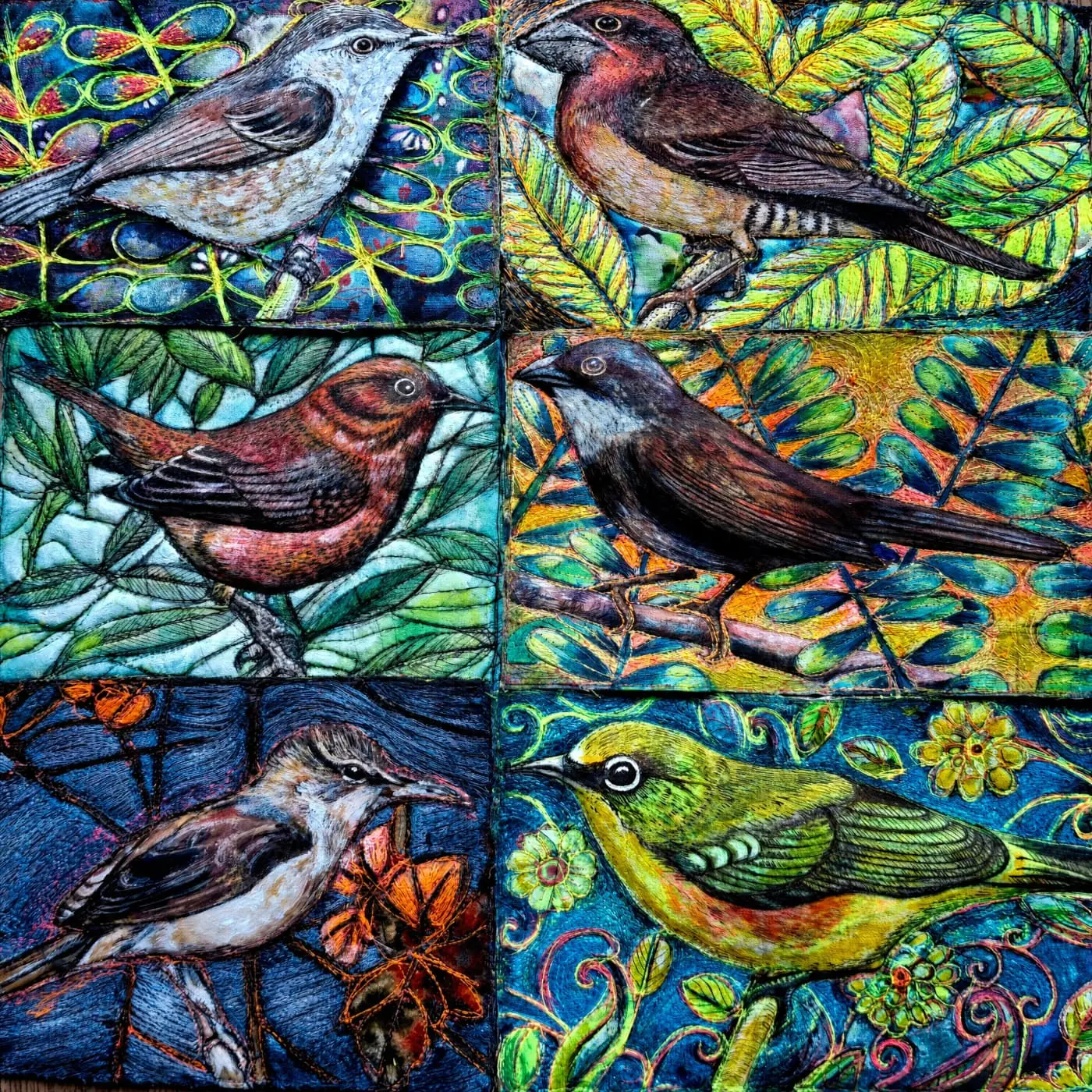
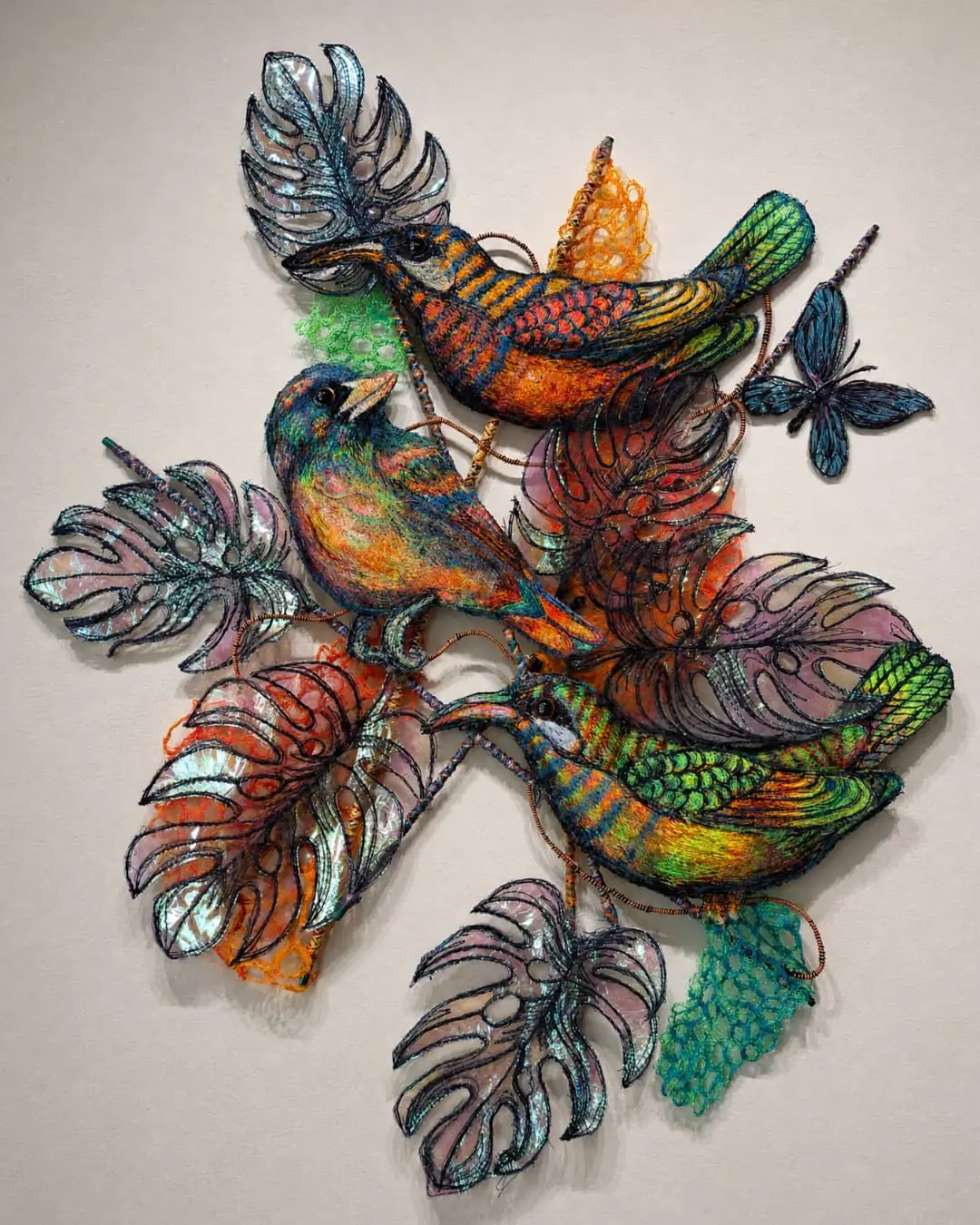
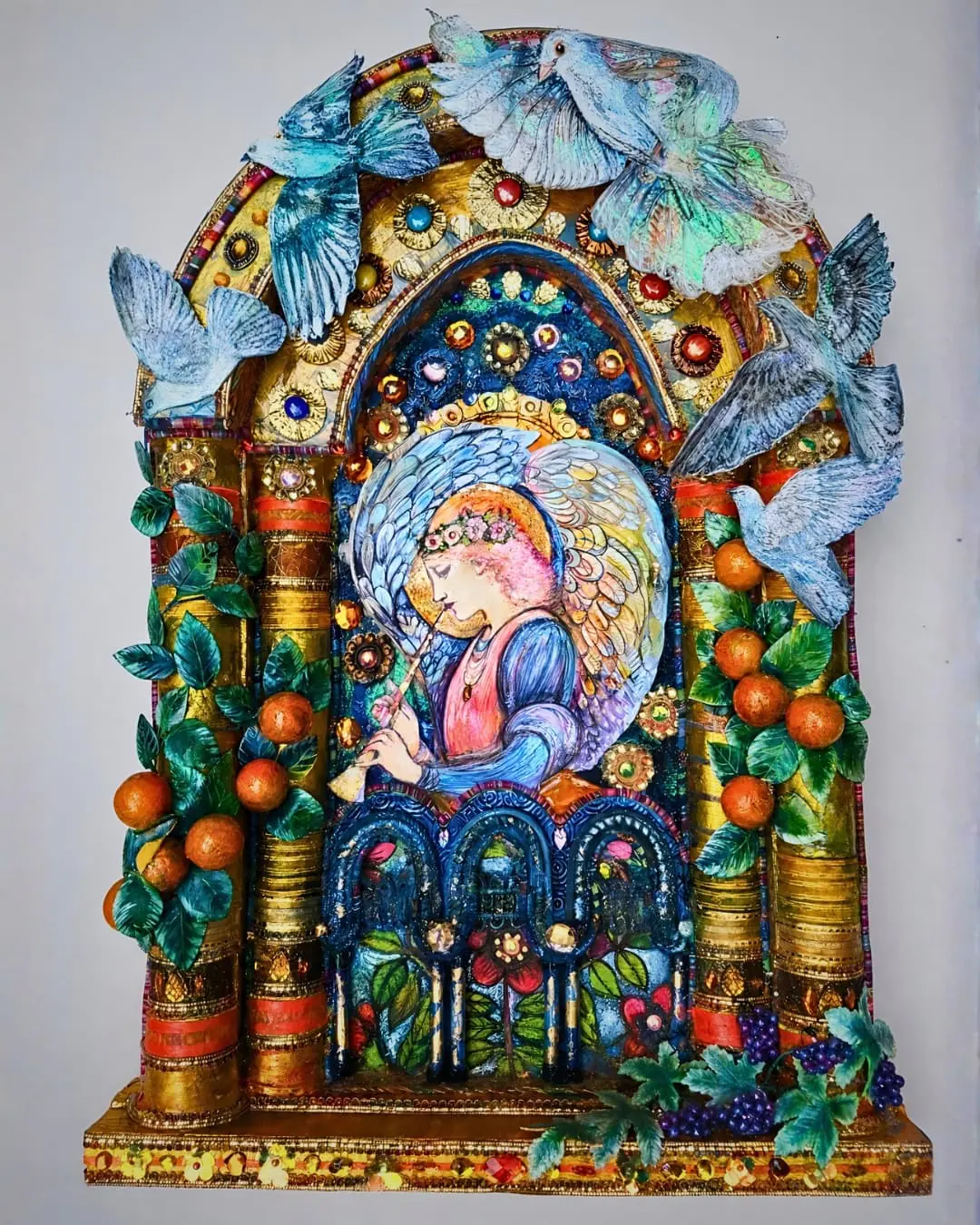
My workshop for Stitch Club is called Flight fantastic – birds in stitch. I show students how to transfer a drawing onto fabric using an oil pastel technique. I know drawing can be intimidating for some people, so I’m hoping this method will give them a foolproof way to overcome their fears.
I encourage members to be ambitious in terms of colour and scale, and be open to experimenting with different ways to display their pieces.
When designing the workshop, I used garden plant supports to make a frame for the birds and leaves, which is something I hadn’t tried before. That has given me lots of ideas for a larger piece and is a perfect example of discovering an alternative composition through experimentation.

8 comments
Ellen Nelson
I didn’t realize that so many of my favorite artworks was from this one artist! I am inspired!!
Siân Goff
Thank you, Ellen! What a wonderful discovery to realise that so many pieces you’ve admired are by Nikki Parmenter. We’re delighted her work resonates with you and that the article has left you feeling inspired!
Amy
This is a incredible body of work. So much for the eye & brain to feast upon. Fabulous. Thank you for sharing
Siân Goff
Thank you, Amy! We love your description of Nikki’s work as a feast for the eye and brain. There’s so much to discover in her extraordinary details, colours and materials. So glad you enjoyed the article!
Dina Osullivan
I am a fiber artist. I mostly use stitching or painting on a piece. I am totaly blow away by this work of stitching by this artiwt. It is the mose beautiful work I have ever seen.I t just amazes me, the detail, the colors, the images.I have never seen work like this. Dina
Siân Goff
Thank you so much, Dina. What a wonderful response to Nikki’s work! Her extraordinary use of colour, detail and stitch really is captivating. It’s especially lovely to hear how strongly her work resonates with you as a fellow fibre artist.
Tuula Heinoben
Your work is beautiful. I’m so impressed with the way you use found materials and natural materials in your work. I thought that was always the best way of creating art for myself too, but I haven’t been that active lately since I’m doing other work as well good luck to you and keep on making those beautiful works!
Siân Goff
Thank you so much, Tuula, for your thoughtful comment. It’s wonderful to hear that Nikki’s use of found and natural materials resonates with your own approach to creating art. We hope you find a little time to return to your own creative work too!