
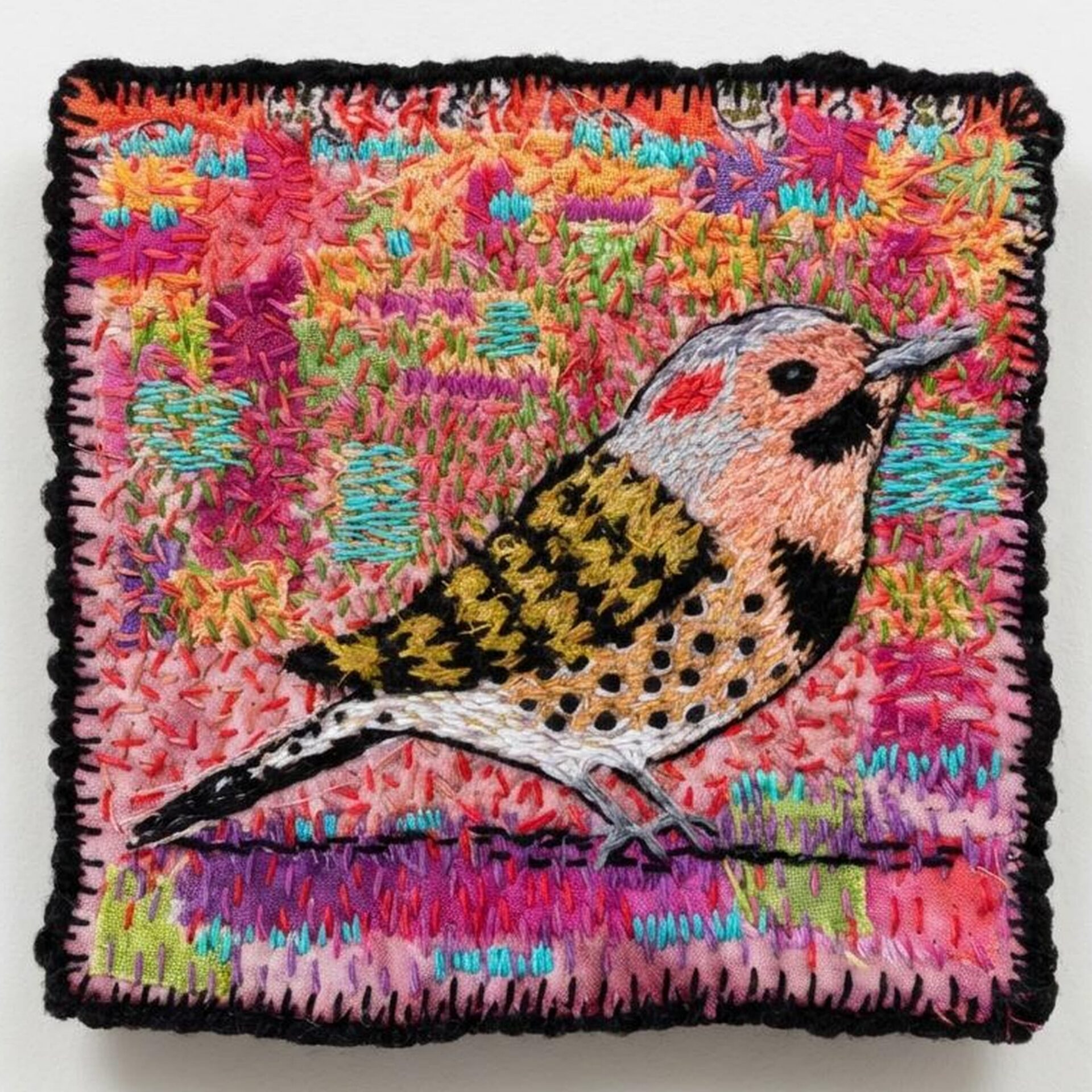
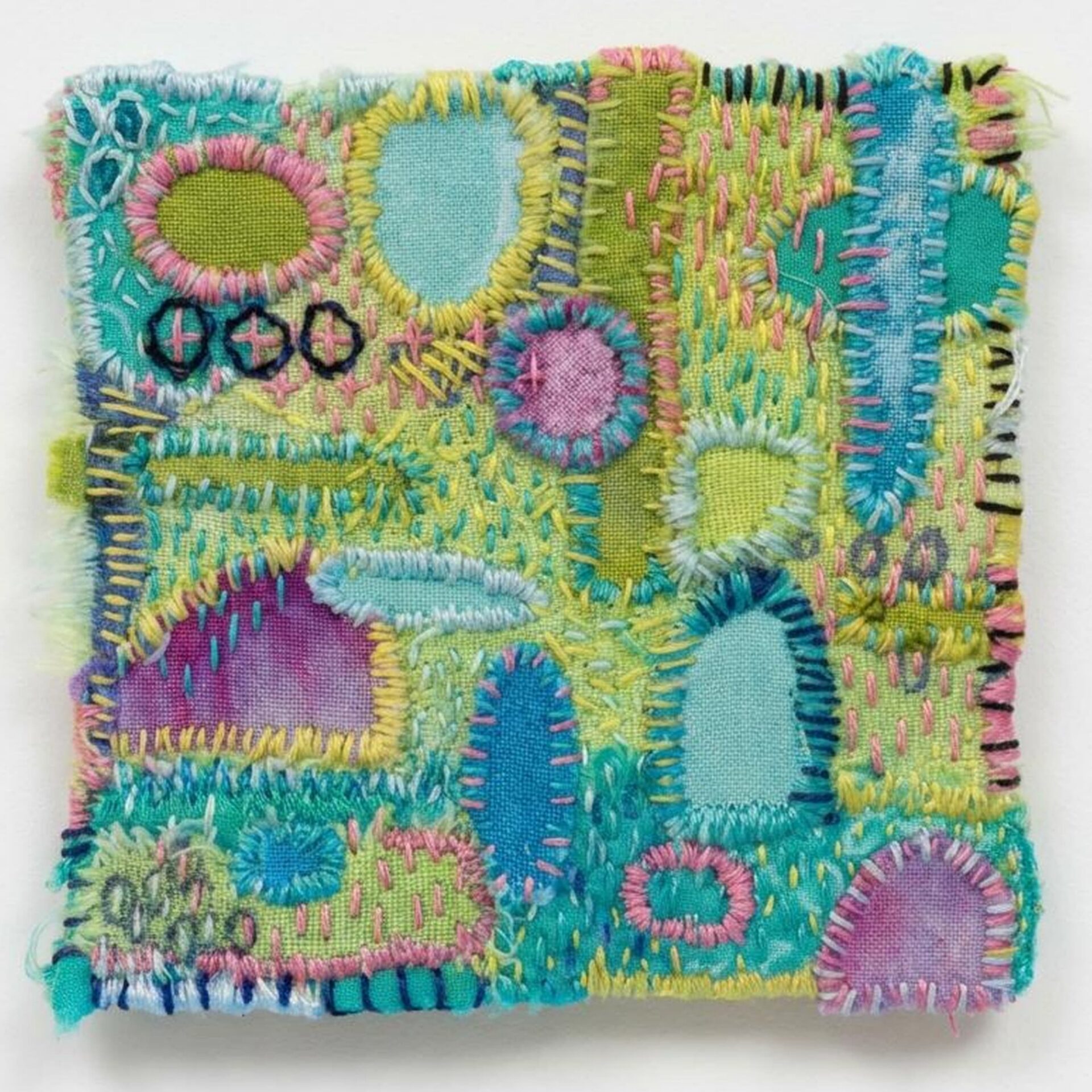
While some textile artists work large, Jo Morphett prefers to keep things small. Her pieces are often no bigger than an outstretched hand, yet they’re packed with colour and texture.
Jo embraces a slow stitching approach to her art, in which the process matters as much as the finished piece. The gentle pace gives her time to consider colour and mark making, and the final pieces are perfectly personal.
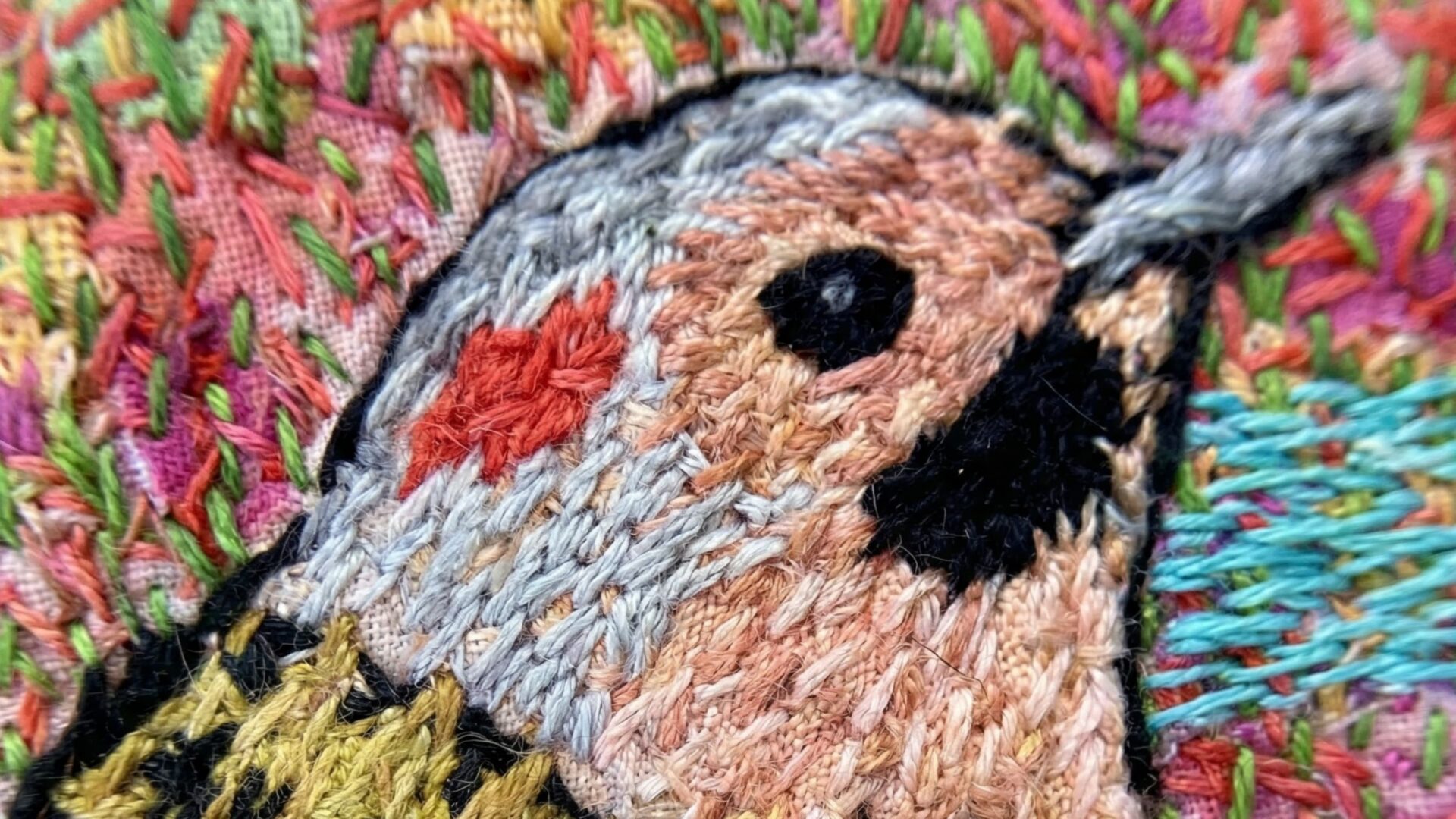
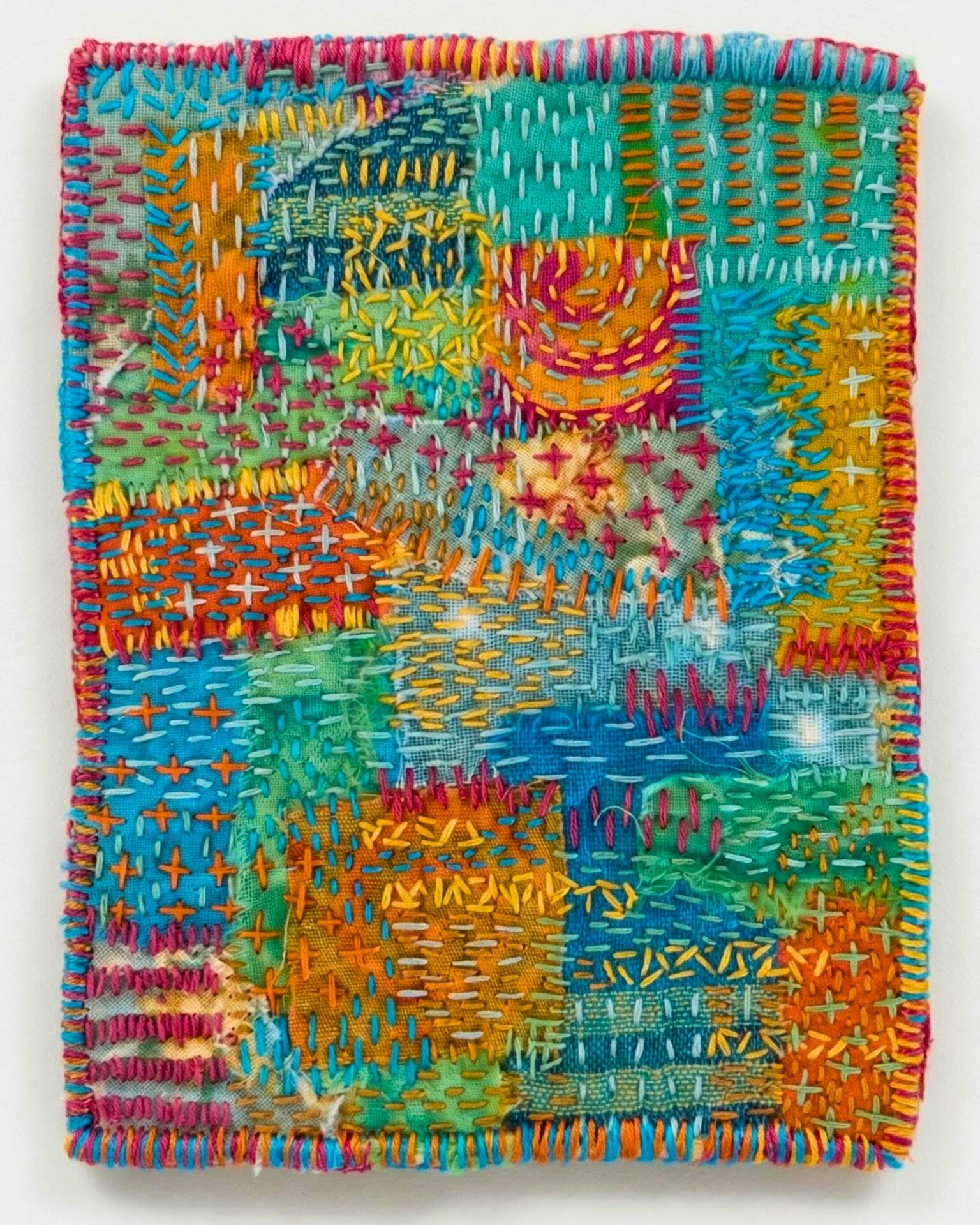
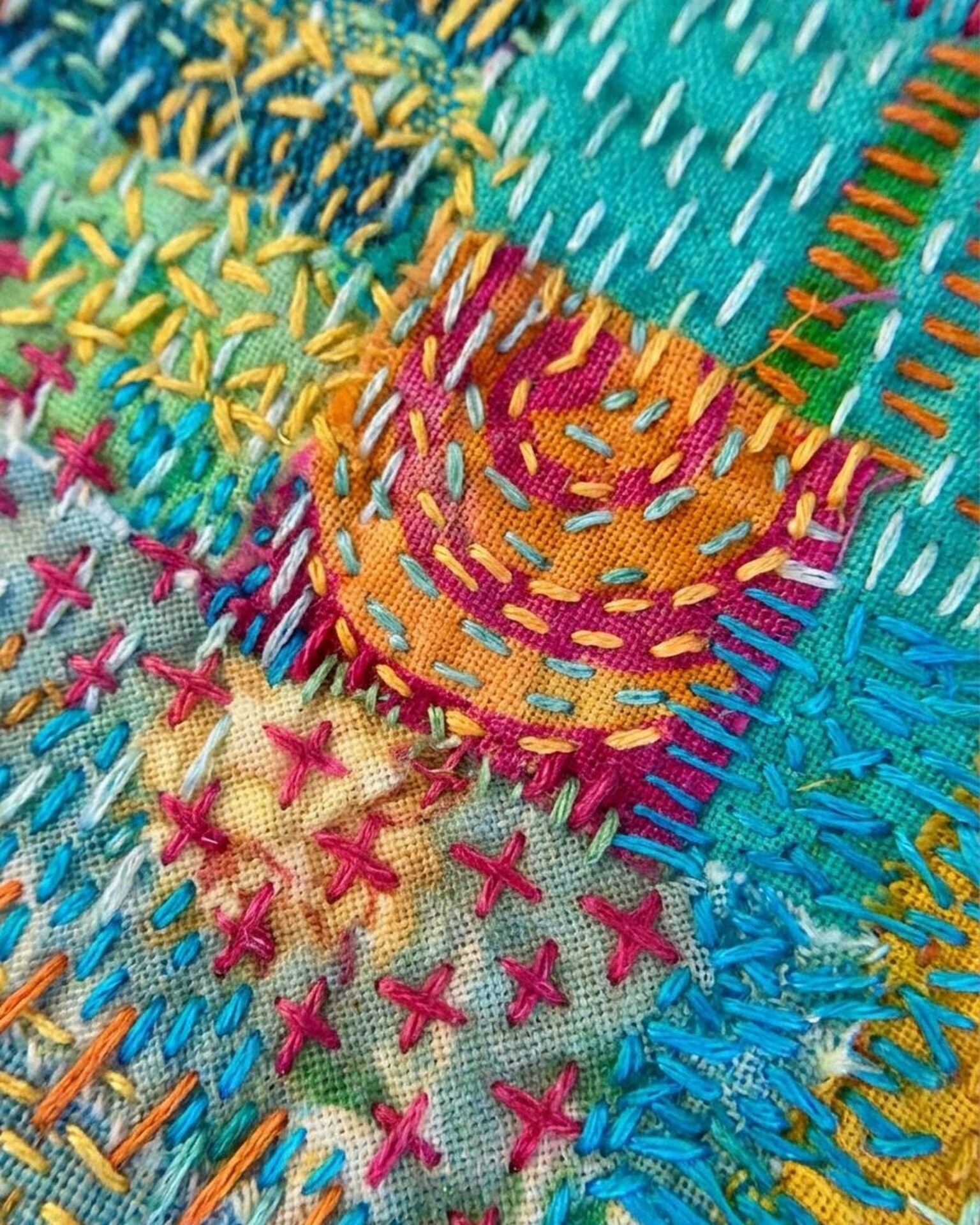
She’s also a fan of simple stitches. Running stitches dance across her compositions, shifting direction, stacking and repeating into patterns full of movement and depth. You’ll be amazed by how a simple needle and thread can create such incredible texture.
‘Small but mighty’ is the name of the game here. Each of Jo’s small collages packs a punch of colour, design and glorious stitchwork.
“I love the variety of textures that can be achieved with hand stitching. They’re unlike anything else, and it’s those textures that keep me coming back.”
Jo Morphett, Textile artist
A love of slow stitching
Jo Morphett: I define ‘slow stitching’ as enjoying the slow and relaxing process of sewing by hand without worrying about perfection or precision. The end project is not the sole goal. The making and creating process is equally important.
The pace of slow stitching suits my working style. The time it takes to create hand stitched artwork allows me to think deeply about colour and mark making. I believe that working slowly gives me space to infuse feeling and emotion into a piece. It gives an artwork something intangible and unique.
I’m very inspired by nature, including flowers, trees, mountains, oceans and rivers, and animals and birds. I also find patchwork patterns to be an inspiring way to organise shape and colour.
Increasingly, I’m drawn to using abstract shapes to explore my more personal ideas. Abstract artwork allows me to work on two levels: my own specific idea and what the viewer sees and interprets.
“From a young age, I saw sewing as an act of independence, creativity and personal expression.”
Jo Morphett, Textile artist
Artistic influencers
Both my mother and grandmother introduced me to creativity, colour and textile art. My grandmother sewed clothing and household items, and she was an avid knitter and crocheter. Her making process sparked my love of fabric, yarn and thread.
My mum painted ceramics creating sculptures, bowls and housewares. I have several of her pieces that I treasure. Her use of colour and attention to detail greatly influenced my own use of colour.
Aside from skills learned from my grandmother and sewing skills in high school, I’m largely self-taught. I started hand embroidery as a teen working with embroidery and cross-stitch kits. I later created freeform embroidery on fabric and clothing.
A light bulb moment
As a young mother, I taught crafts to children which led me to start a personal art practice. I added collage and mixed media to my exploration of embroidery, which then grew into more than a hobby.
Several years later, when the internet was new, I started selling my art online. I was exposed to so many types of creativity, including someone who was combining machine sewing with mixed media. A light bulb switched on in my mind, and I decided to explore adding stitch to my mixed media work. It felt like coming home.
Almost immediately, my painted and stitched work changed, and fabric became my default material. I began to create mixed media art quilts and, over time, I chose fewer mixed media elements. Today, only occasionally do I add a hint of mixed media to enhance a work.
Politically stitching
Spinning, weaving, sewing and stitch have been considered women’s work for centuries. Much of today’s clothing and textiles are primarily made by women in factories. They’re paid extremely low wages, and they work within terrible conditions. Clearly, their labour isn’t valued.
I had a similar experience as a younger person at a small-scale workshop sewing custom sails for sailboards. I was one of three female sailmakers. Initially, I enjoyed the job, but the work environment quickly became intolerable in many ways, due to the smoke and fumes and exposure to harmful chemicals.
Fortunately, it was a summer job, so I could walk away. But I’ve never forgotten how people working similar jobs are real people. That’s why I consider working with fabric and stitch to be a political act that reveals the beauty, labour and intention behind jobs that have historically been sidelined and undervalued.
I also learned that I come from generations of women makers on my mother’s side, including shirtmakers and collar turners. And now as a grandmother myself, my granddaughter is learning to sew by my side. I humbly embrace the role of knowledge keeper, and I aim to freely share what was passed on to me.
“My process is completely intuitive. I usually just show up, pull out fabric, and start moving pieces around.”
Jo Morphett, Textile artist
Working intuitively
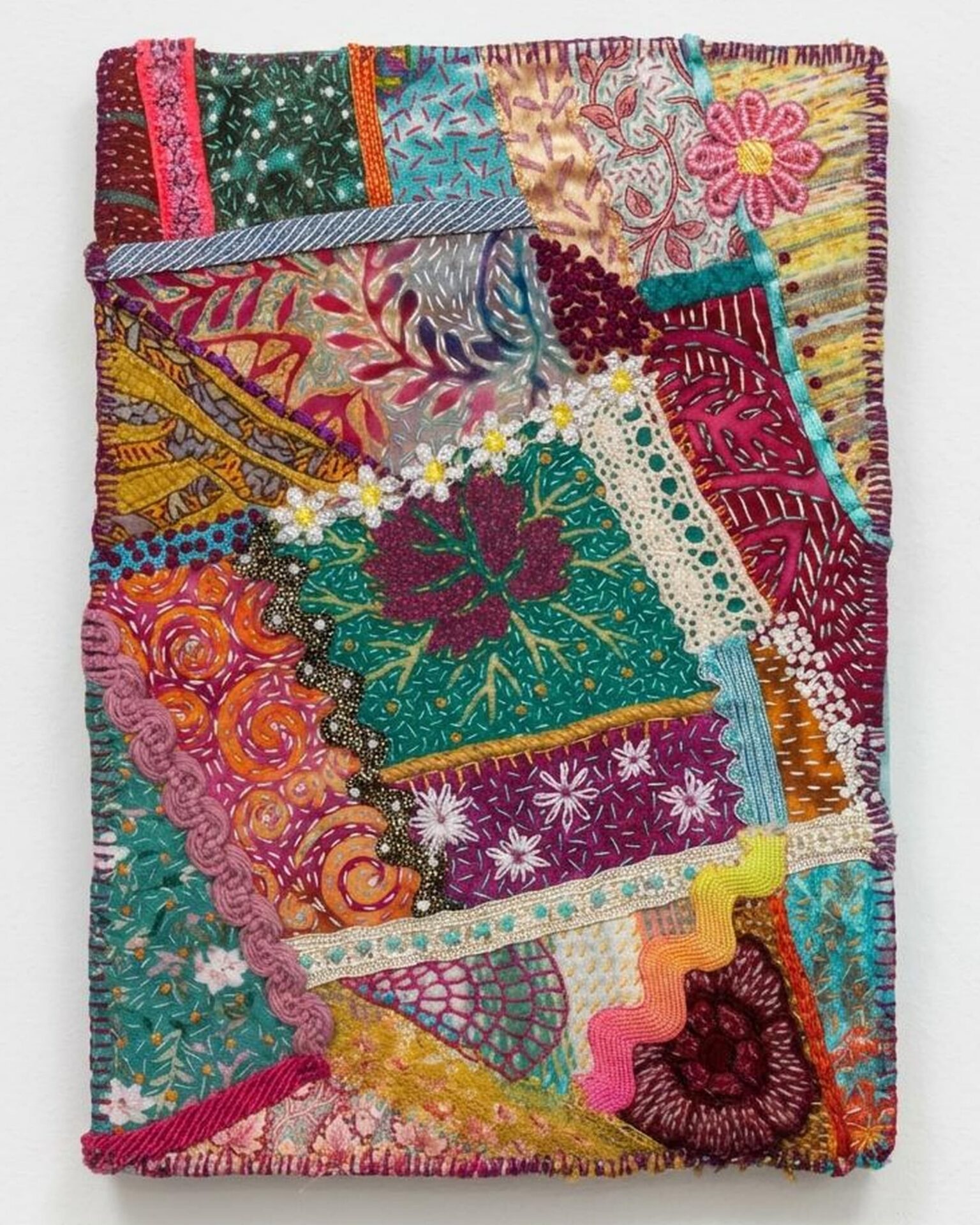
My inner editor or critic is not part of my initial process. I simply gather some fabric and start moving them around.
Sometimes I’ll start with an idea, such as a bird I saw on a walk. Or an emotion will come up, so I’ll choose a colour that captures that emotion and build a collage from there.
To start building my collage, I select my main fabric colours. I choose dark, medium and light tones of each colour. I thread baste the collage pieces in place using threads that coordinate with the fabrics.
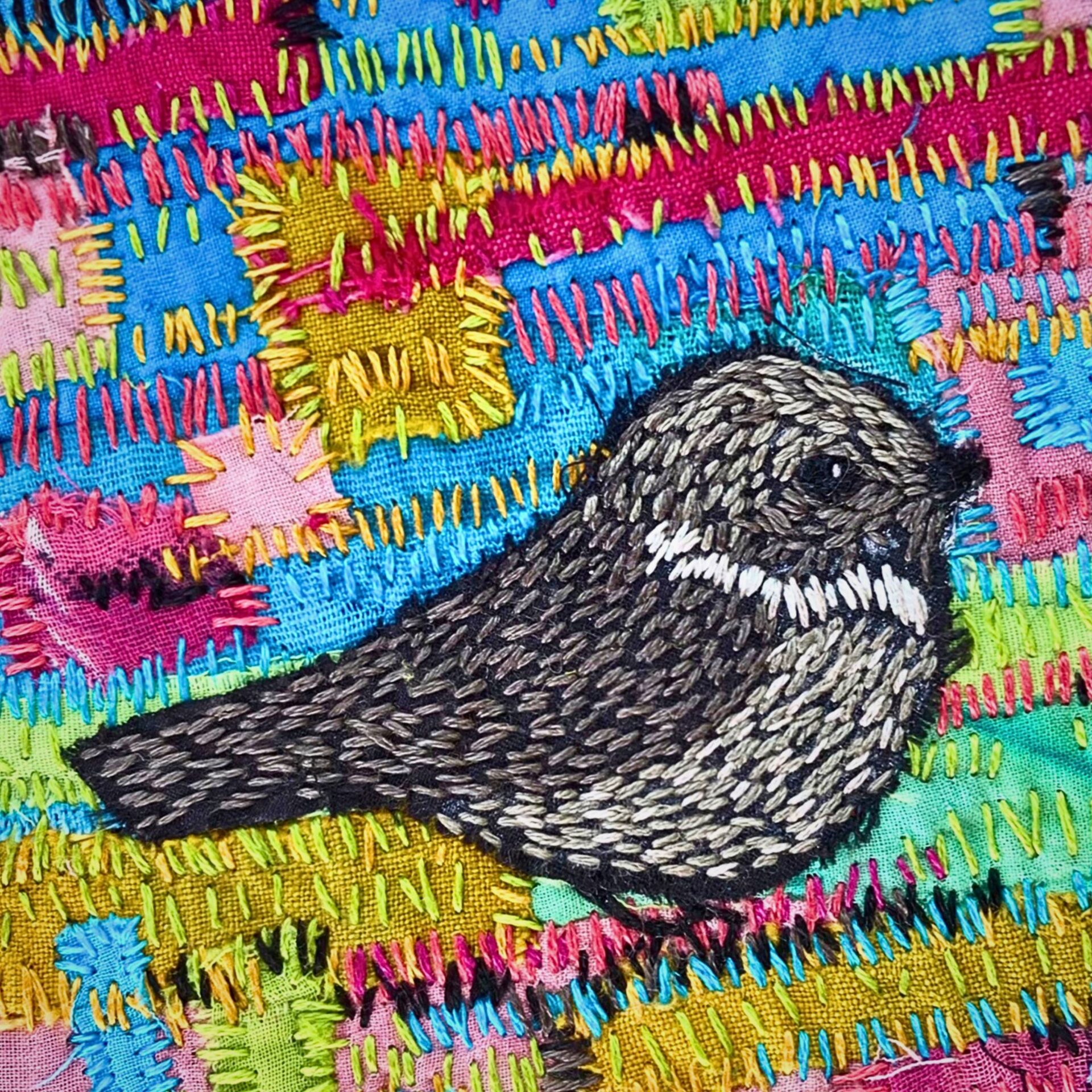
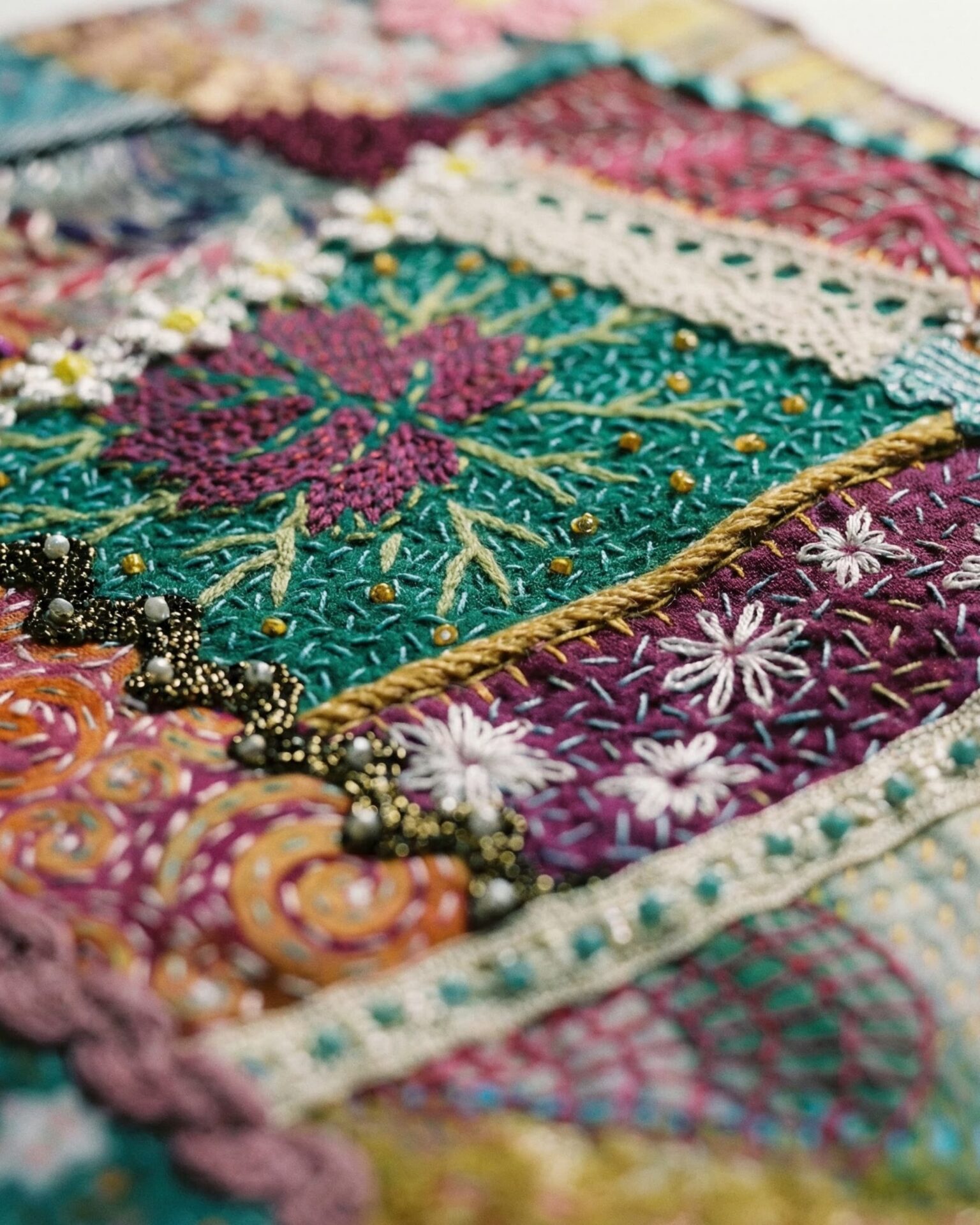
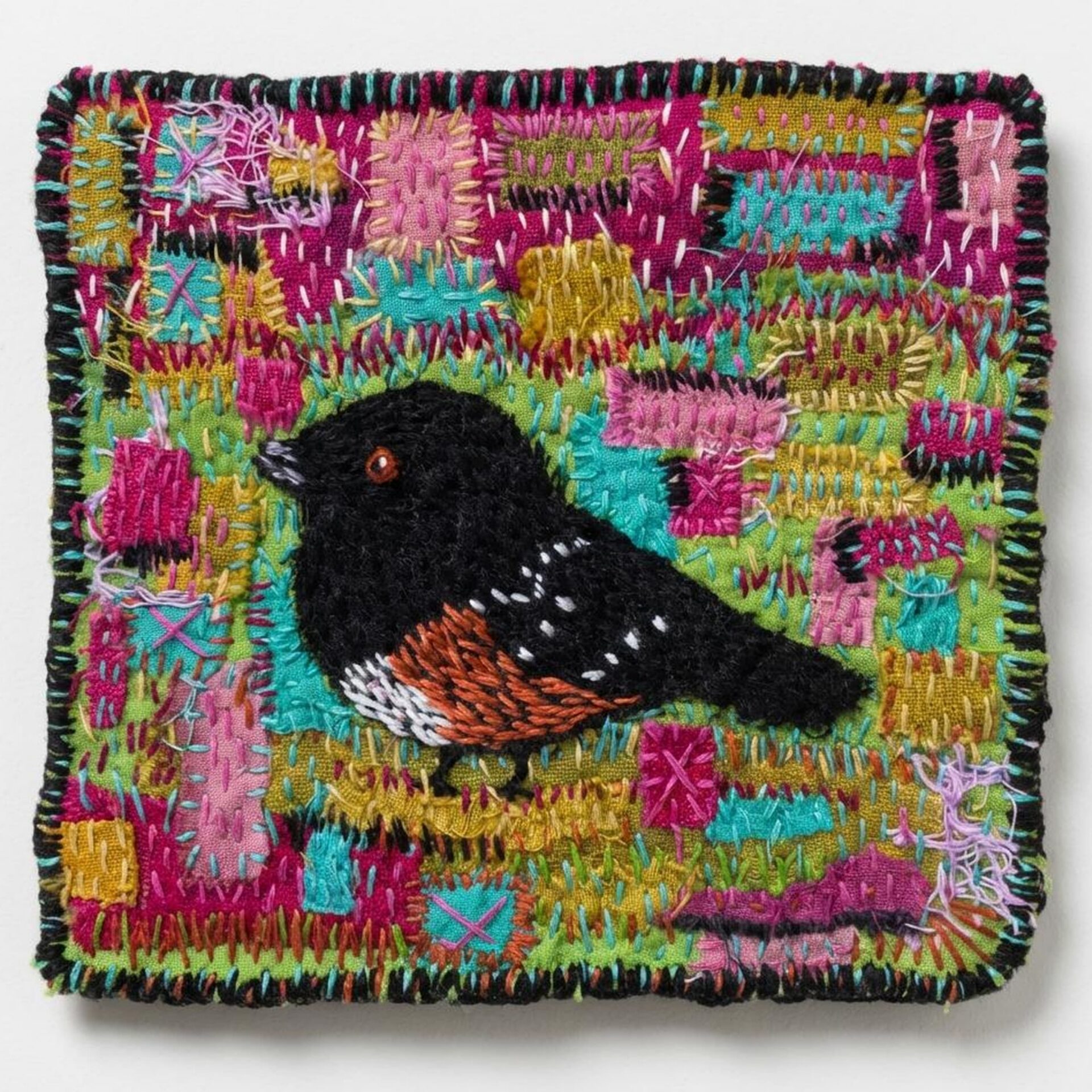
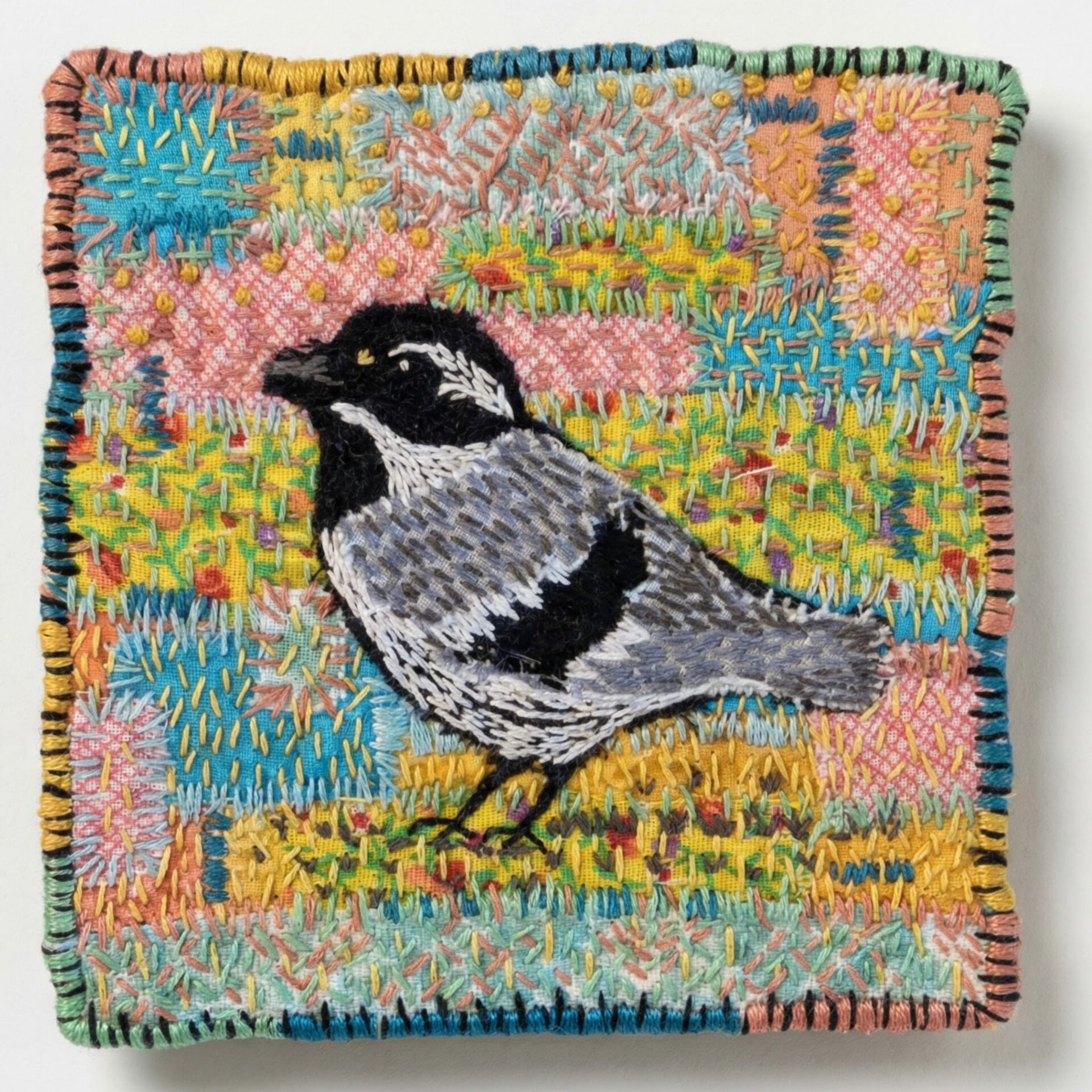
I stitch in layers, adding stitch on top of stitch. For the first layer, I use seed and running stitches to secure the fabrics. I continue to add mostly seed stitch, varying the length of the stitches. I don’t worry about my stitches being uniform.
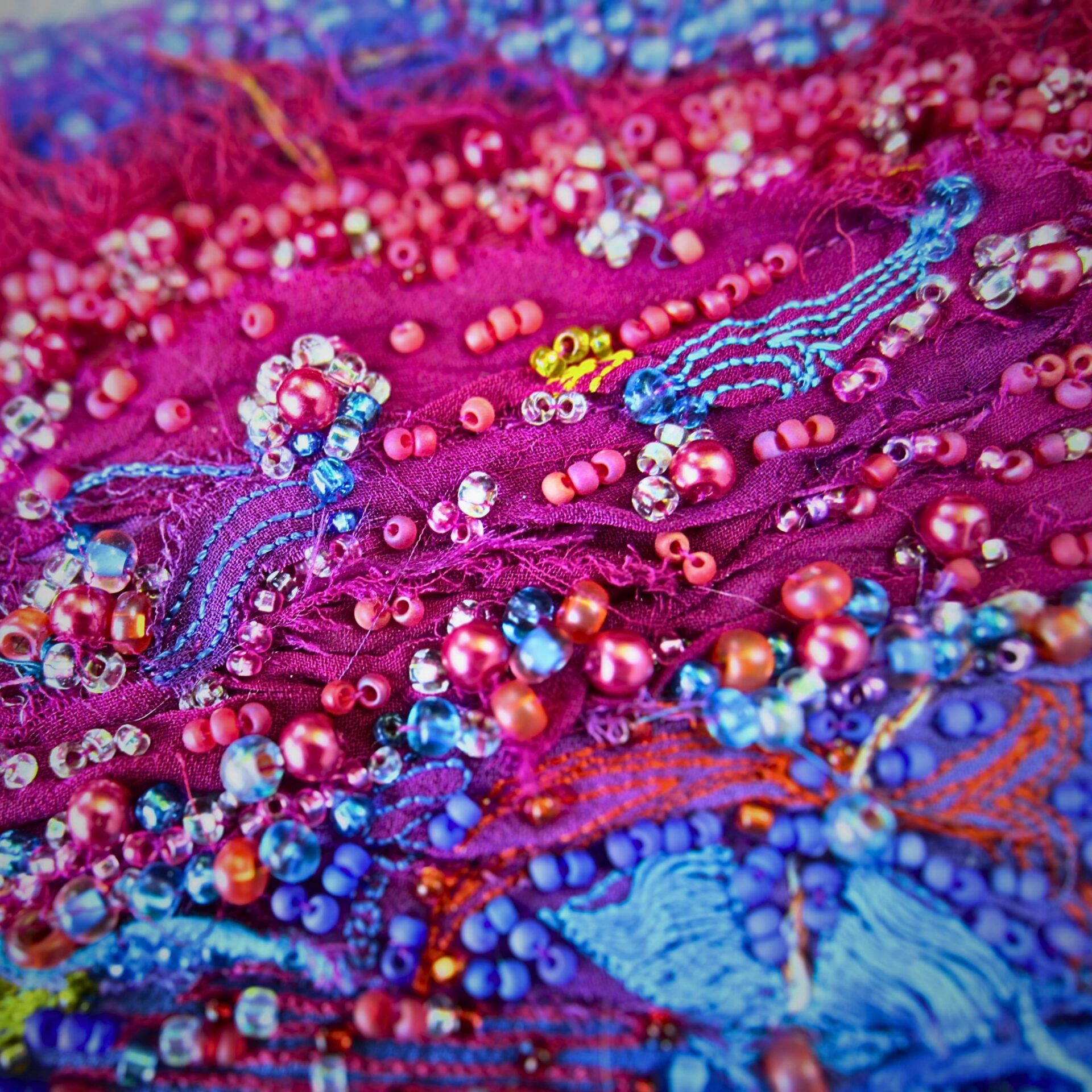
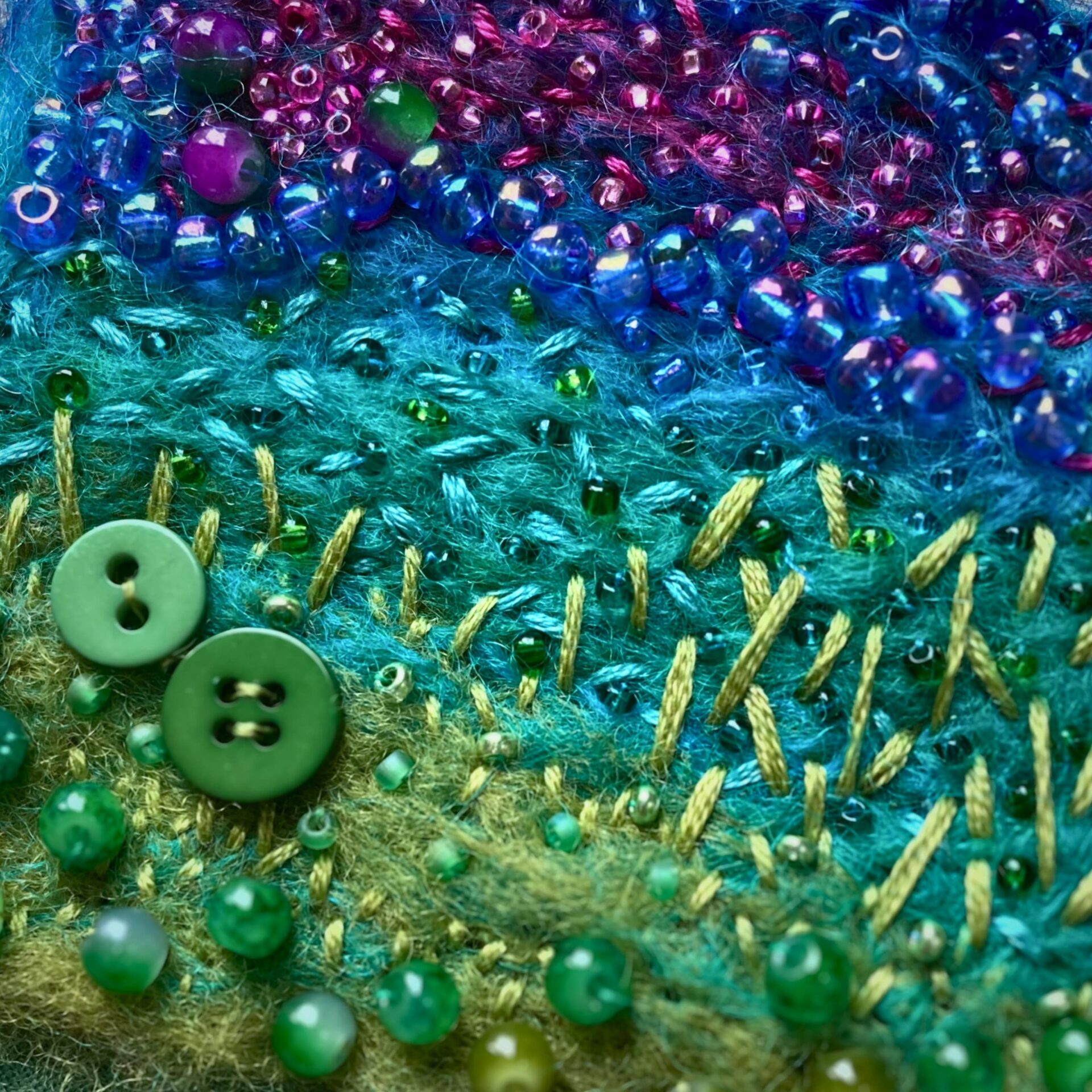
I also alternate stitch placement to create thick and thin marks. Sometimes I add beads depending on the texture and colour I’m looking to create.
Throughout the making process, I pay attention to colour balance, moving colour around to create a blended harmonious piece. For smaller works, I usually finish the work with a blanket stitch along the edges as a border or frame.
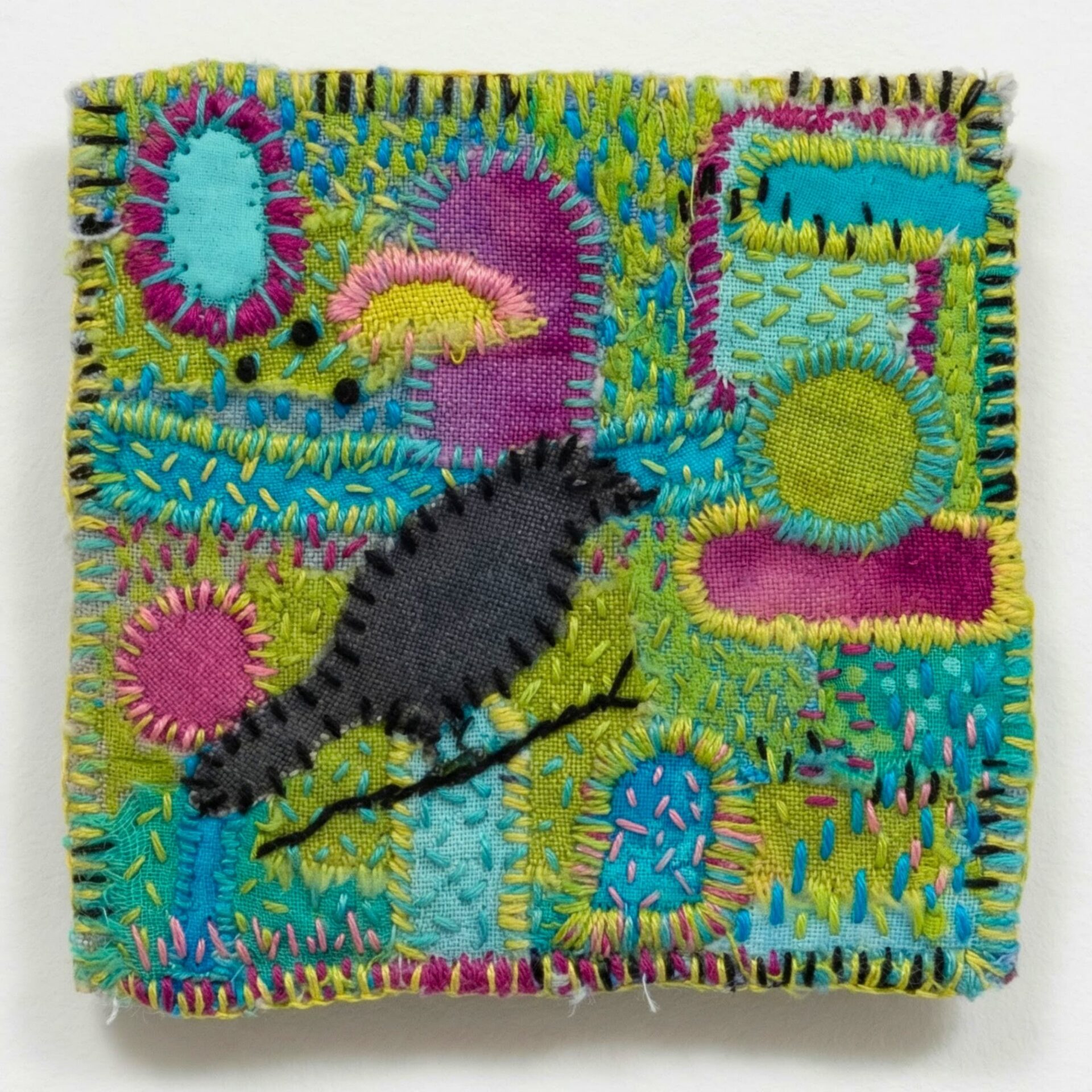
“I’m drawn to filling a small space with a lot of information by way of colour and stitch.”
Jo Morphett, Textile artist
Working small
I mostly work small because of the intense stitching in my work and the time it takes to accomplish all the stitch layers.
The physicality of being able to hold the entire work while stitching also keeps me in the creative flow. Being able to see everything at once is also what keeps me working small.
I prefer to work no bigger than what will fit on my tabletop. That way I can see the entire work and continue to be inspired about what and where to stitch next.
Working small does pose a challenge, though, when sharing my work. Small works lack grandiosity and require viewers to get up close. Also, photographs and the internet don’t fully suggest the scale of my work. When viewed online, people often assume my work is much larger than it is and are shocked when they learn the actual size.
My larger works use the same principles and aesthetic as my smaller pieces, but they tend to have less stitching. I’m also forced to step back to view the entire piece, which can break the flow of creativity and make it more challenging.
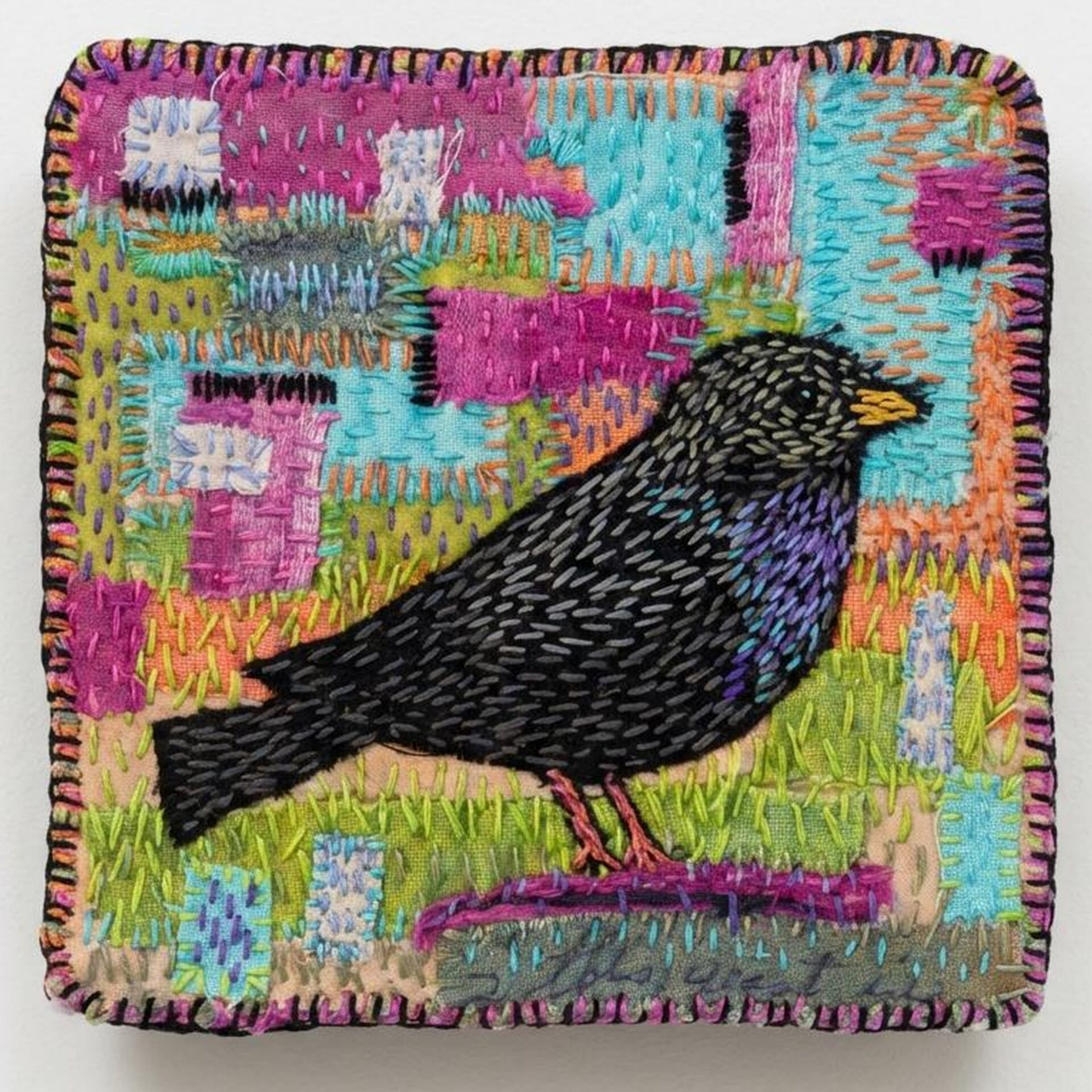
“I think it’s only by showing up and continuing to explore the process that my colour sense has become something I can trust.”
Jo Morphett, Textile artist
Fearless use of colour
I’m drawn to bright colours. I particularly love blues and greens, but they always need an accent to shine. That’s where oranges and fuchsias come in.
I love other artists’ use of neutral tones and have experimented with quieter colour palettes. But I get stalled midway and the work never feels like ‘me’. Part of developing my personal style was embracing my colourful approach.
After years of practice, I rely on my instincts and intuition to guide my colour choices.
When it comes to fabrics, I like to recycle, reduce waste and be kind to the environment. I’ve built my fabric stash over the years from a combination of gifted, thrifted, recycled, deadstock and store-bought fabrics. Other than buying felt by the yard, I rarely buy fabric.
I prefer cotton, and most of my fabric stash is cotton with some silk, linen and wool. Because I mostly hand stitch, I avoid fabrics that are too thick or too tightly woven.
Making marks with stitch
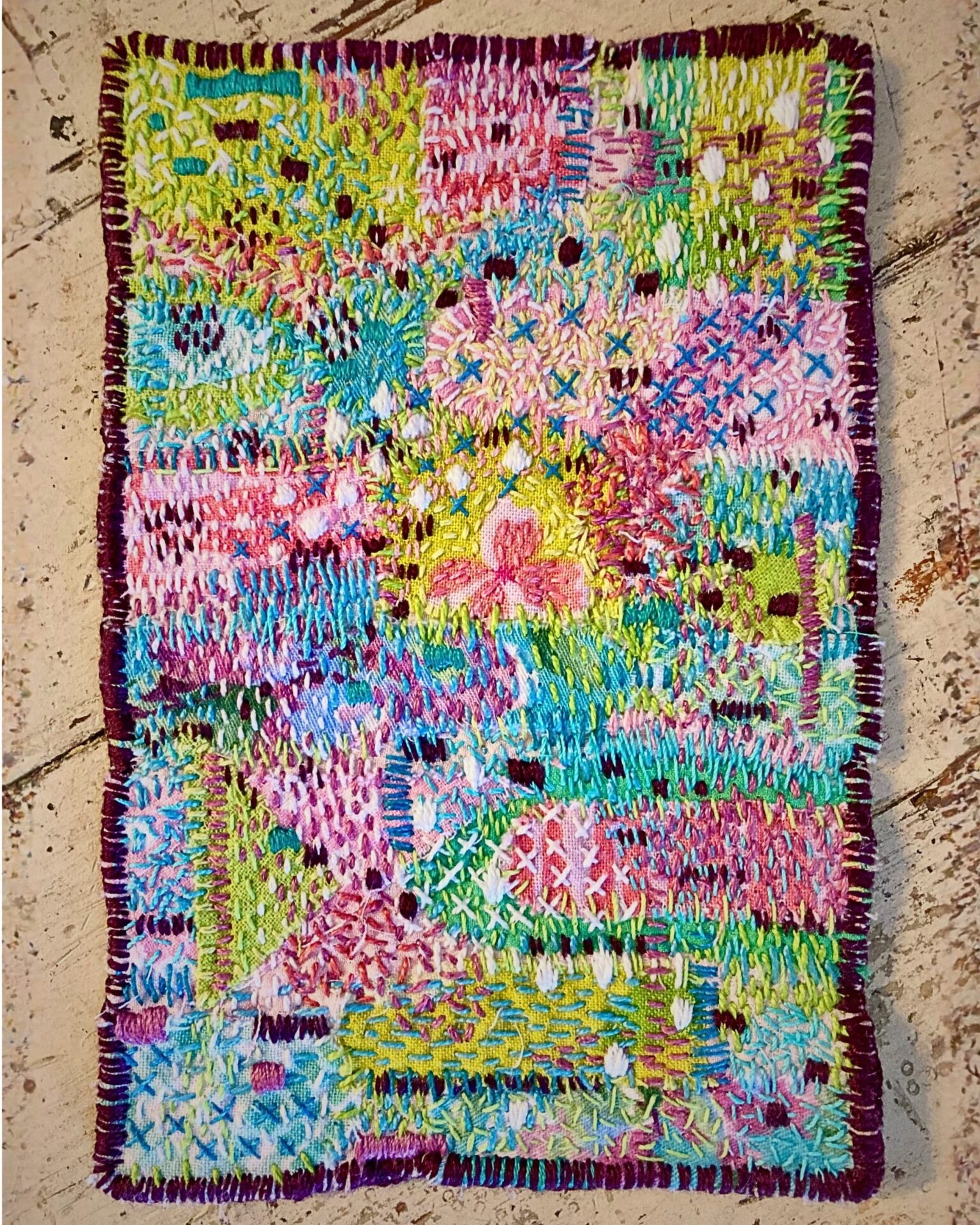
Mark making is my primary goal, so I prefer simple straight stitches to make marks and build up texture. I mostly use seed stitch, satin stitch, running and blanket stitch. I also enjoy using french knots.
My number one thread choice is DMC stranded cotton embroidery floss. It’s beautiful, the six strands are divisible, and it comes in so many colours. It’s really all I need, and it’s widely available.
I also like perlé cotton size 8, and occasionally I use sizes 5 and 12. DMC and WonderFil are my favourite brands. WonderFil Spagetti 12 weight cotton and Sulky 12 weight cotton come in many colours. They’re available online and in sewing and quilting stores.
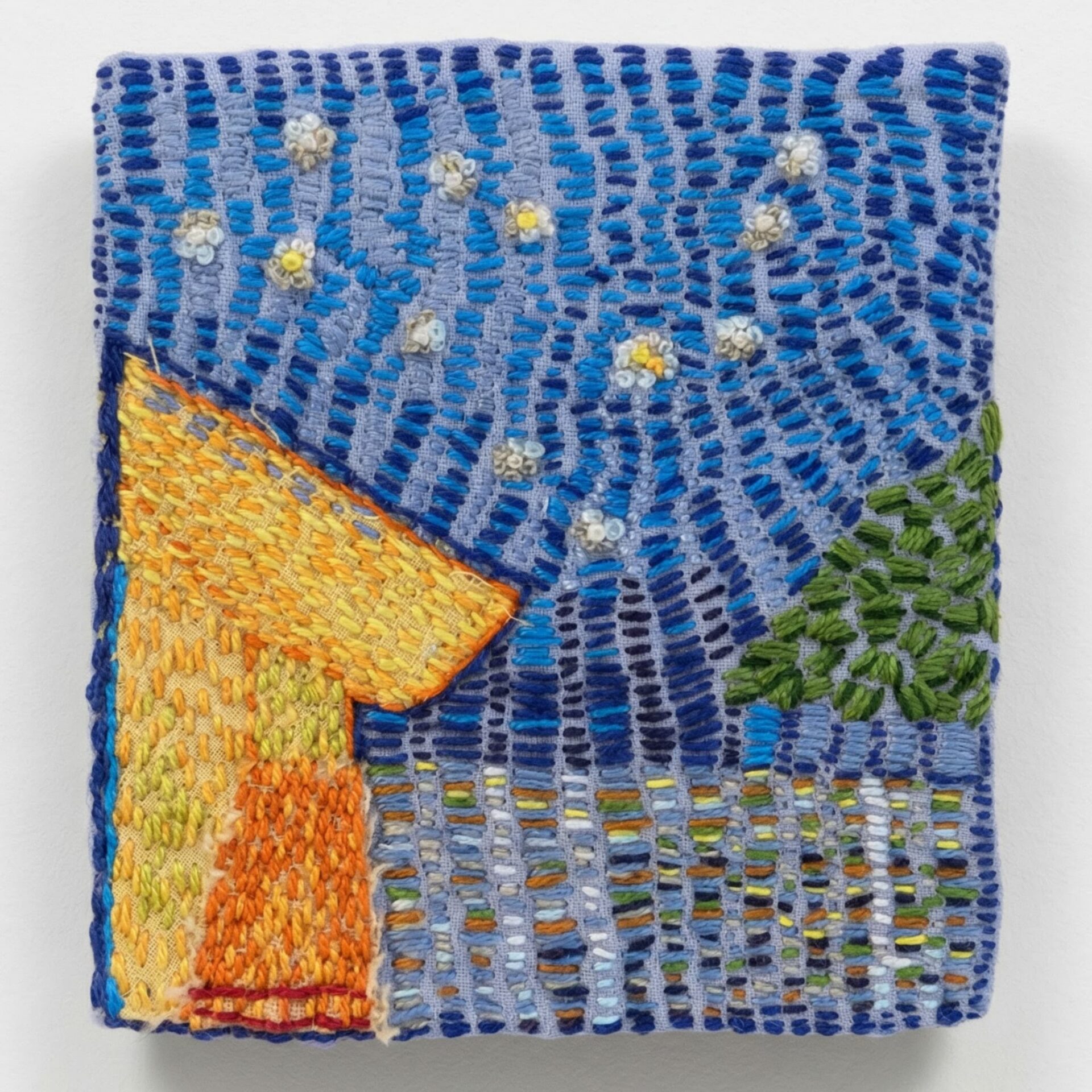
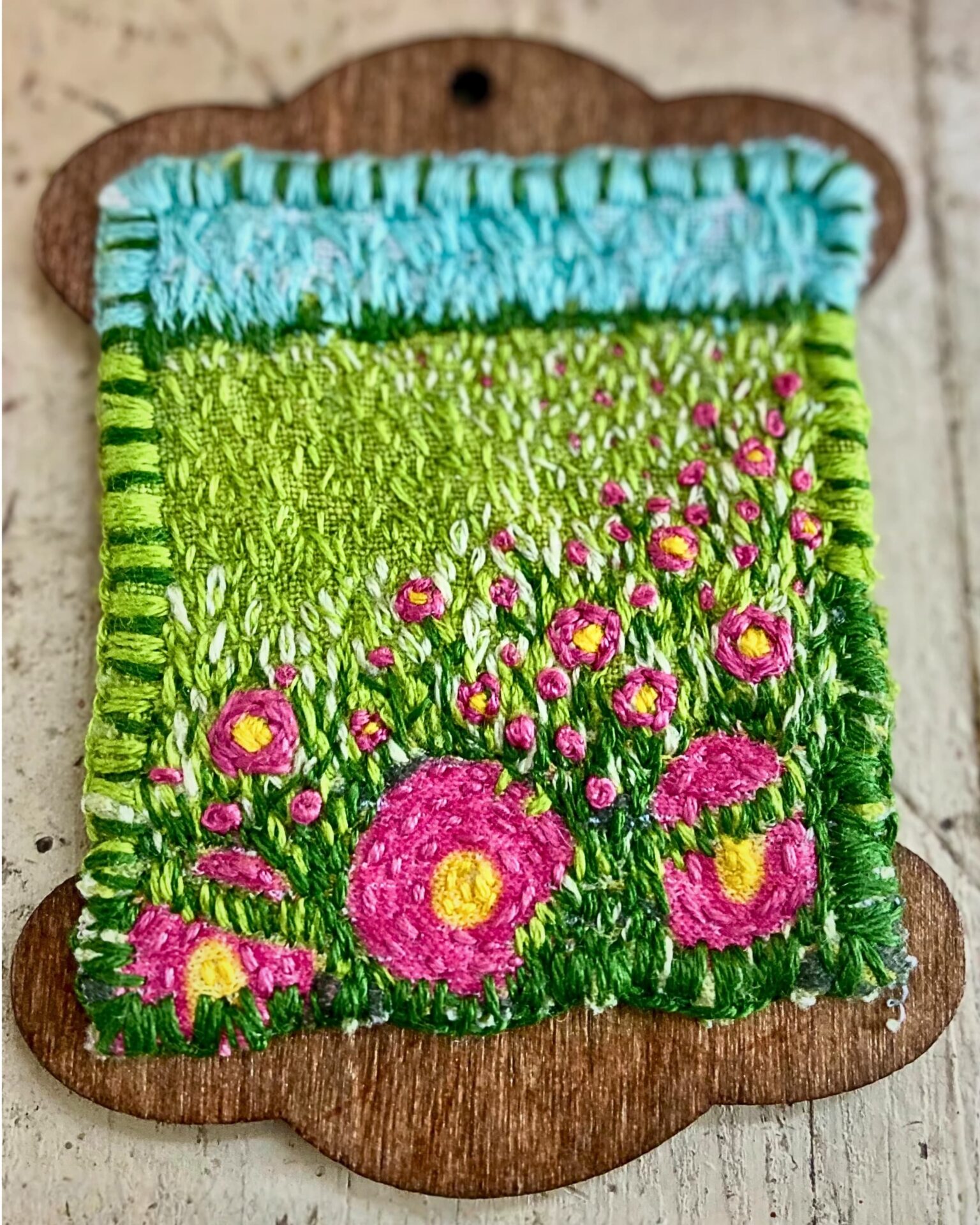
I introduce students to my techniques in my Stitch Club workshop. The artwork I created for this workshop is called First Bloom, and members learn how to build up simple stitches with slight variations to create bold and subtle marks. I’m hoping they’ll find that no matter their stitching experience, they can create a piece full of beautiful depth and texture.
Putting down the needle
Because my work features so much stitching, the most important step of my creative process is knowing when a piece is finished and allowing myself to step away.
I’ll often set a piece down and leave it for a day so I can come back with fresh eyes. It’s surprising how much that helps. And if I’m still not sure, I just keep repeating the process.
There are times, though, when I can’t make a piece come together no matter what I try. I think this happens to all artists, and that’s completely okay. It’s just part of the creative process and knowing what doesn’t work is good information. The only way to get there is to keep making and creating.
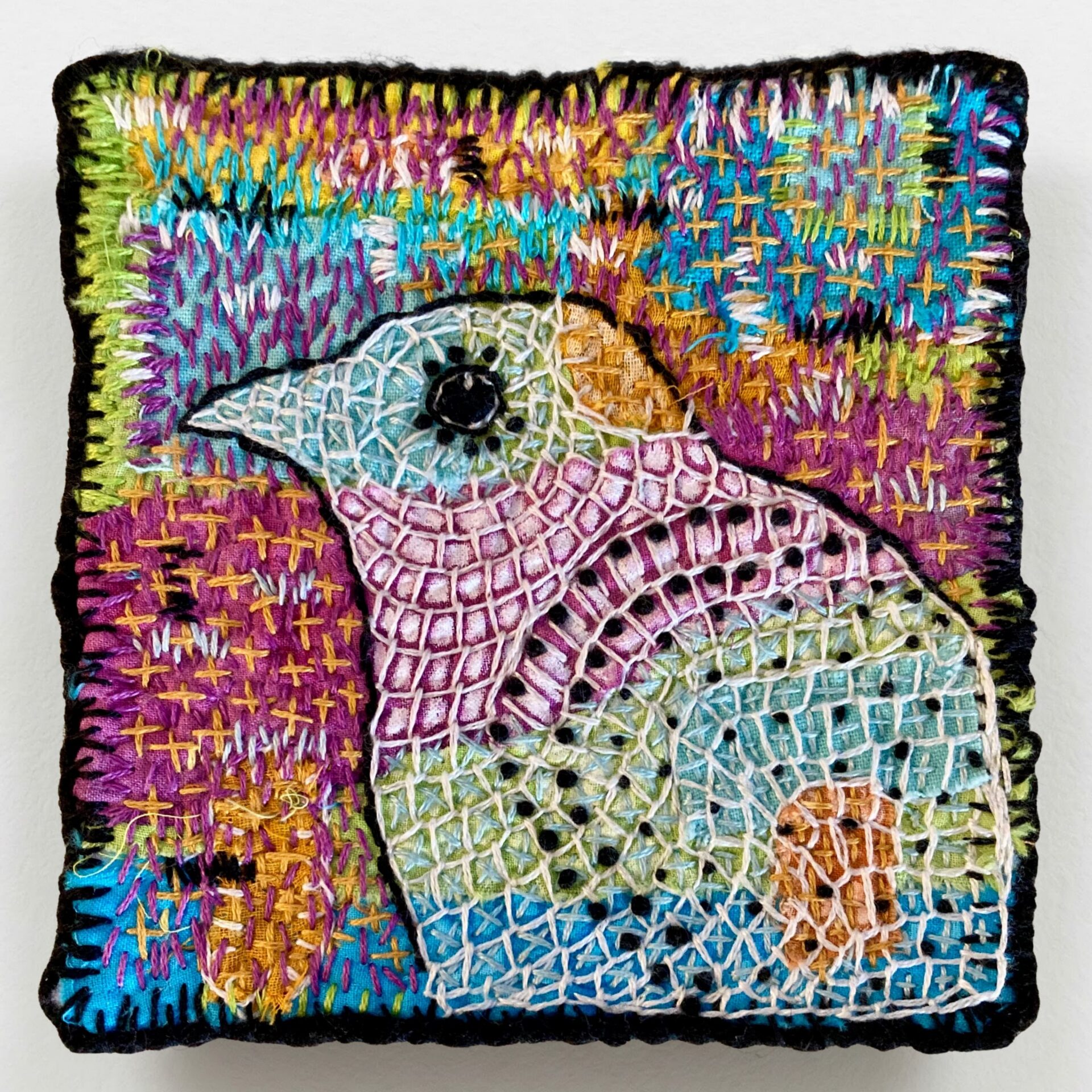
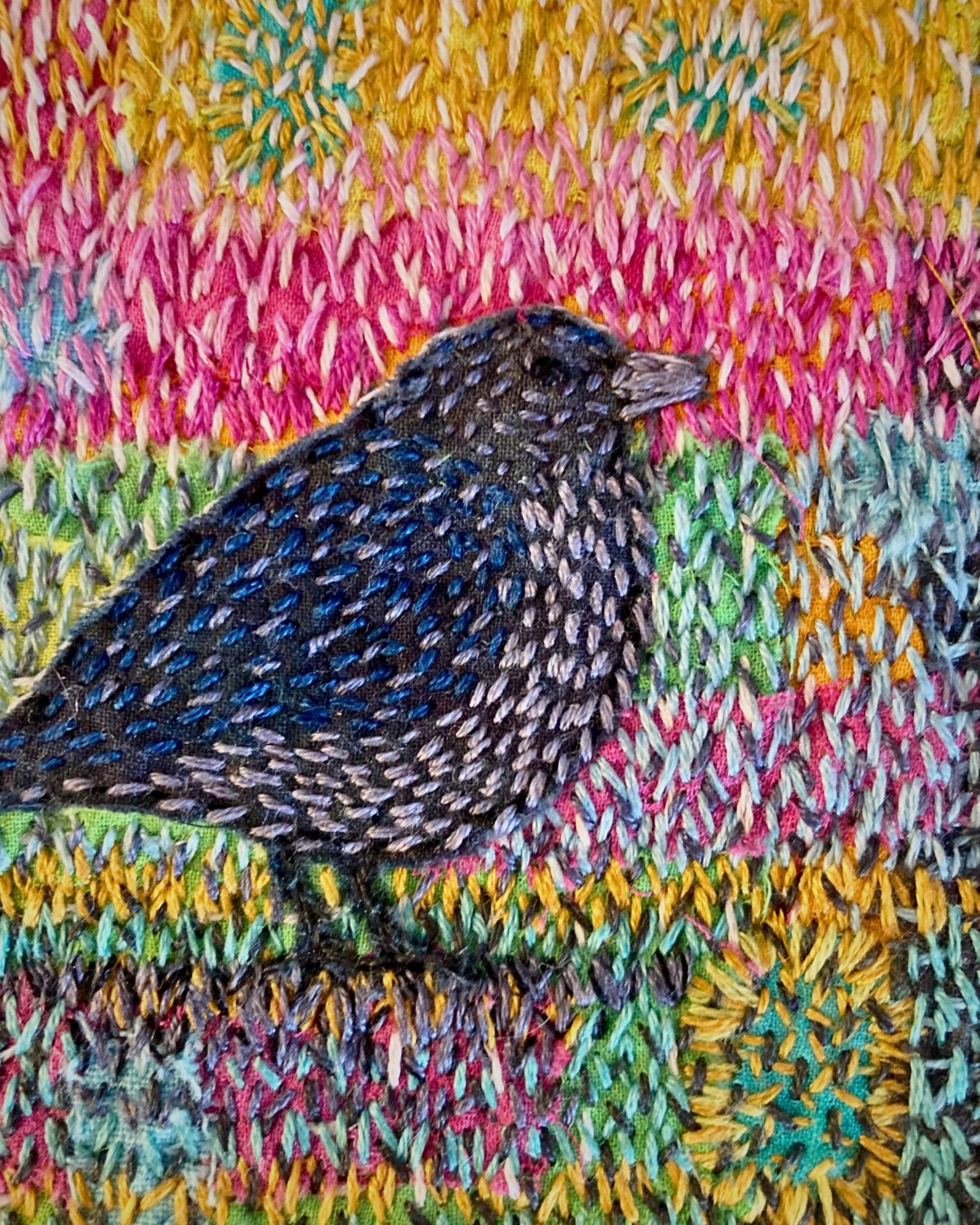
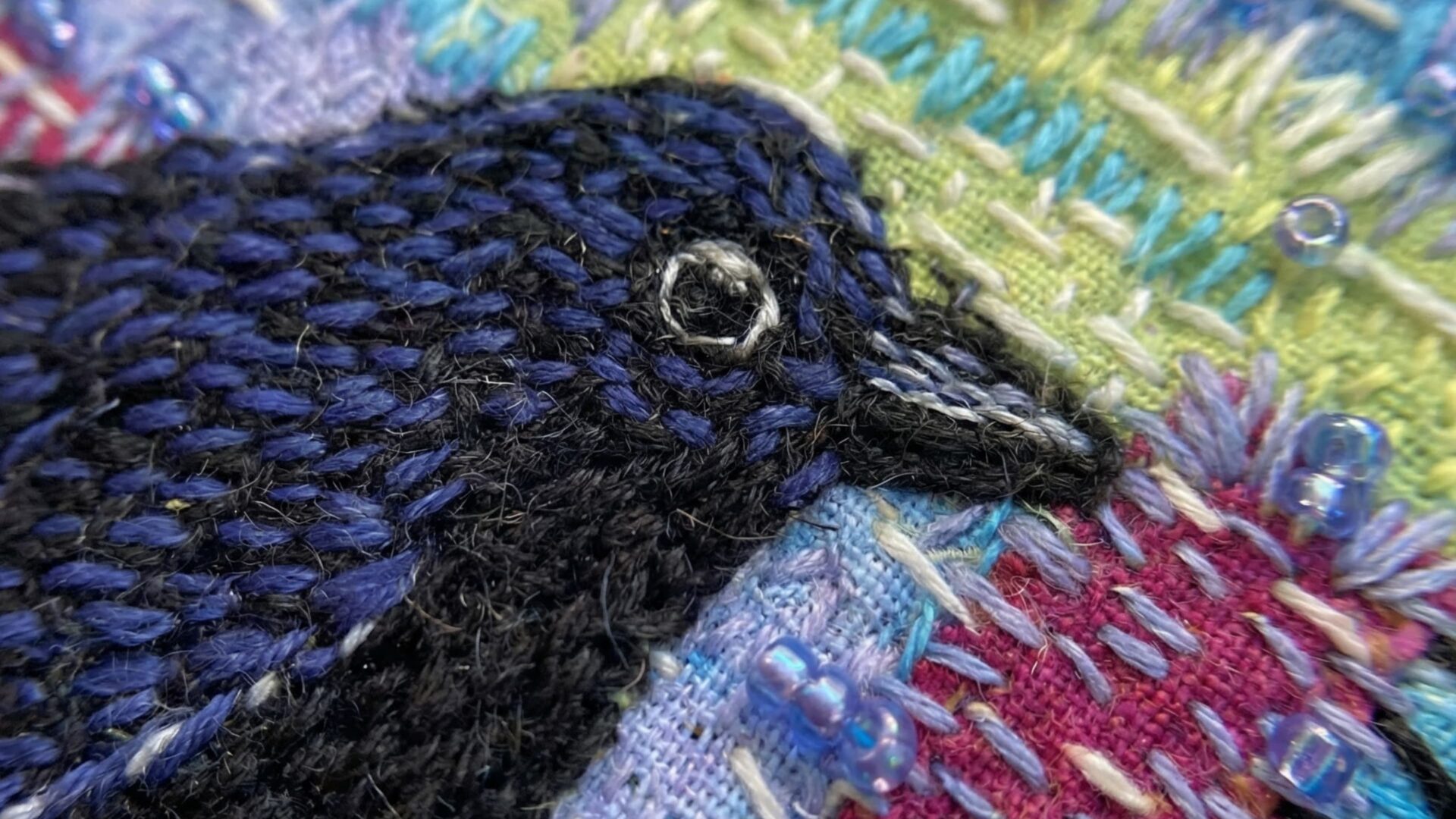
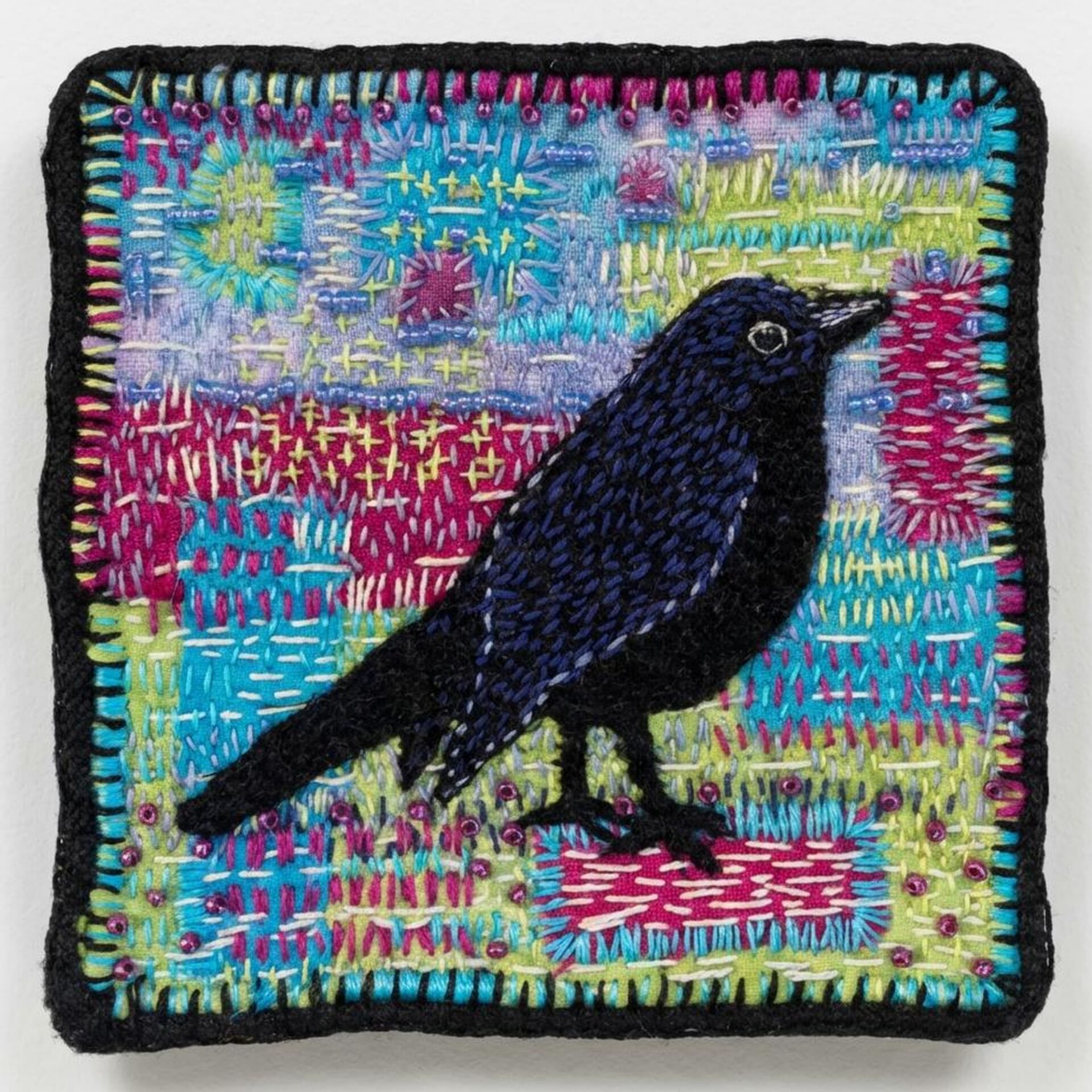
Purple Martin
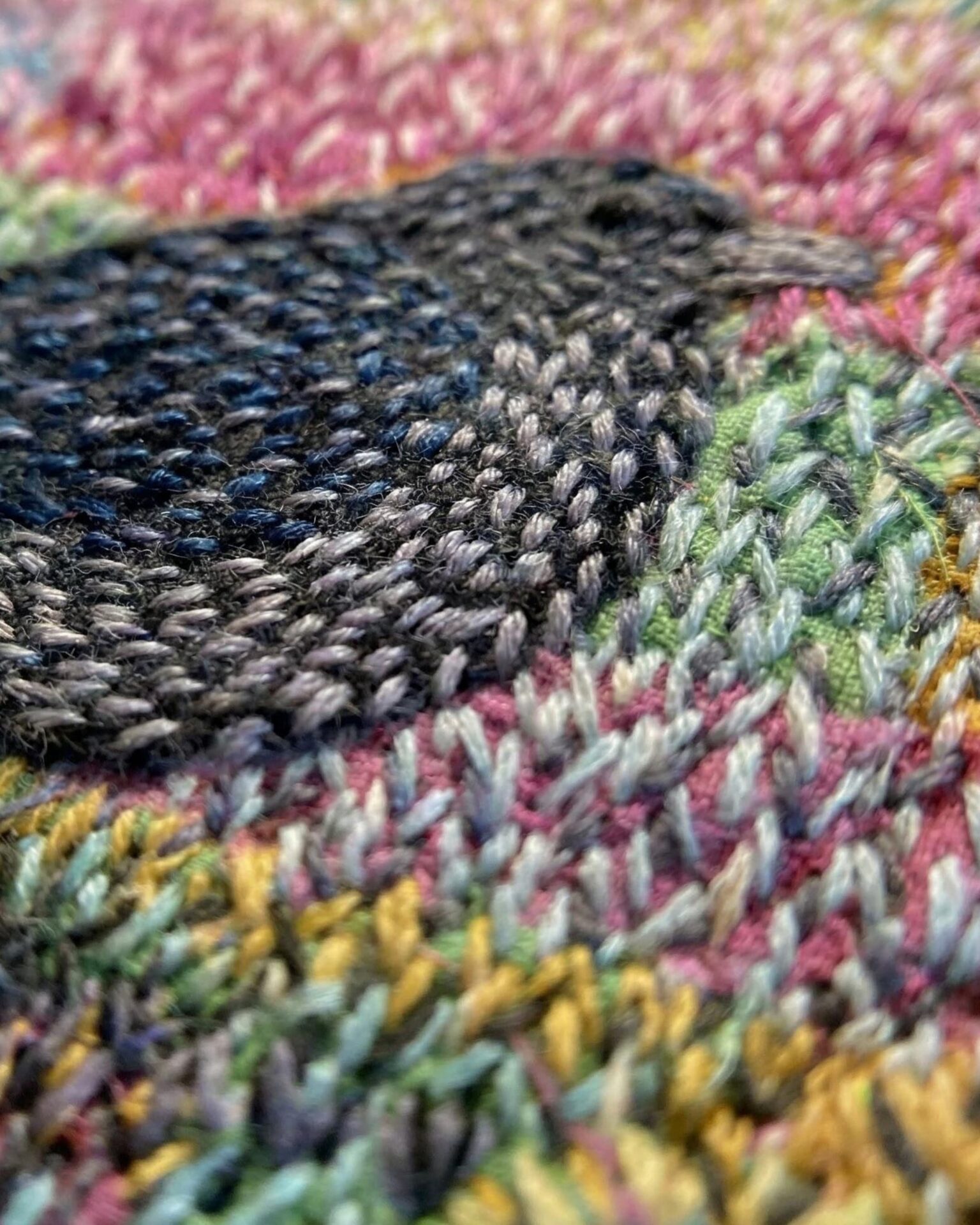
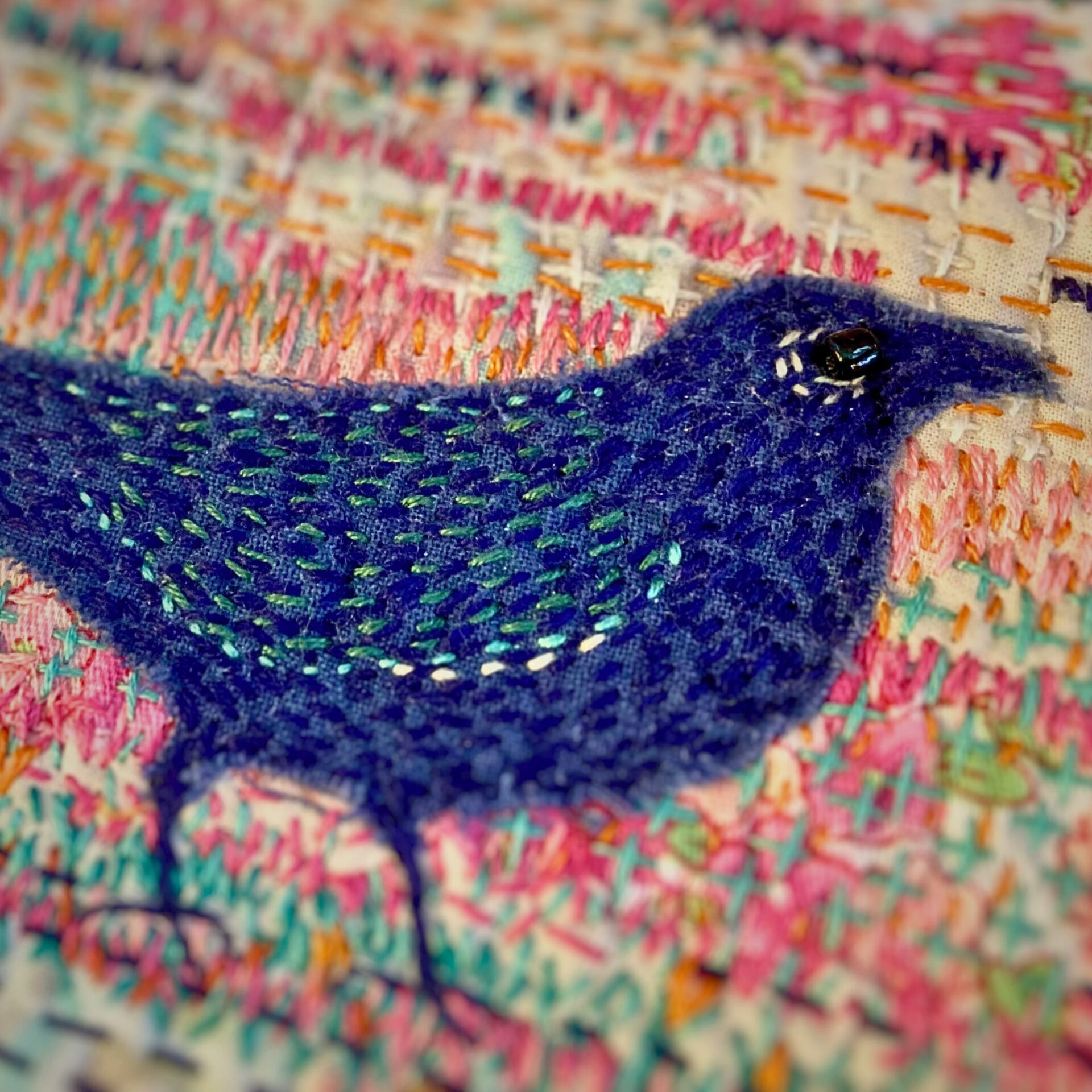
As a birdwatcher, I’ve observed several birds with feathers that flash an iridescent purple. I find purple difficult to work with, so I rarely feature it in my art. But I wanted to capture a colour I admired in nature, so my plan was to incorporate purple stitching in both the background and on the bird.
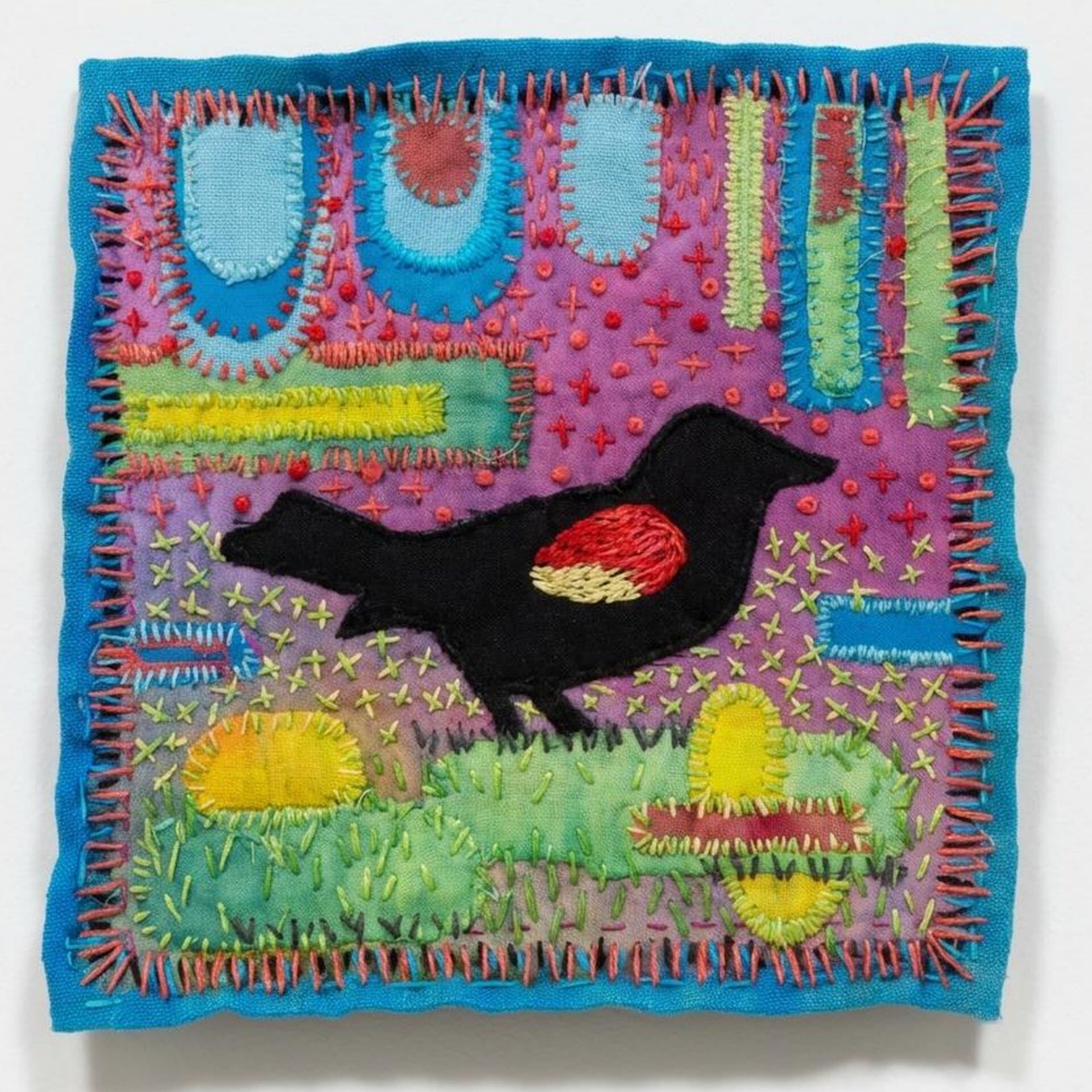
For Purple Martin, I built a collage on top of a violet blue fabric, adding magenta for warmth and bright blue and pale green for a cool colour balance. The bird is cut out of black fabric and stitched in black and violet.
White running stitch was added from top to bottom, and the other thread colors match the background fabrics. Black yarn is couched on the edge with blanket stitch, and seed beads offer extra texture and catch the light for that iridescent element.
I was happy to use purple successfully and capture some of that striking purple glow I saw in the wild.
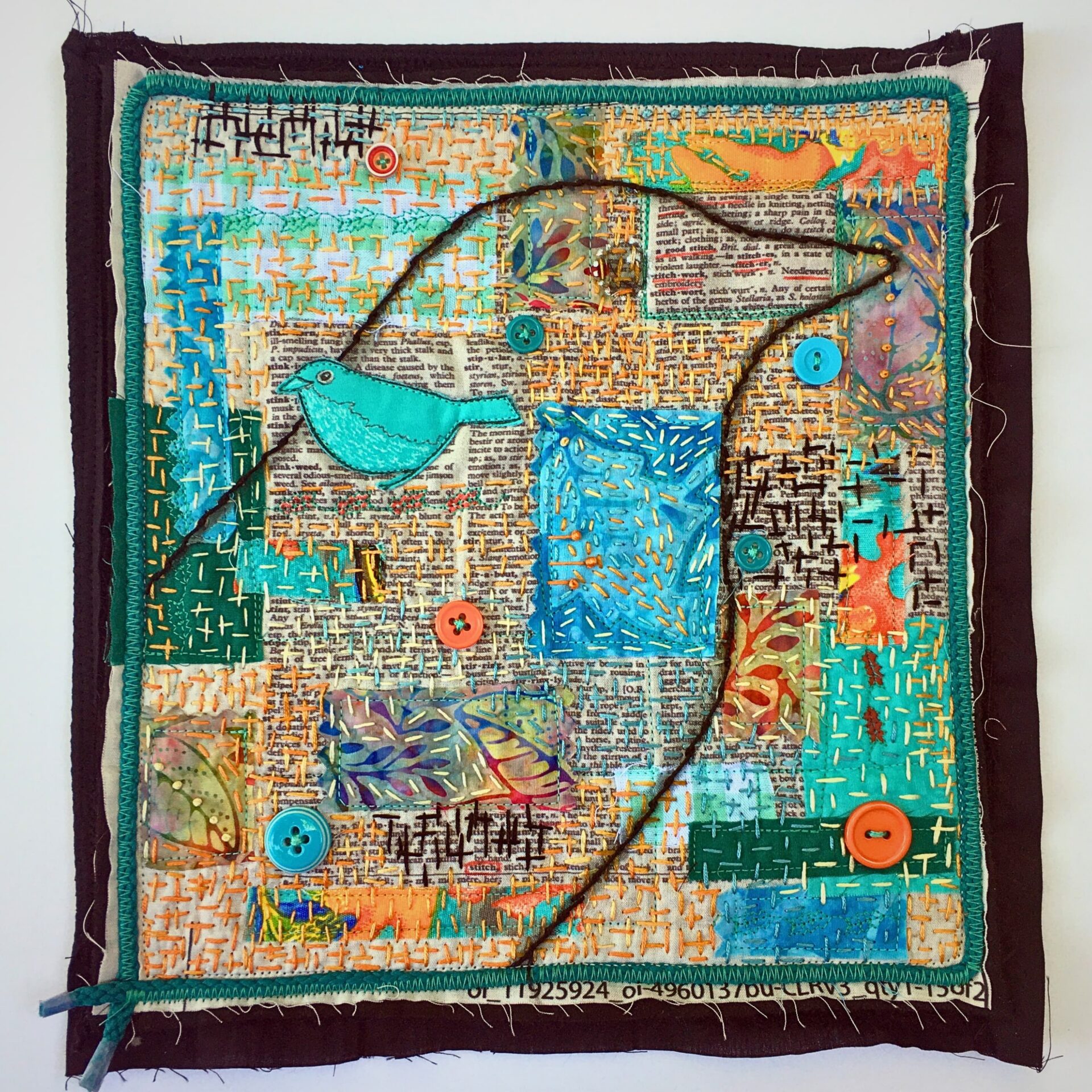
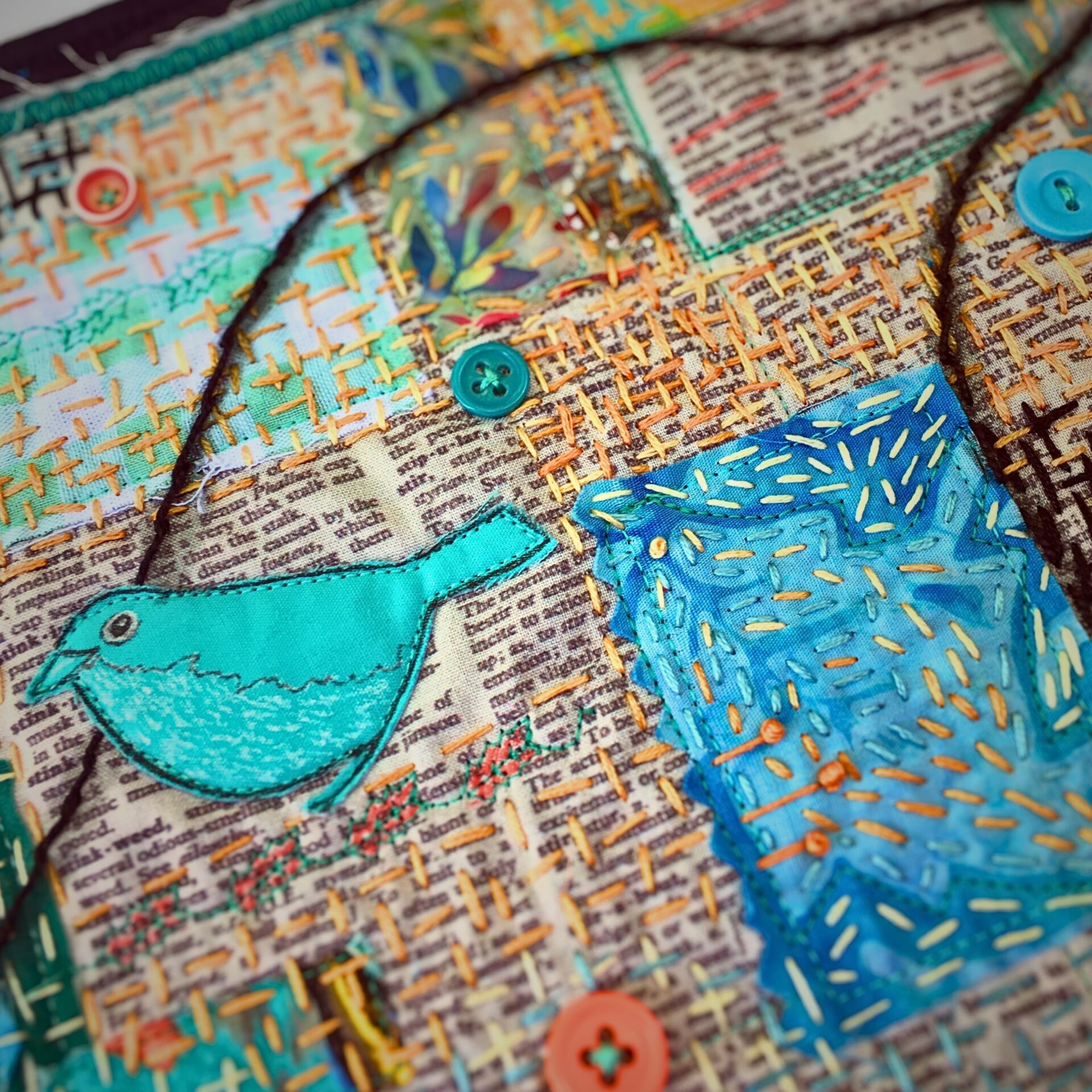
Working on fabric
Stitch Dictionary Birds explores an urban bird’s world. It’s a mix of what’s important to humans, such as knowledge and progress, with the realities of a bird’s life amongst buildings, concrete, and power lines.
In many ways, this was a transition piece from creating mixed media pieces to textile only works. For years, I had created stitched work on vintage book pages, so this piece started with a vintage dictionary page printed on fabric.
I swapped stiffer paper for soft fabric. The piece has both hand and machine stitch, and I used some paint to add details on the small bird and the eye of the big bird.
Even though this work features birds, I think of it as abstract art. It’s all hinting at the meeting of nature and human urban life.
Moving toward abstract
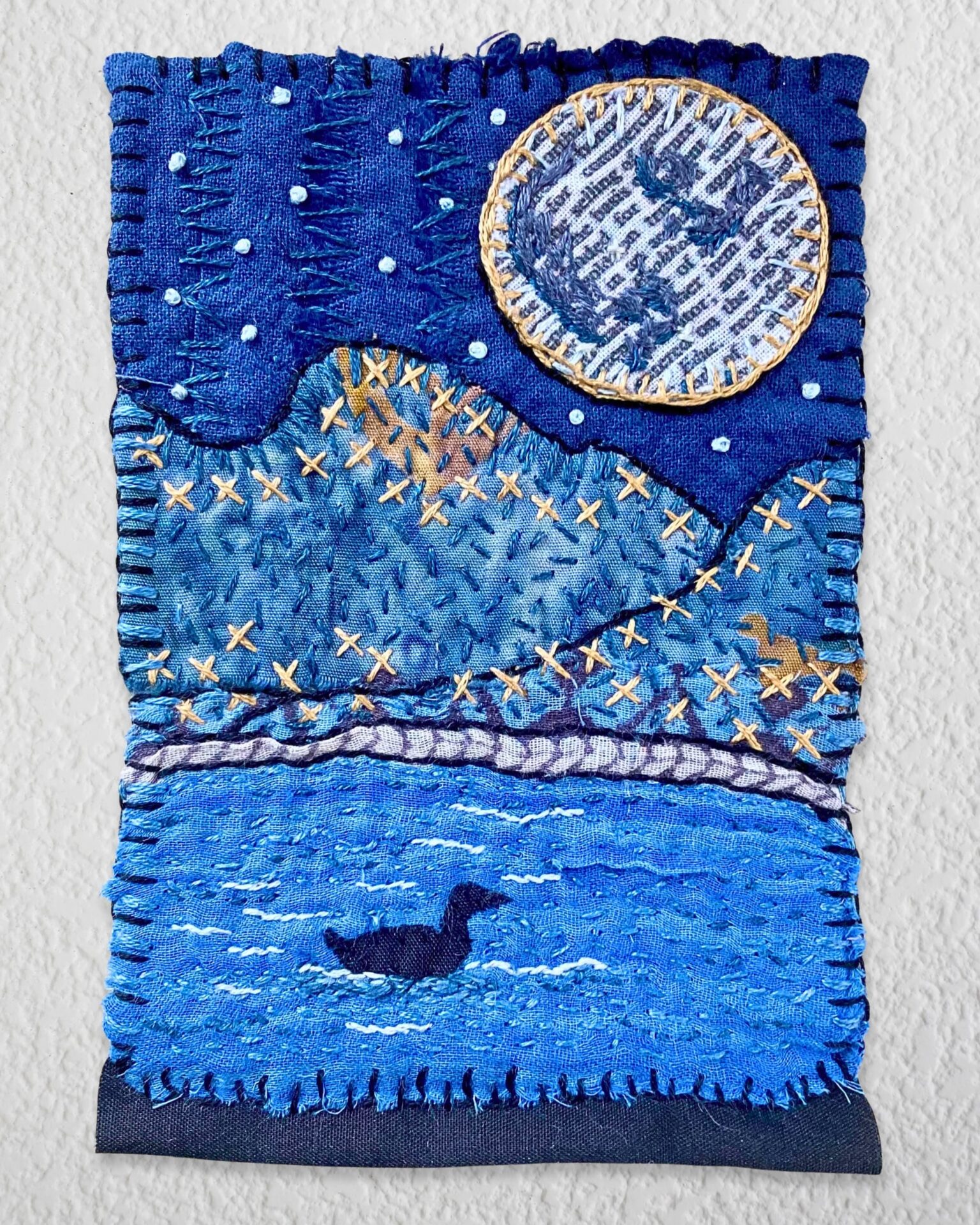
Hiking is inspired by summertime hikes in the woods. Aside from the past few years, I’ve lived most of my life amid a lush, mostly evergreen rain forest right on the edge of the water. The shapes in this work suggest rocks, trees and the feeling of being immersed in such a grand landscape.
I’ve been steadily moving my work toward abstraction. It appeals to me as I can use it as a shorthand to suggest things. For example, a simplified line shape can suggest a tree, or a rounded shape can suggest a hill or rock.
This not only allows the viewer to add their own interpretation, but it also allows me to conceal. I can create a shape that signifies something very specific to me, but the abstraction allows it to be more general and open to viewers.
Studio space
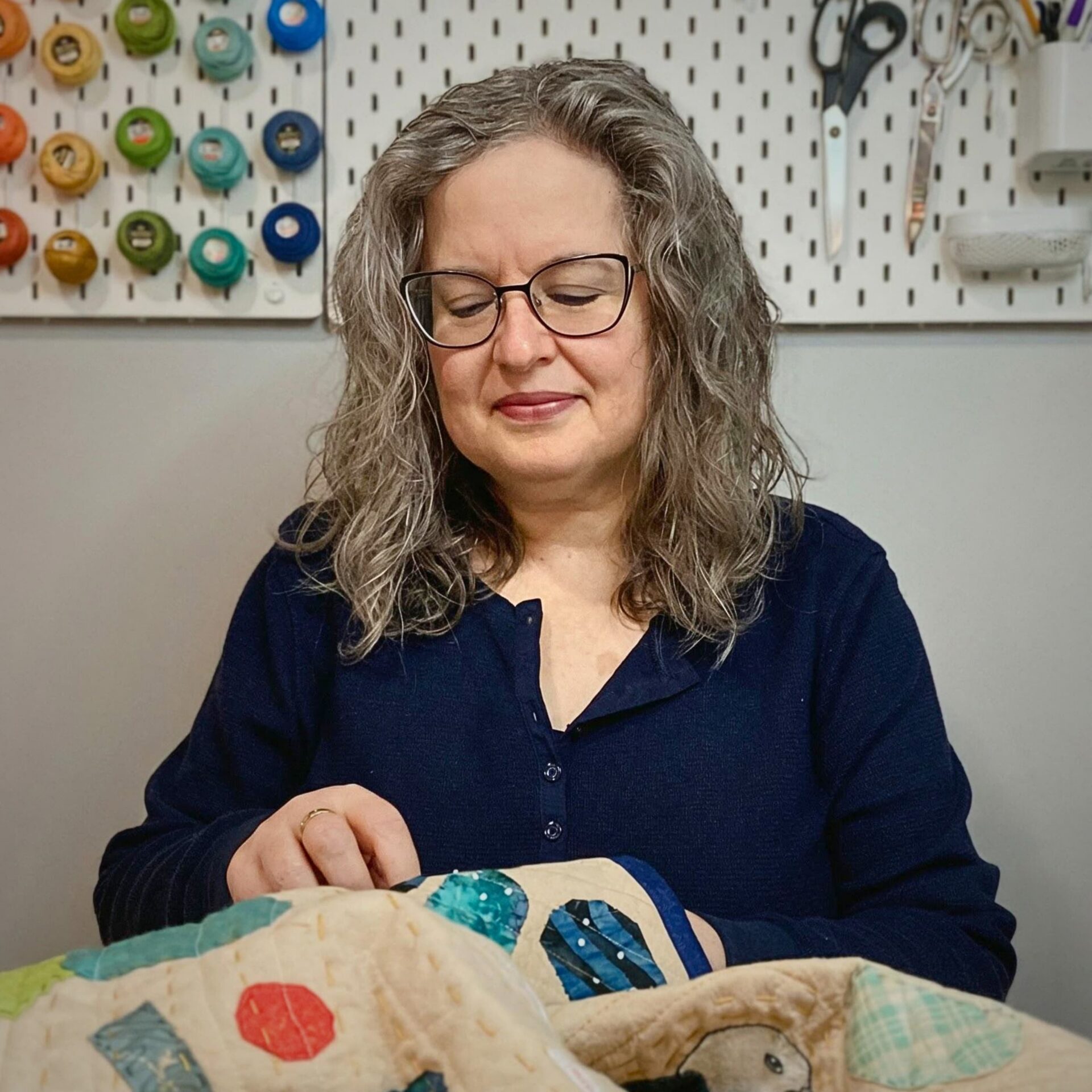
My studio space is small but well organised. I work at two tables. One is used for cutting fabric and stitching, but it also doubles as a desk. The smaller table has folding sides that I use for stitching, ironing, filming and photographing.
A vintage dresser drawer stores larger pieces of fabric, batting, felt and embellishments. A slim IKEA storage shelf with pull-out bins is handy for storing mid-size fabric pieces, as well as works in progress and completed work.
Rolling carts store my threads and needles, and I have a peg board on a wall that is ever-changing. I use it to display stitched work and to hang supplies like scissors and rulers.
I also converted a long, skinny storage closet into a space that holds a small desk with my sewing machine.
My must-have tools are a sharp needle and embroidery scissors. I want my needle to glide through fabric smoothly, so my needles must be sharp and the right thickness for my thread. My favourite pair of stork embroidery scissors is like an old friend by my side as I work.
2 comments
Gloria Lewis
This artist and this article is inspiring me to continue to experiment with slowstitching. Thank you!
Siân Goff
We are so glad to hear this, Gloria! This is exactly what we hoped it would do. Thanks for your comment 🙂