

Anita Bell is drawn to the fringes of the day, where light is neither fully here nor gone. Dawn and dusk offer no fixed lines, just shifting colours and dissolving horizons. It’s those in-between moments she seeks to capture with paper and stitch.
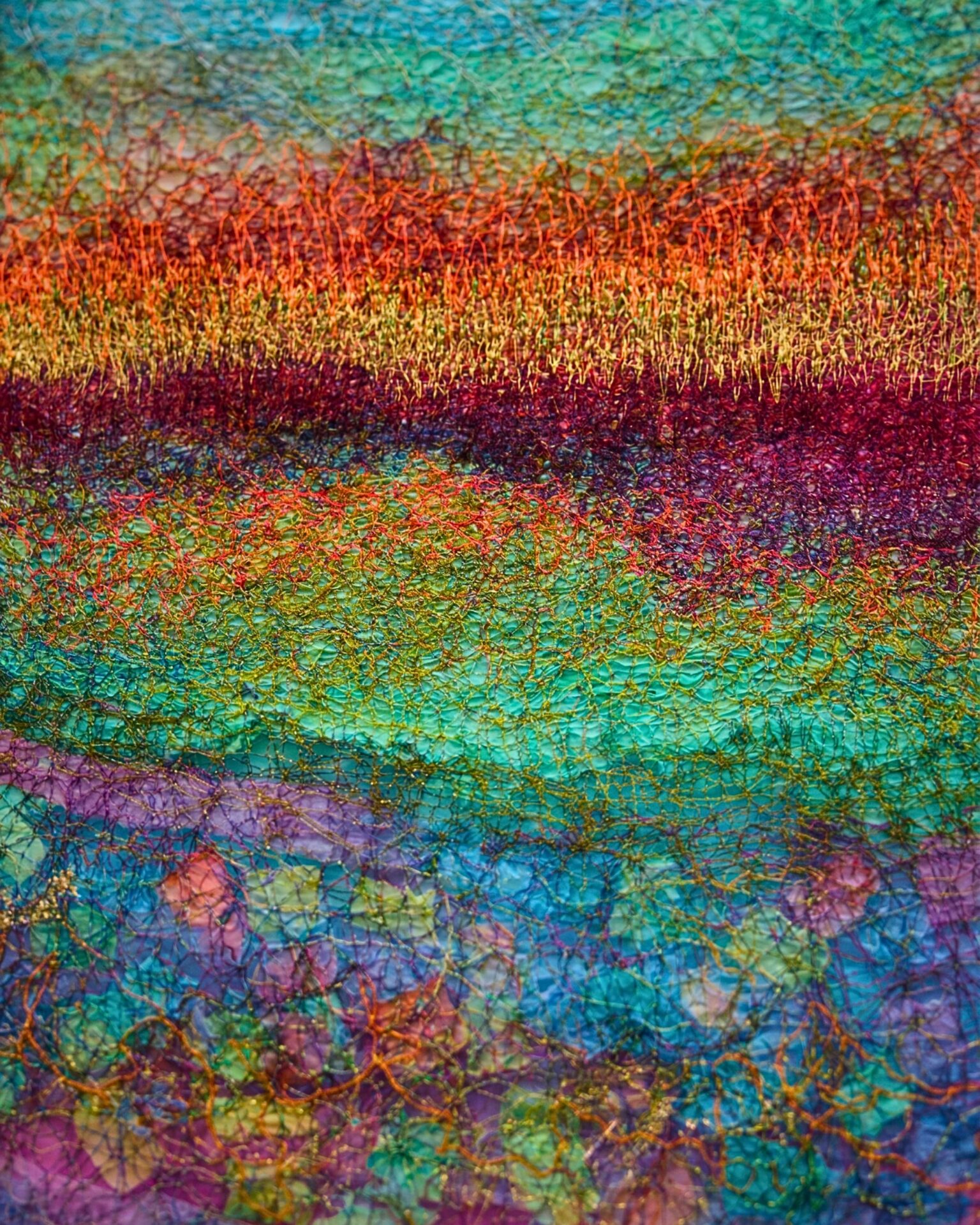
Her creative process starts by tinting papers with watercolour, letting the pigments pool and fade like the sky. The papers are torn and rebuilt into collaged landscapes. Dense layers of machine stitching help to amplify the colours and shadows of spectacular sunrises and sunsets.
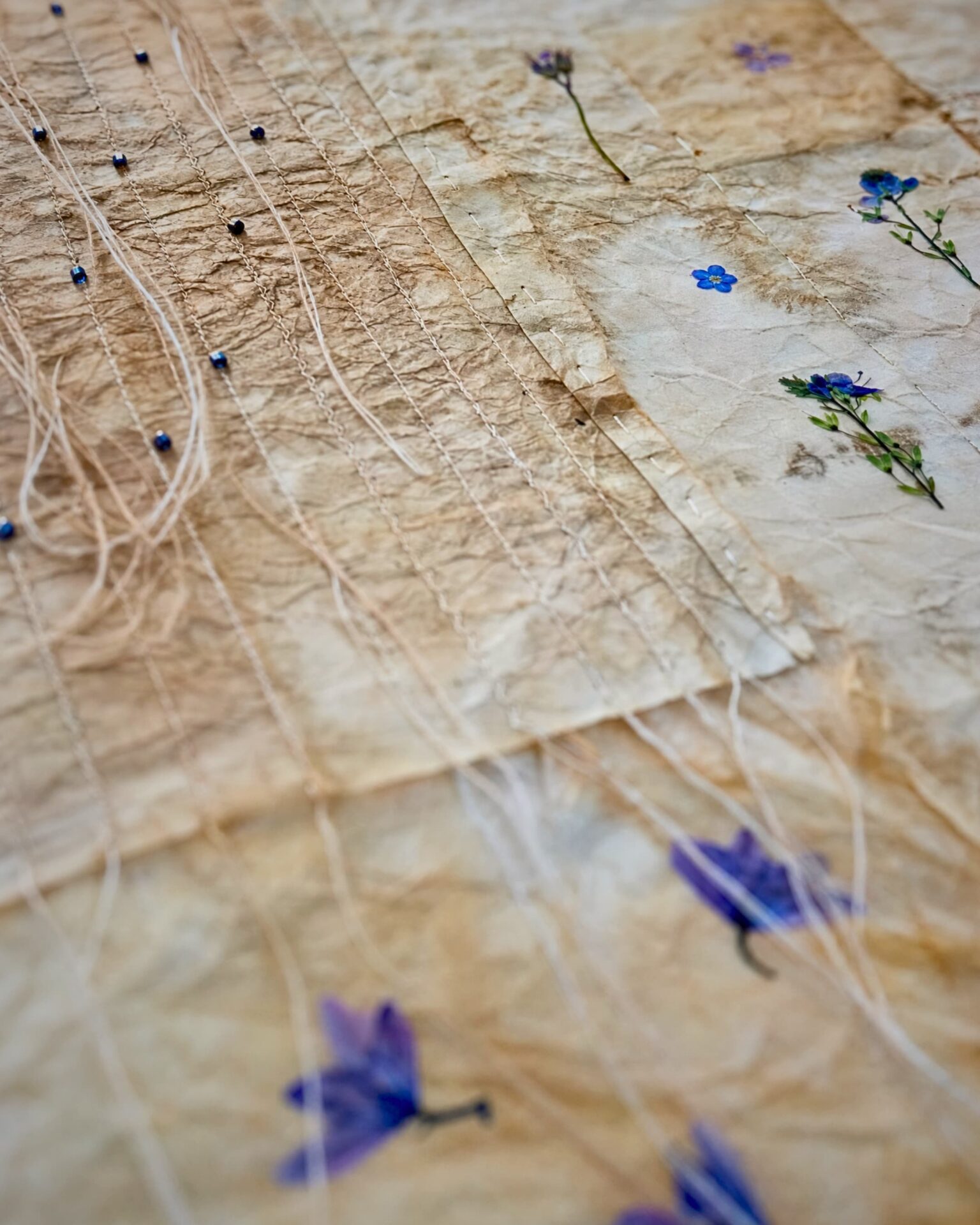
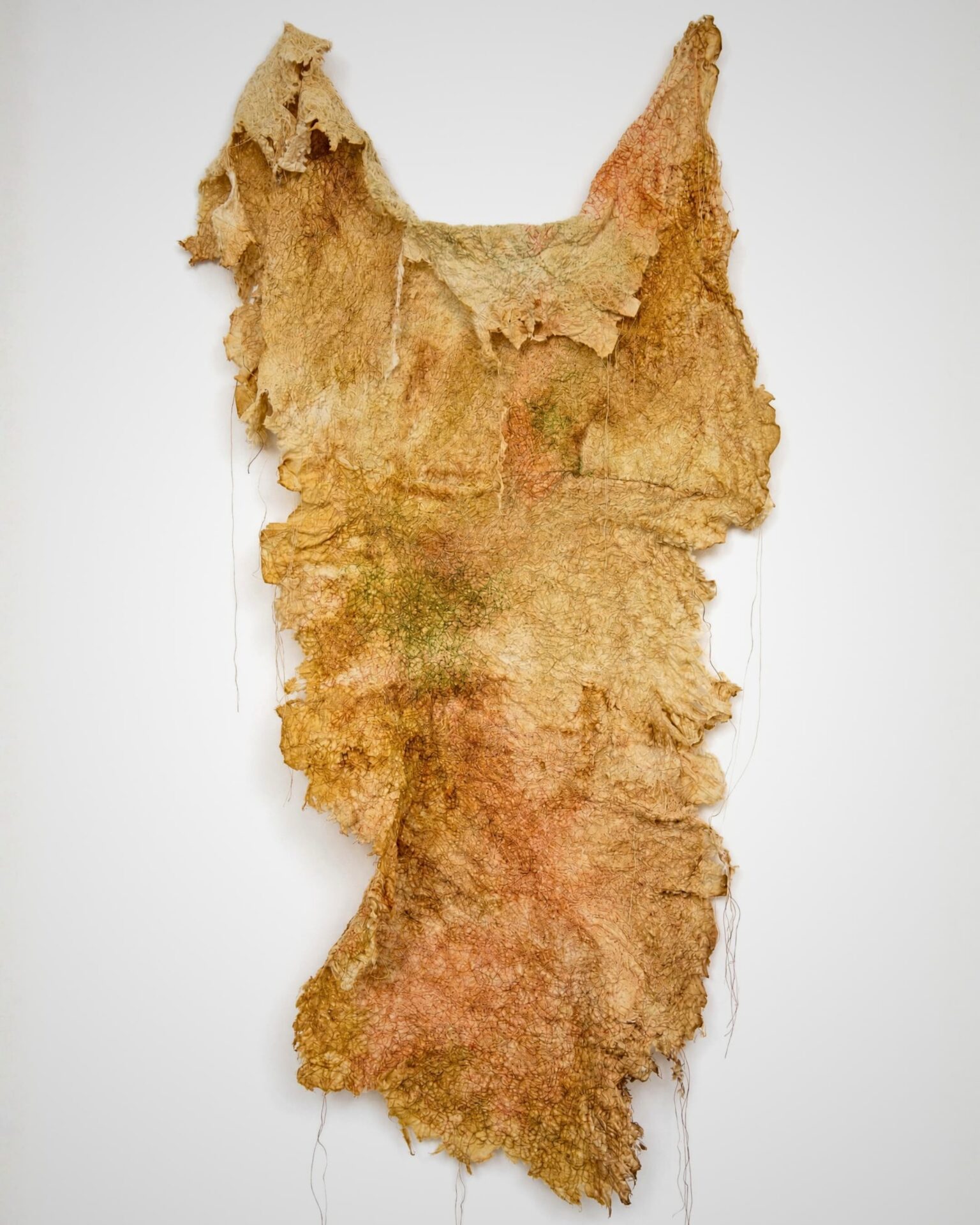
Anita is also exploring the myth of Persephone, imagining fragments of clothing she might have worn. Using the same process, layers of colour and thread suggest folds and movement, blurring the line between paper and cloth.
Discover how paper can become a powerful foundation for textile art.
Enticed by embroidery
Anita Bell: My earliest memory of stitching is making a tiny apron for a doll from scrap material and adding an embroidered face. I also made a peg bag at school and took O-level needlework classes.
My mum was partially sighted, and she did a lot of handicrafts. She especially loved macramé. All her sisters did some type of textile art, like patchwork or knitting, and an aunt on my father’s side taught me to knit at a young age. We knitted red mittens, but because I hadn’t mastered tension, my pair was huge.
I always enjoyed art at school, but because it wasn’t considered to be important, we couldn’t take examinations. So, it wasn’t until my children started school that I enrolled in an evening course at a local college to study for a General Certificate of Secondary Education in art.
After that, I went on to an Access Art and Design course at Portsmouth College, followed by completing a degree in Art and Related Arts at the University of Chichester. At the time, Carol Naylor, a well-known textile artist, was the Head of Art at Chichester, and she encouraged everyone toward the textiles department. Once I tried free machine embroidery, I was hooked.
Painting with thread
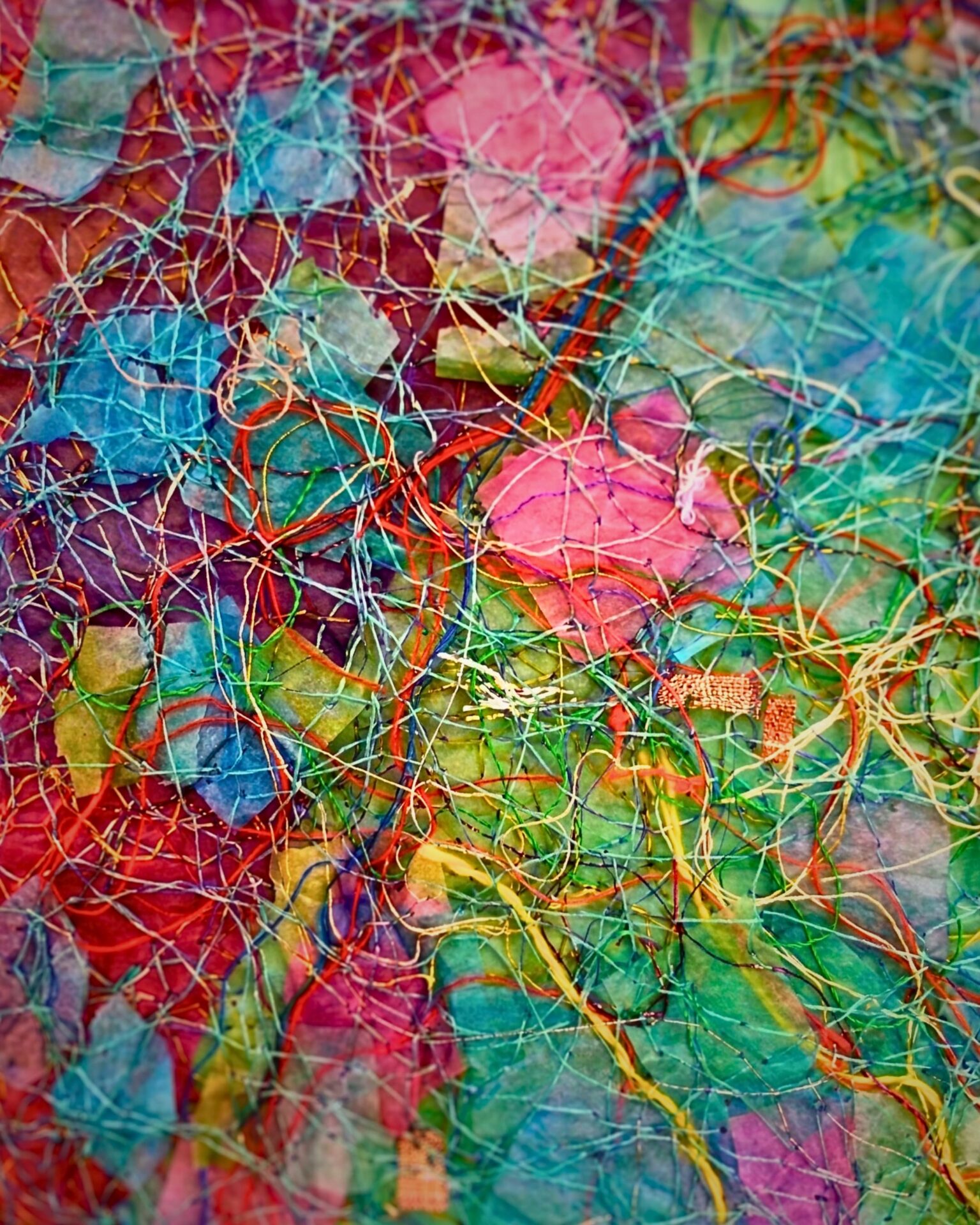
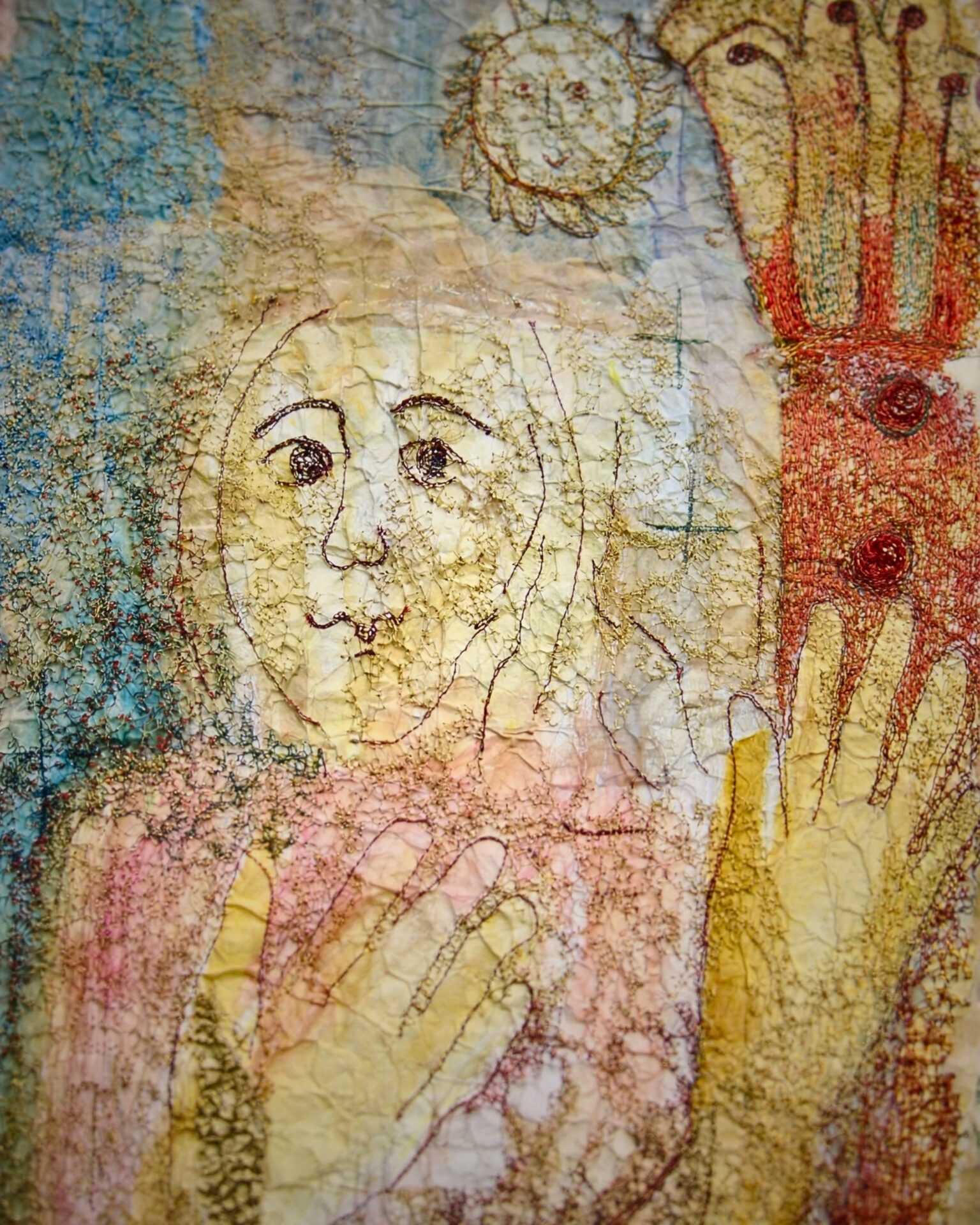
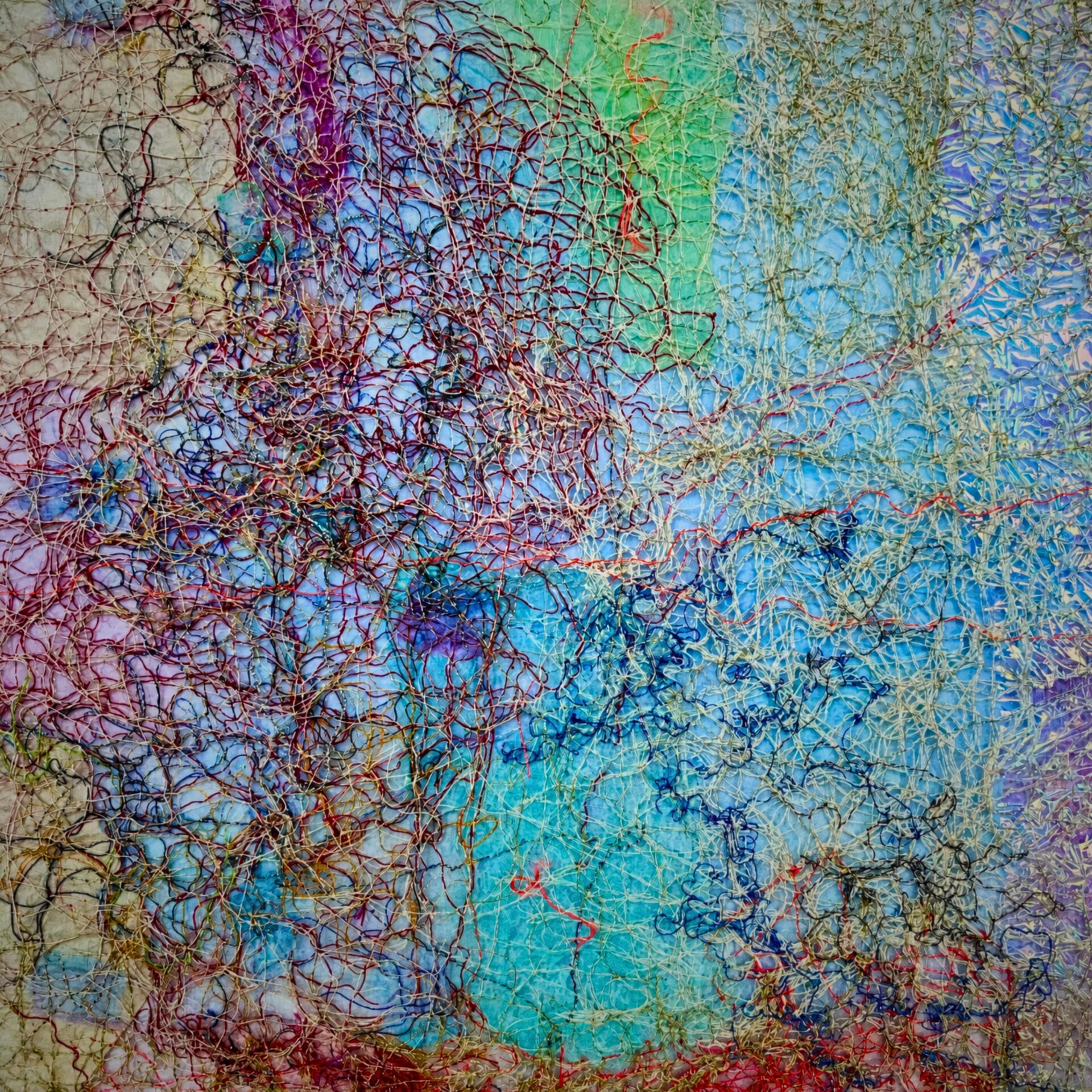
I’d describe my work as painting or drawing with thread on paper. Each work is a one-off piece made using a variety of papers, often recycled or handmade. I paint or dye the papers, and then tear, layer and embellish them with stitch.
Using this process, I’ve created hangings, framed and mounted pieces, handmade paper, vessels and books.
“Embroidery helps make colour come alive – blending threads makes momentary memories more vivid.”
Anita Bell, Textile artist
Multiple inspirations
My earliest works were inspired by the frescoes and architecture of Romanesque churches. My technique evolved to reflect the colour in the natural pigments, along with depicting the peeling paint and faded imagery.
More recently, my art is inspired by text or stories. Persephone’s Dress is based on the Greek myth that, along with many other readings, explains the changing seasons. It explores ideas about the fragility of the natural world, femininity and vulnerability.
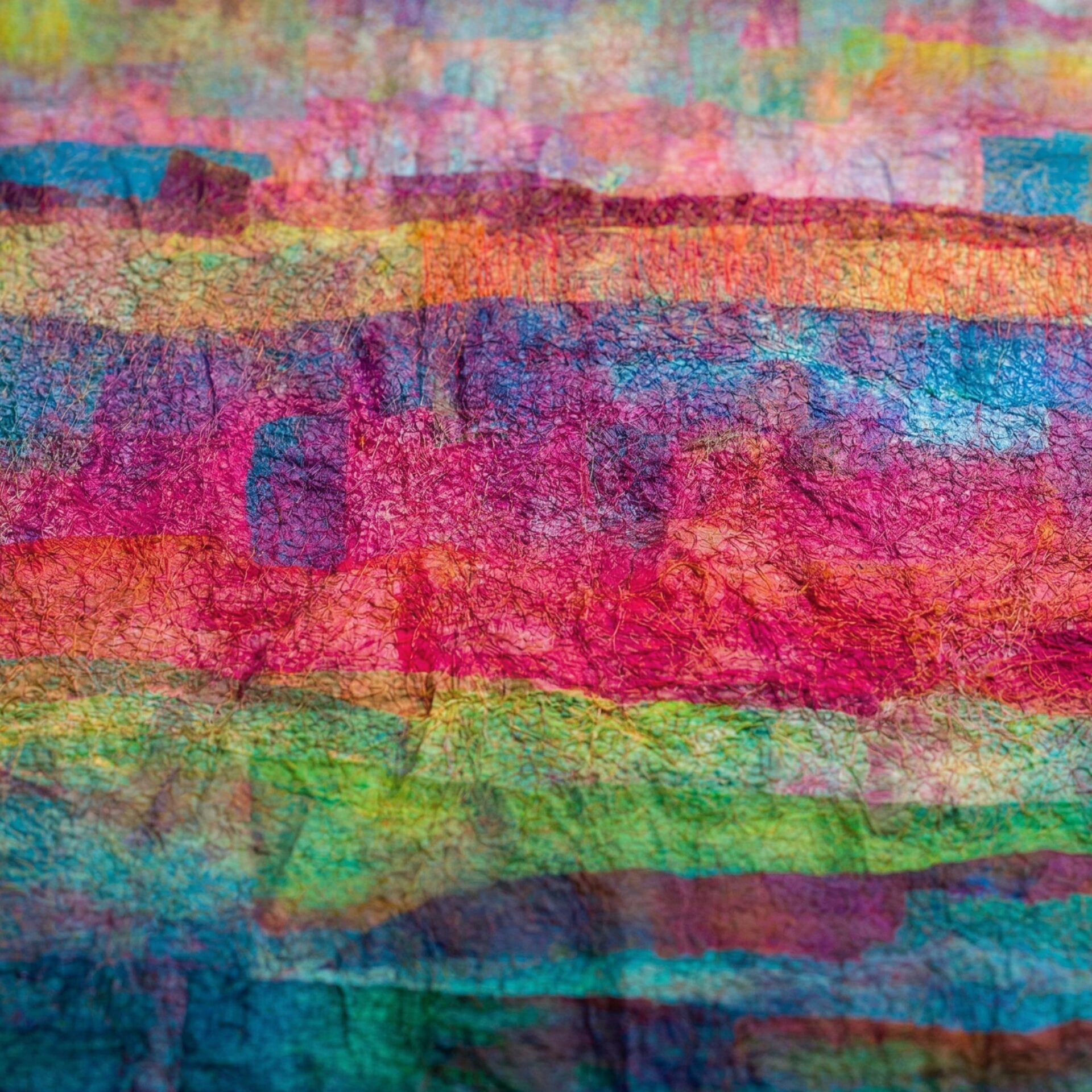
My Borrowed View and Colour Field series evolved after a visit to Monet’s house and gardens. I sought to capture the reflective qualities of the water. The underlying Japanese influence left an impression of tangible colour and vivid views.
I looked at Japanese garden techniques, particularly ‘shakkei’, which means ‘borrowed view’ and ‘ikedori’, meaning ‘captured alive’.
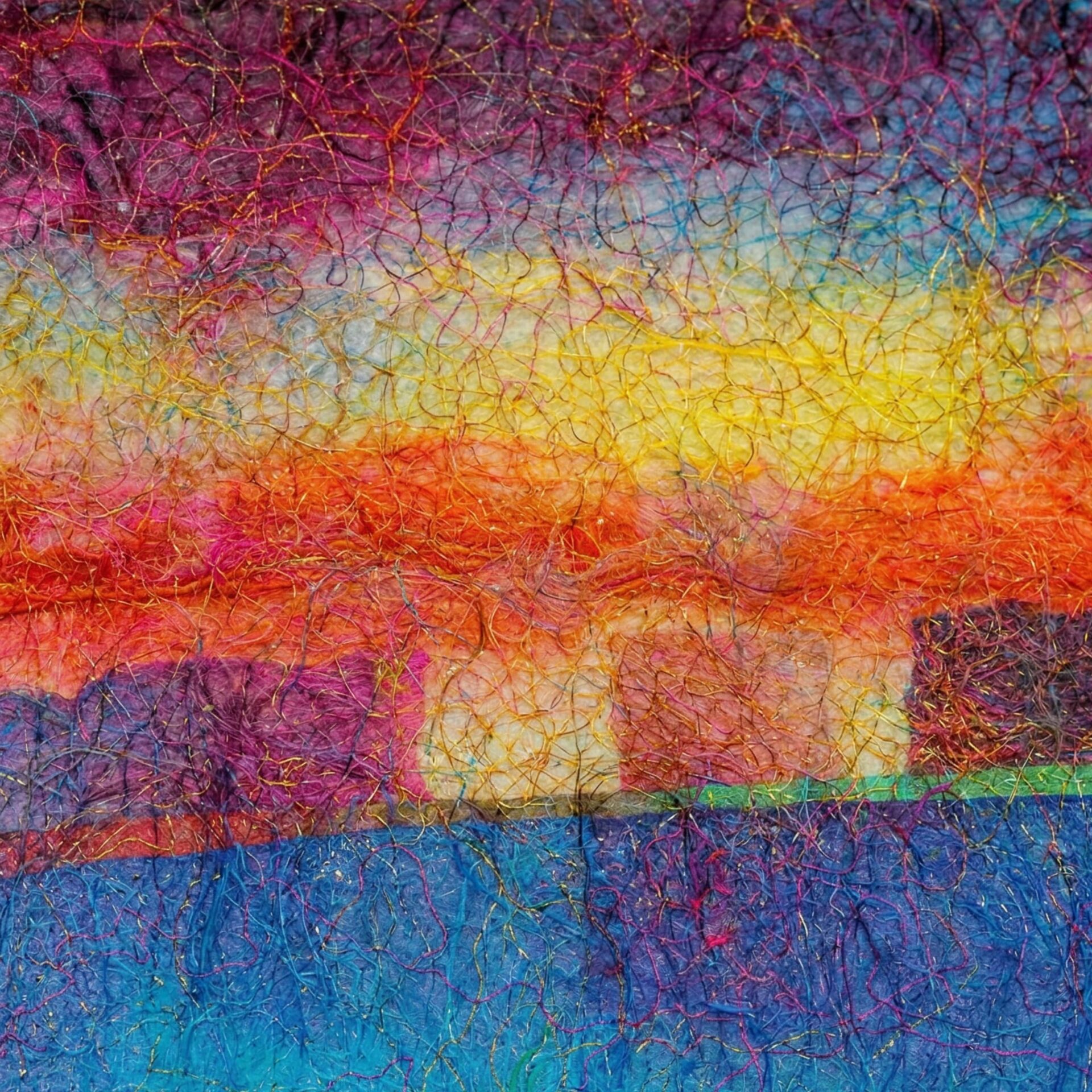
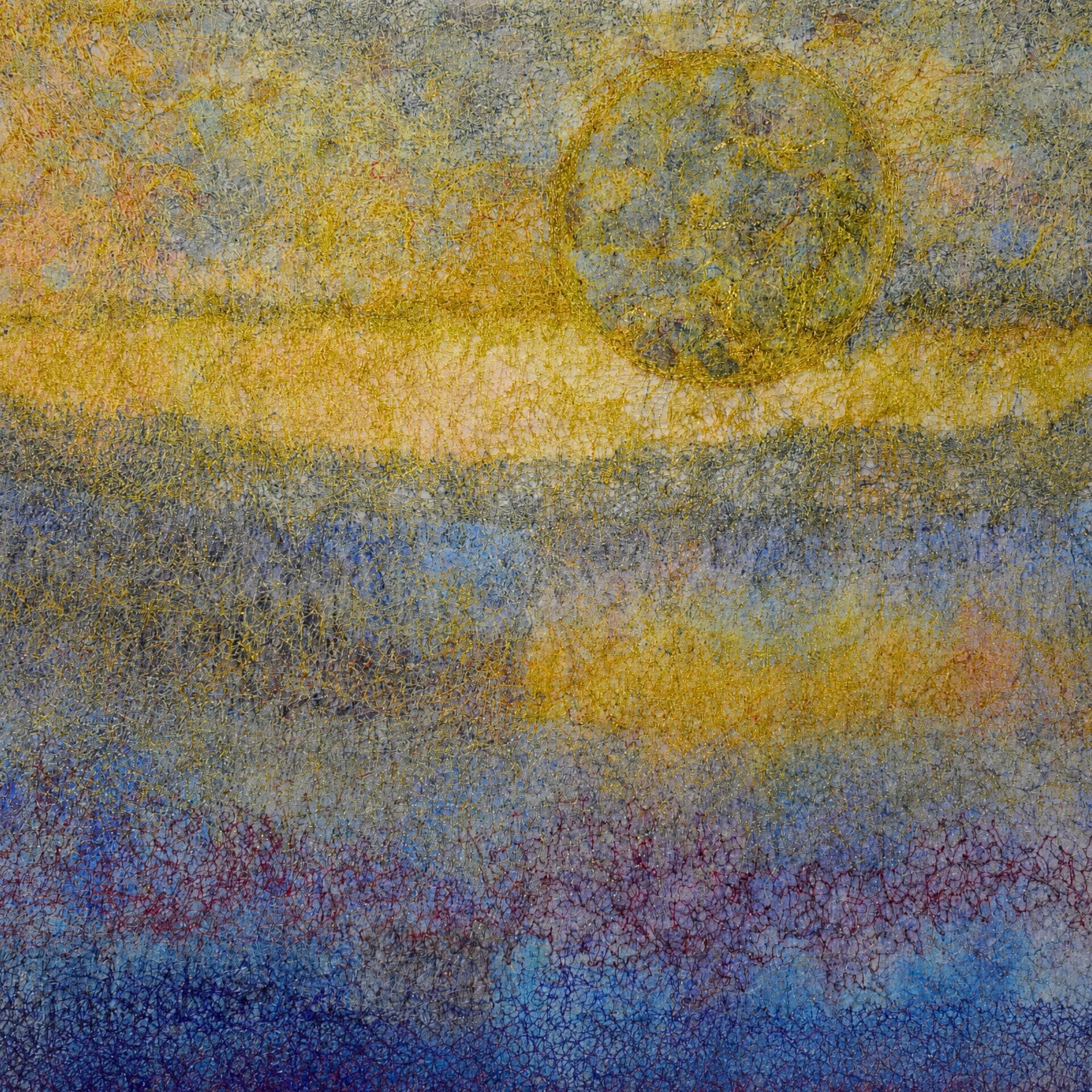
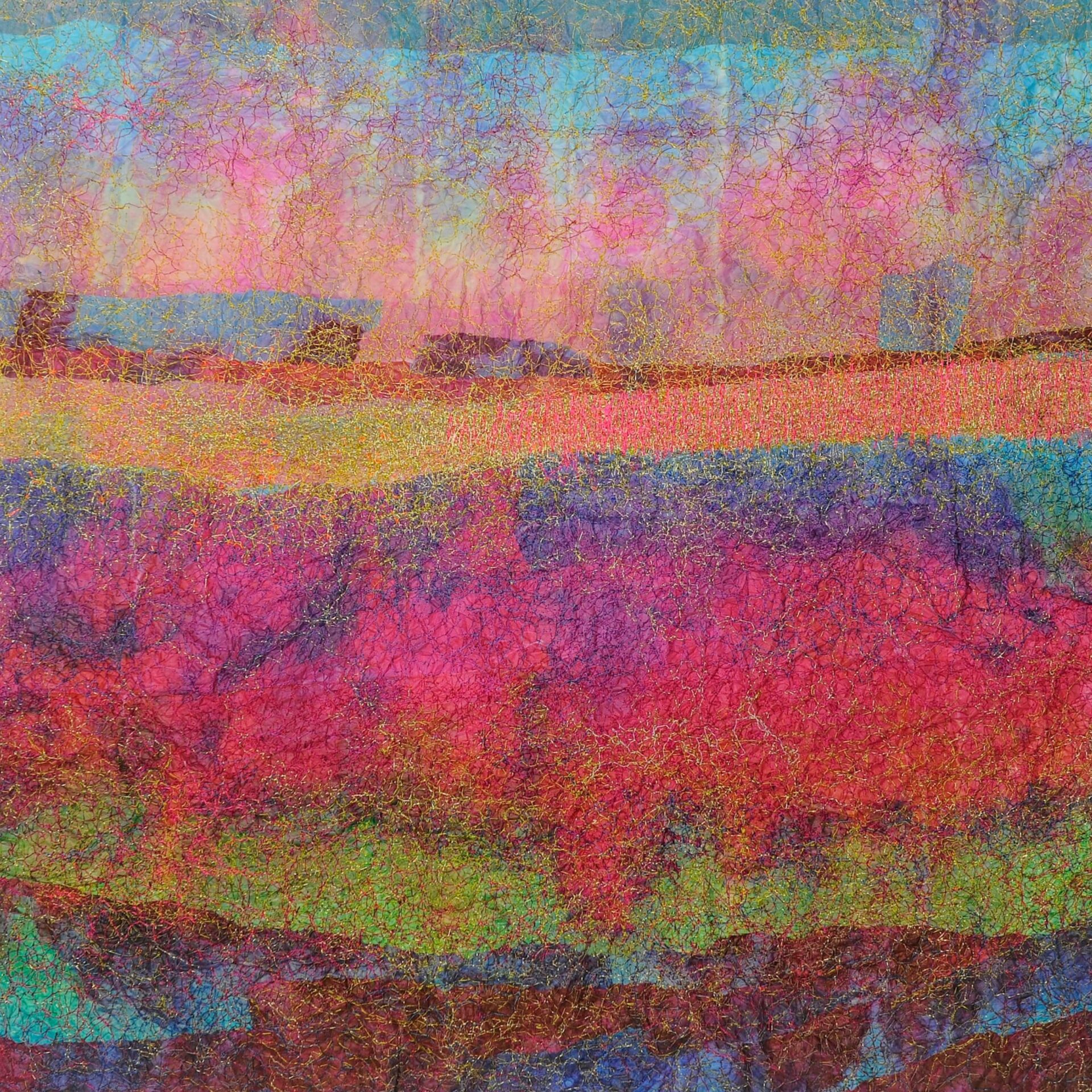
Horizons and Skies is a continuing series of artworks looking toward the horizon, an imaginary line where earth or sea meets the sky. Those pieces reflect the changing light, particularly at dawn and dusk. This series also led to my Fired Earth and Imaginary Landscapes series.
Working in series
I have many ideas, and sometimes while working on one, I’m inspired to do something else. Or I might spend a whole day on one piece, only to feel like I haven’t taken it forward. At those times, I find it’s best to leave it to another day and come back with fresh eyes.
I also tend to work on several pieces at the same time and rotate them. Some pieces come together quite quickly, while others may be in a pile for many years before I know how to finish them. Other pieces grow steadily as I add bits I think they need along the way.
Sometimes when working on something quite large, I may end up only being happy with one section, so I cut it up and go from there.
“I like working in series because there is never just one response.”
Anita Bell, Textile artist
Layers of process
There are quite a few steps in creating my art. After coming up with an initial idea, I colour or make the paper, then tear and reassemble it into a collage. I add free machine embroidery, followed by hand stitching.
I mostly work intuitively and through making samples. I don’t use a sketchbook as such. I tend to sketch or paint on odd bits of paper, add notes, and then put them in a pile. Sometimes I put them together in a sketchbook.
When I’m inspired by something, I set about researching and gathering lots of information in mind map styles with lots of lists. I use a highlighter to pick out the main ideas. I love researching, and it can take quite a bit of time.
For example, for my dawn and dusk works, I observed many sunrises and sunsets, and took countless photographs, often just seconds apart. I made watercolour studies to try to capture the atmosphere and constantly changing light of a fleeting moment in time.
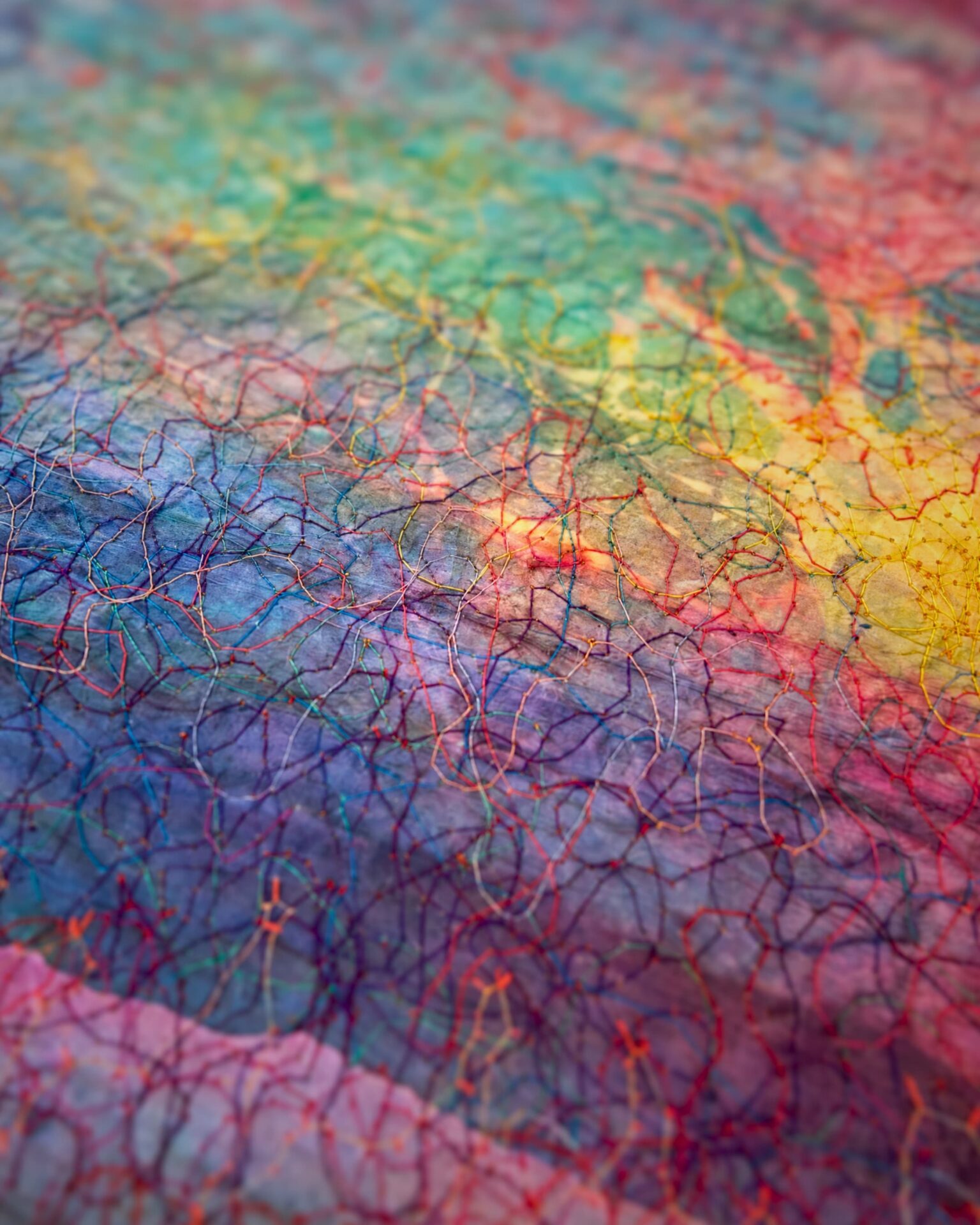
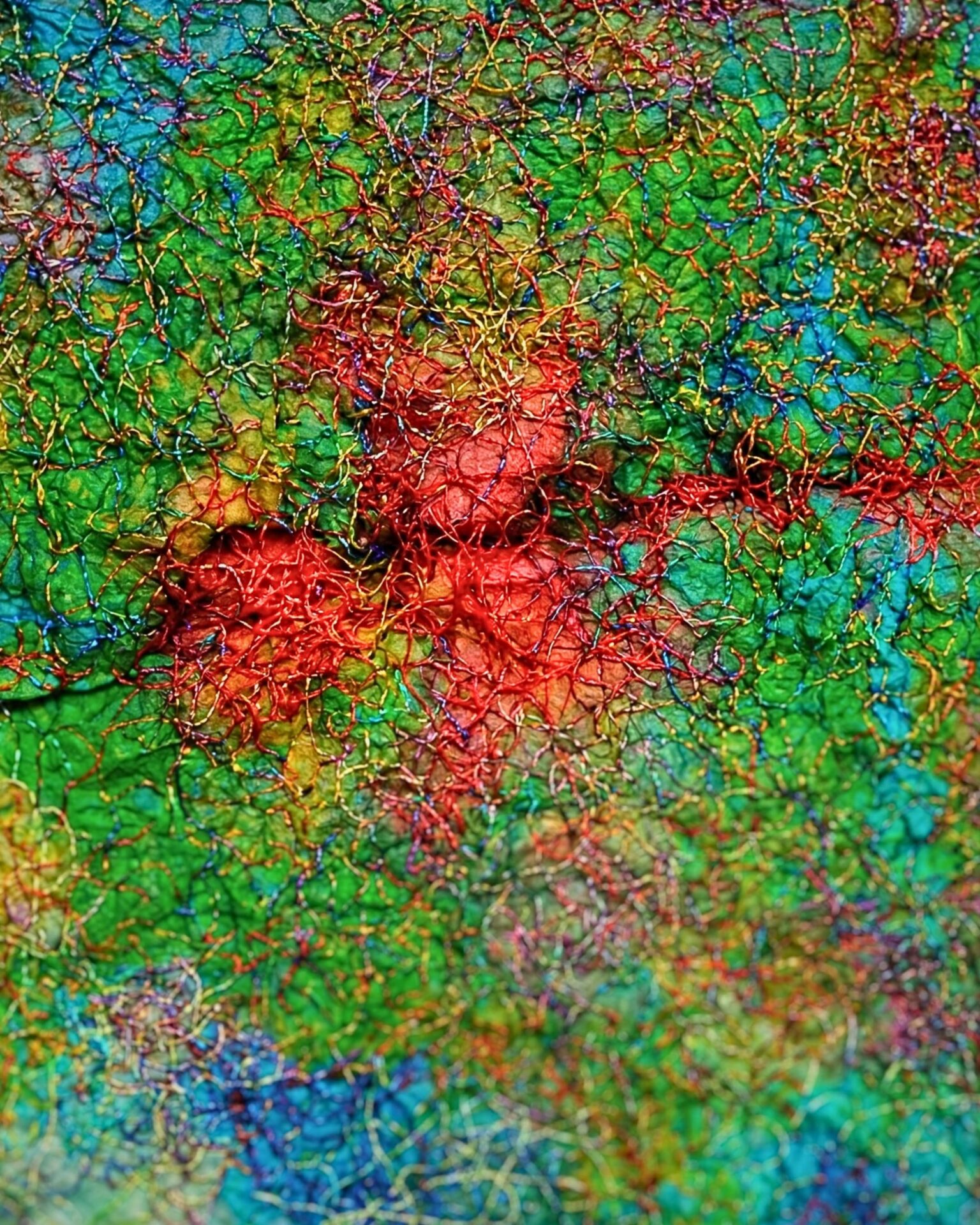
Then, using a thin thread as a medium, I transfer those ideas onto paper. Details are drawn out using dense lines of stitch that are overlaid like paint to build up depths of colour.
Wonderful watercolour
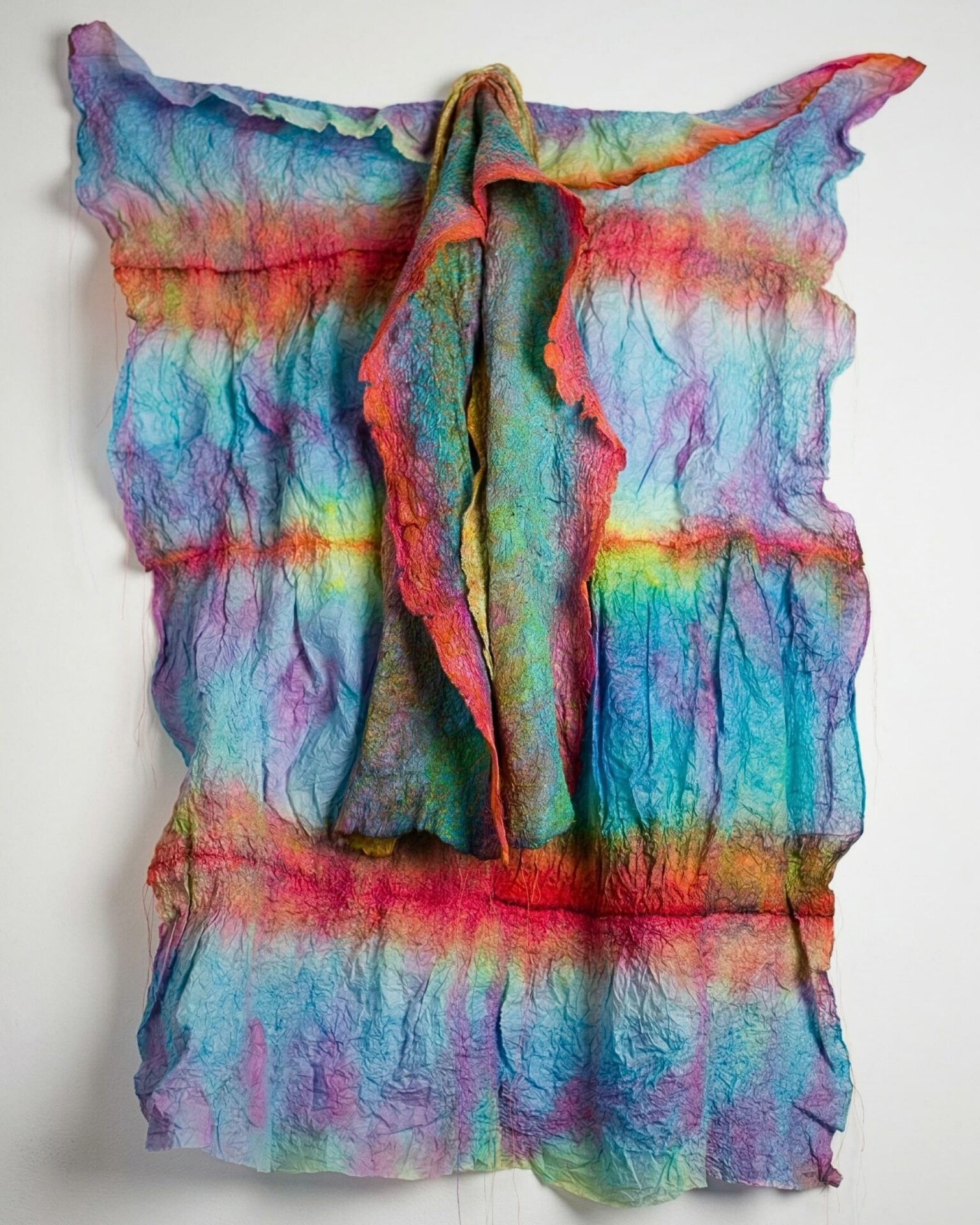
My favourite colouring medium is watercolour, simply because it’s transparent and I love the way it stains tissue paper. It’s simple to use and does not require lots of cleaning up afterwards. I can also overlay the painted papers to change the colours.
Mainly, I use Pelikan brand watercolours. I water them down quite a lot, so they last a long time. I also take them on holiday if I want to sketch. I’ve also tried watercolour in tubes, and I recently found some liquid watercolours in large bottles at a charity shop that have been quite successful.
The watercolour paint makes the paper cockle slightly, adding to the texture of the work, and the layers of stitching creates even more depth.
Garden dyes
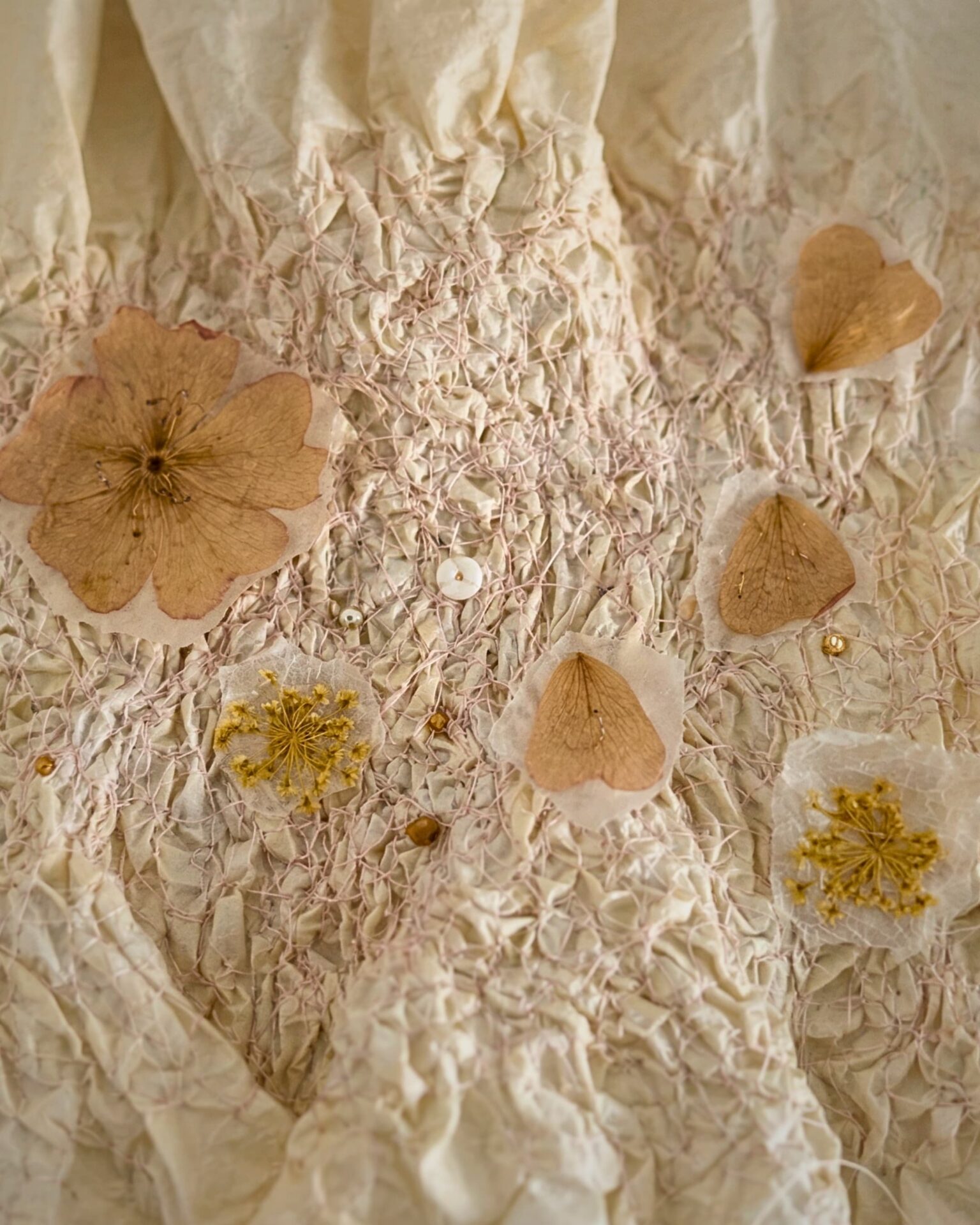
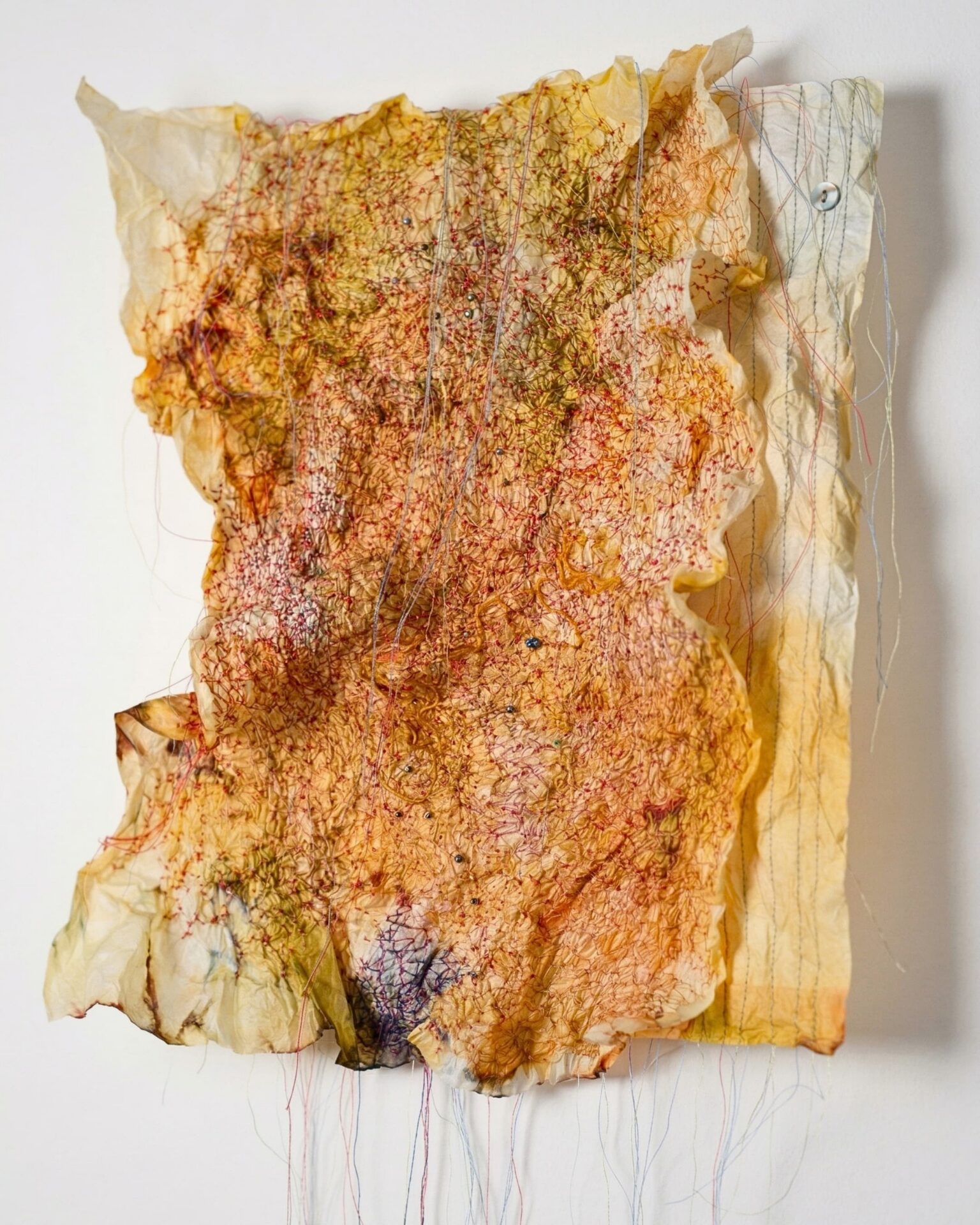
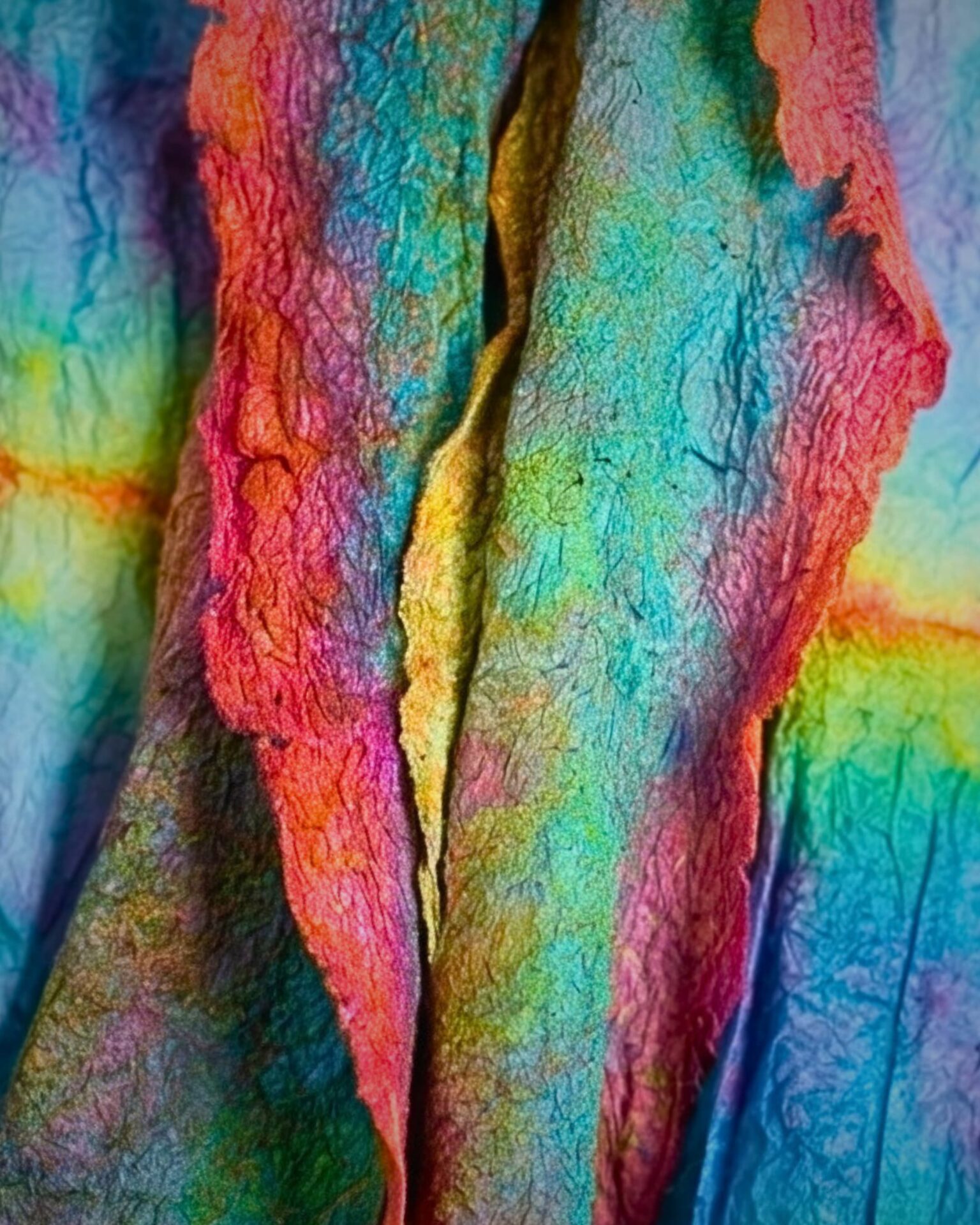
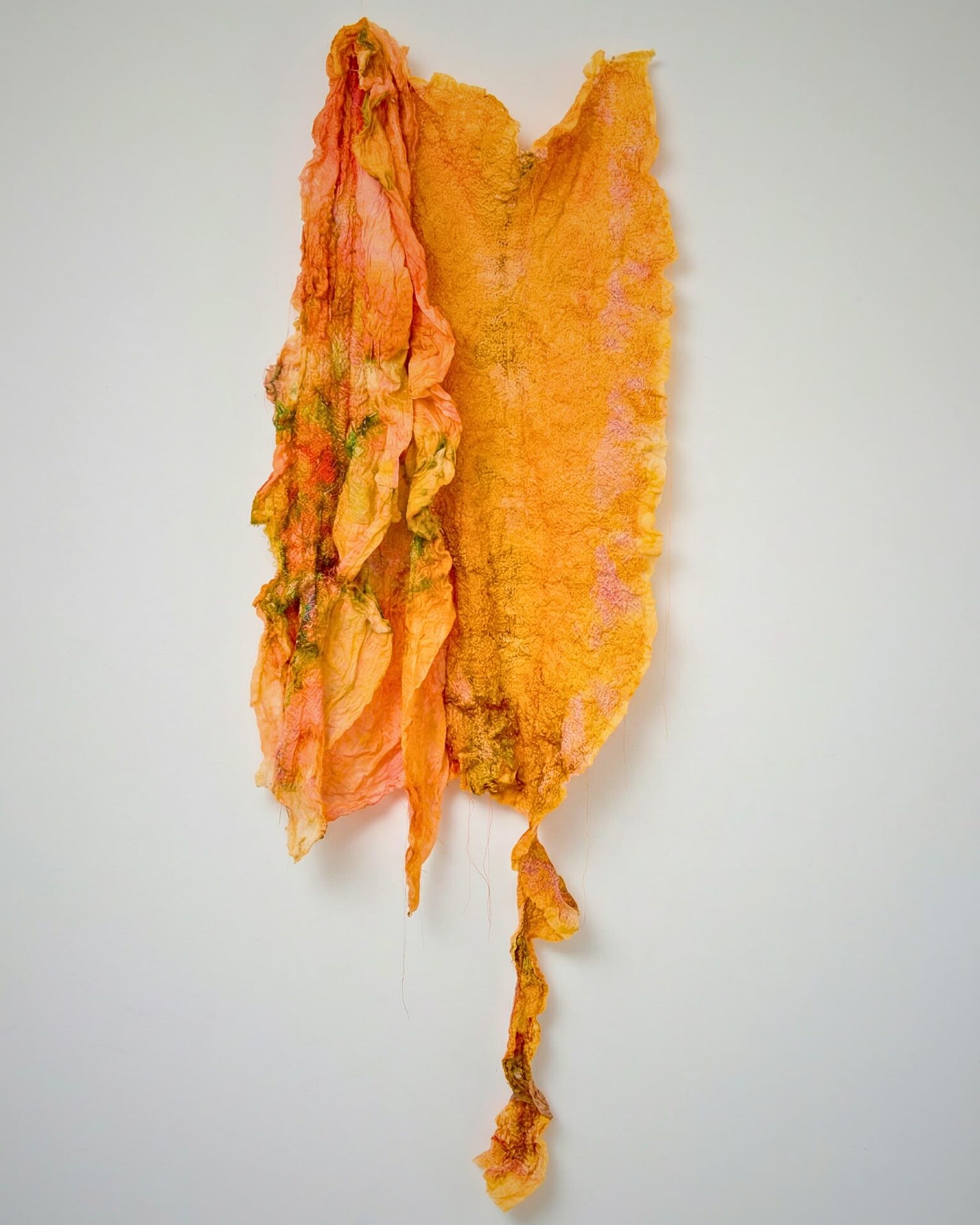
For my Persephone’s Dress series, I work with natural dyes created from plant materials from my garden on paper, fabric, threads and fibres. I like the soft apricot from brown onion skins and soft greens from nettles. At the moment, I’m enjoying experimenting with dark red hollyhock flowers.
I use solar dyeing in jars on the window ledge of my studio, as well as buckets in the greenhouse. The goal is to not use chemicals or energy to create my colours.
To add interest, I use shibori techniques like Itajime (folding and dipping the papers), or I scrunch them quite tightly so some areas remain pale. At times, I’ll overdye the papers in another colour after they dry.
Stitching on paper
I try to use as much recycled paper as possible, but I do buy white acid-free tissue paper and handmade tissue paper from online art suppliers. I also use sustainable plant papers made from plants that are harvested and then regrown to provide another crop.
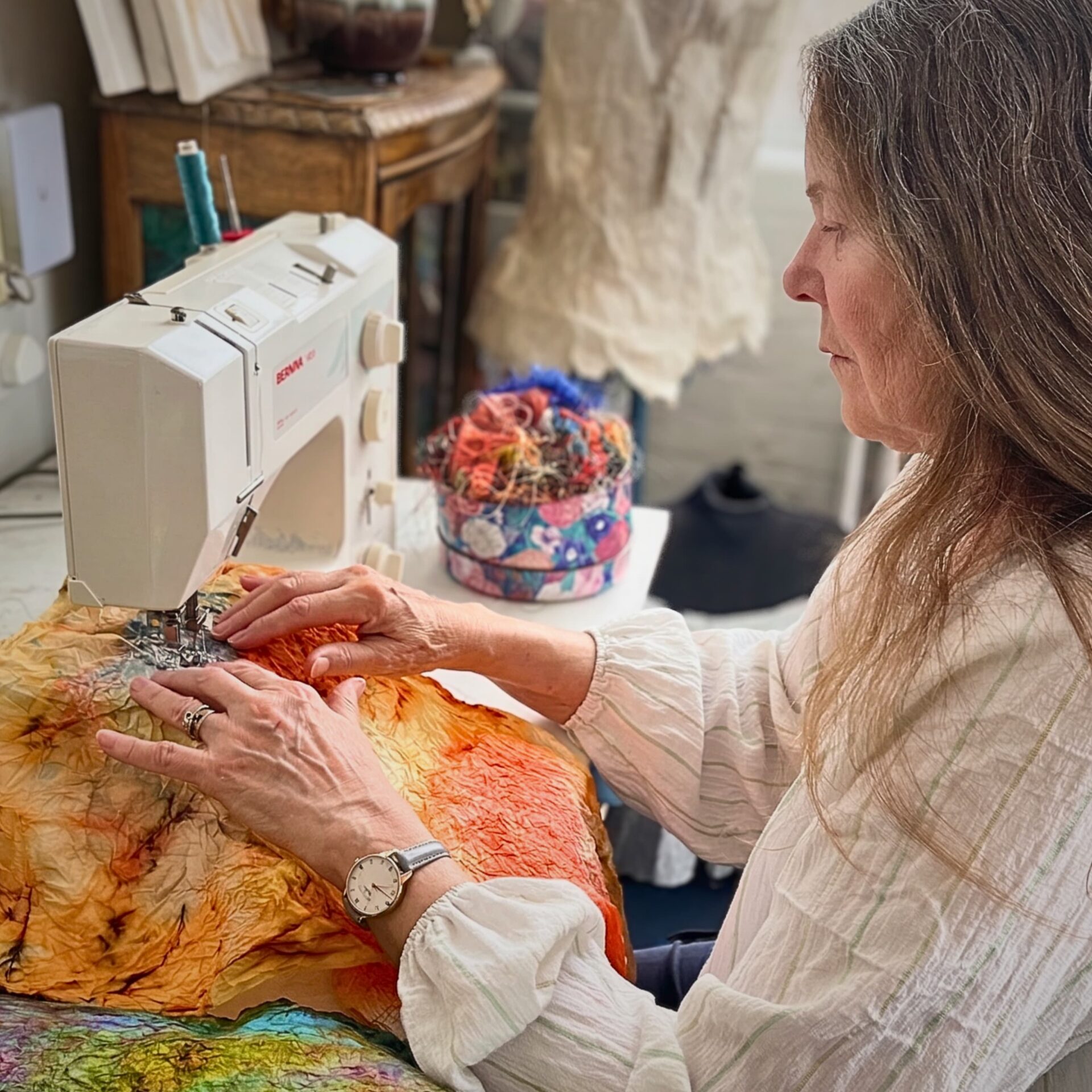
My Bernina 1001 machine is 30 years old and still going strong. I bought it while I was at university. I also have a Bernina 1005, just in case.
I feed the paper into the sewing machine, holding it on both sides. I’ll sometimes use a round wooden embroidery frame to hold the paper taut if I’m working on a particular area or making a repair.
The stitching gathers up the paper and can shrink it by about a third, so I must bear that in mind. If I get a tear, I add paper to the top or below and carry on stitching.
I’ll also sometimes deliberately distress and tear the paper and then make visible repairs using darning, either by machine or by hand.
“By stitching directly on paper, I create a mesh structure, making the paper more fabric-like and stronger.”
Anita Bell, Textile artist
Bits & bobbins
I use an embroidery foot, and I rarely change my needles. I’ve used many types of needle brands, like Smetz and even needles from a local supermarket. I’m currently using some Bernina needles I bought on an auction site.
I mainly use Madeira threads, usually a rayon 40 or 30. They kindly sponsored me during my degree and gave me a lot of threads. The choice of colours is incredible.
For bobbin threads, I use up any threads I may have obtained from charity shops or auction sites. Sometimes I work double-sided and turn the work over and stitch from the back. This means I don’t have to keep changing the colour on top. Mostly I wind metallic thread on the bobbin and work upside down.
I’m excited to help Stitch Club members experiment with stitching on paper. They’ll use a variety of papers and hand embroidery stitches to create abstract samples. I’m hoping they’ll enjoy stitching on paper and be open to experimentation and play.
Their samples might also prompt new ideas for future work.
“Sampling is a great way to take the pressure off thinking you need to create something spectacular.”
Anita Bell, Textile artist
Knowing when to stop
With so much stitching, it can be difficult knowing when to put the needle down. If I have a deadline for an exhibition, I know I must finish a piece. But without a hard deadline, a piece could lie for ages waiting for me to return. It’s also not unknown for me to further work on exhibition pieces after having them returned to me.
I don’t have set rules as to when a piece is finished. I keep going until it seems to look right and achieves a kind of balance.
Display techniques
For display, a lot of my work is put into a mount and then framed. If a piece is going to be surface mounted, I attach it to another piece of paper first, then stitch that to a board that’s ready to frame.
Some pieces are stitched onto a canvas board that is not seen, to make them easier for a gallery to hang. Some of my older fresco pieces are attached to wooden battens with Velcro, similar to the way quilts are hung.
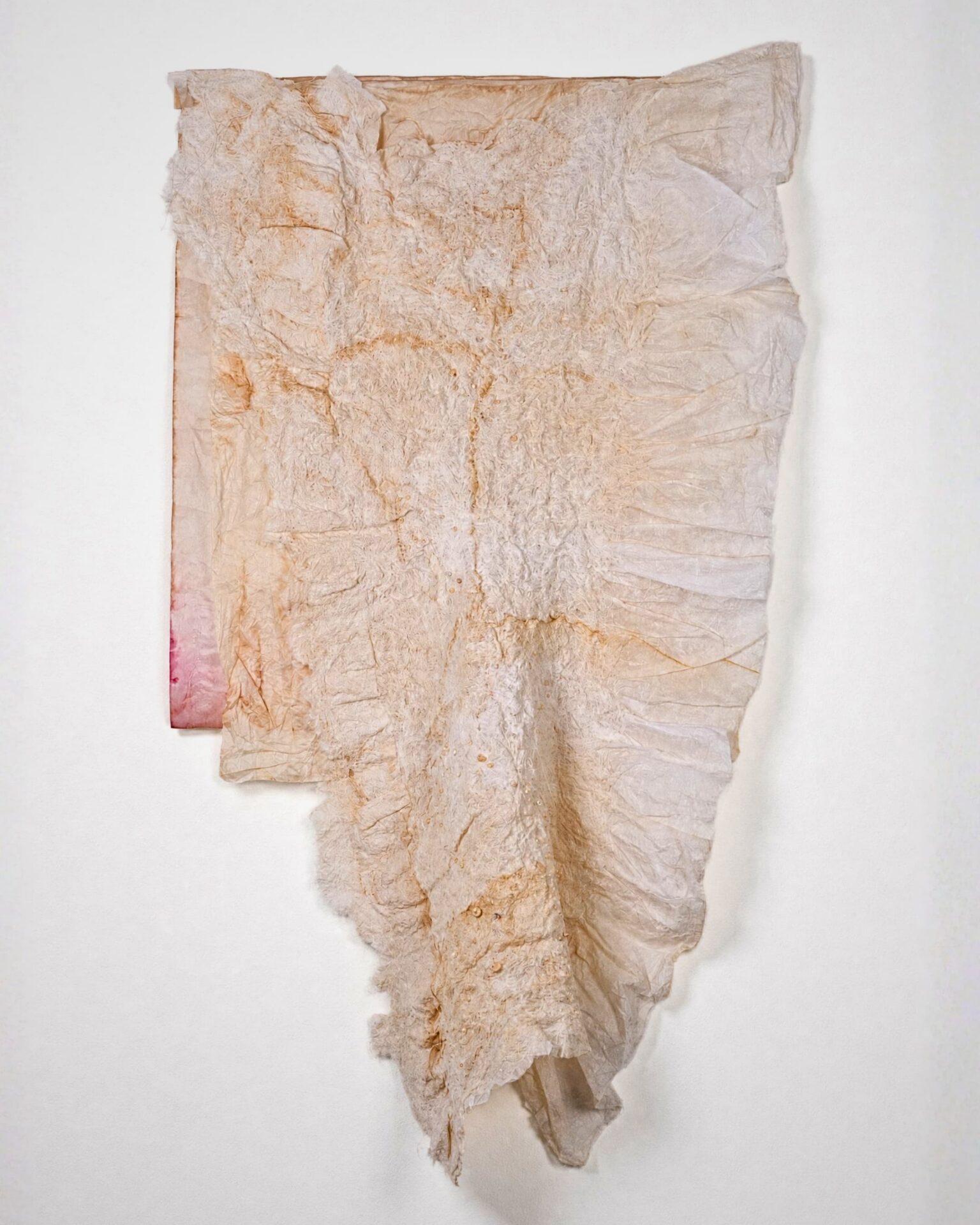
Some of the very fragile pieces from my Persephone series have hidden loops on the back for hanging, and then I thread fishing wire through the loops so I can adjust the height.
Persephone’s dress
The Persephone series is a body of work I hope to exhibit soon. I’ve been working on it for many years, so it’s quite a large collection.
As with most of my work, the inspiration came from a collage of ideas. Whilst on a camping holiday in Italy, I saw Sandro Botticelli’s Primavera at the Uffizi Gallery in Florence. I later saw Alexander McQueen’s Savage Beauty exhibition in London, and I started to look at ideas linked to spring and autumn.
As a child, I’d read the myth about Persephone. She was abducted by her uncle Hades, king of the Underworld, and later wed to him. The story of her abduction and travel between the Underworld and earth symbolises the cyclical nature of spring vegetation followed by autumn harvests.
Upon further research, I learned she had been picking flowers when she was taken to the Underworld, and one of her handmaidens was left holding a tear-stained piece of her dress. That led me to thinking about what that dress might have looked like.
The idea is that Persephone will need new clothes when she appears in the spring, and she may also leave fragments behind when she disappears in autumn.
Greek costumes at that time would have been simple rectangles that draped the body. I also looked at how Persephone had been depicted in art over the years, particularly the Pre-Raphaelite painters Millais and Rosetti. I also explored Zeng Chuanxing’s Paper Brides series.
At the same time, I was trying to make my practice more sustainable. After looking at the materials I was using and their sources, I decided to experiment with plant papers and natural dyes. I started sculpting the paper with stitch and exploiting the sewing machine’s tensions to create paper wall pieces that suggested garments or fragments of fabric.
I also imagined what Persephone’s wedding dress might have looked like when she got married in the Underworld.
Twilight magic
My first creative space was my kitchen table, and then I moved into a spare bedroom. Today I have a separate studio in a unit in a business centre in Portsmouth. It’s on the fourth floor of an old brush factory and has windows on two sides.
It’s an incredible place to be, and I often get to view a sunset from my window.
I’ve always had a fascination with the sky and looking toward the horizon. And I particularly enjoy twilight.
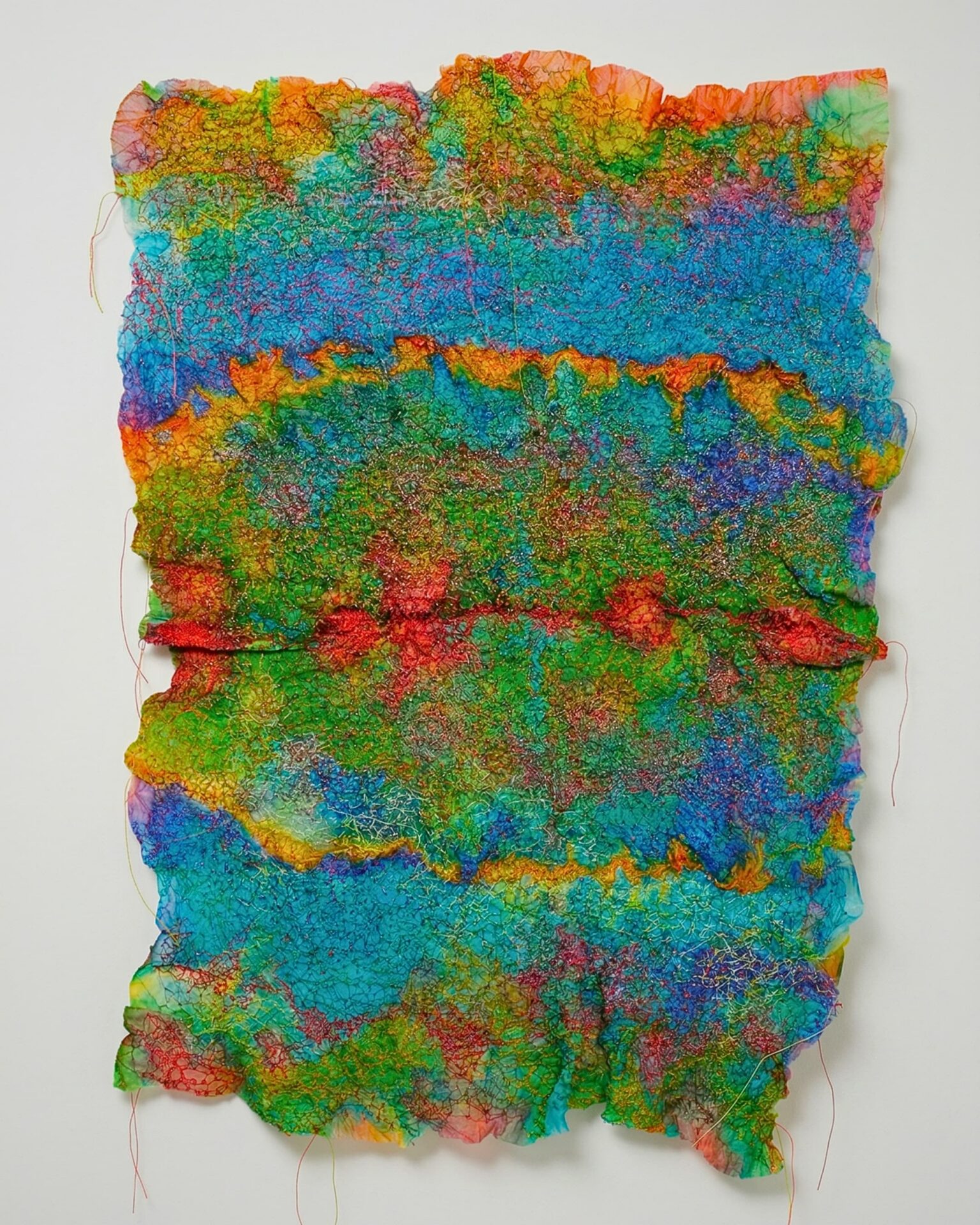
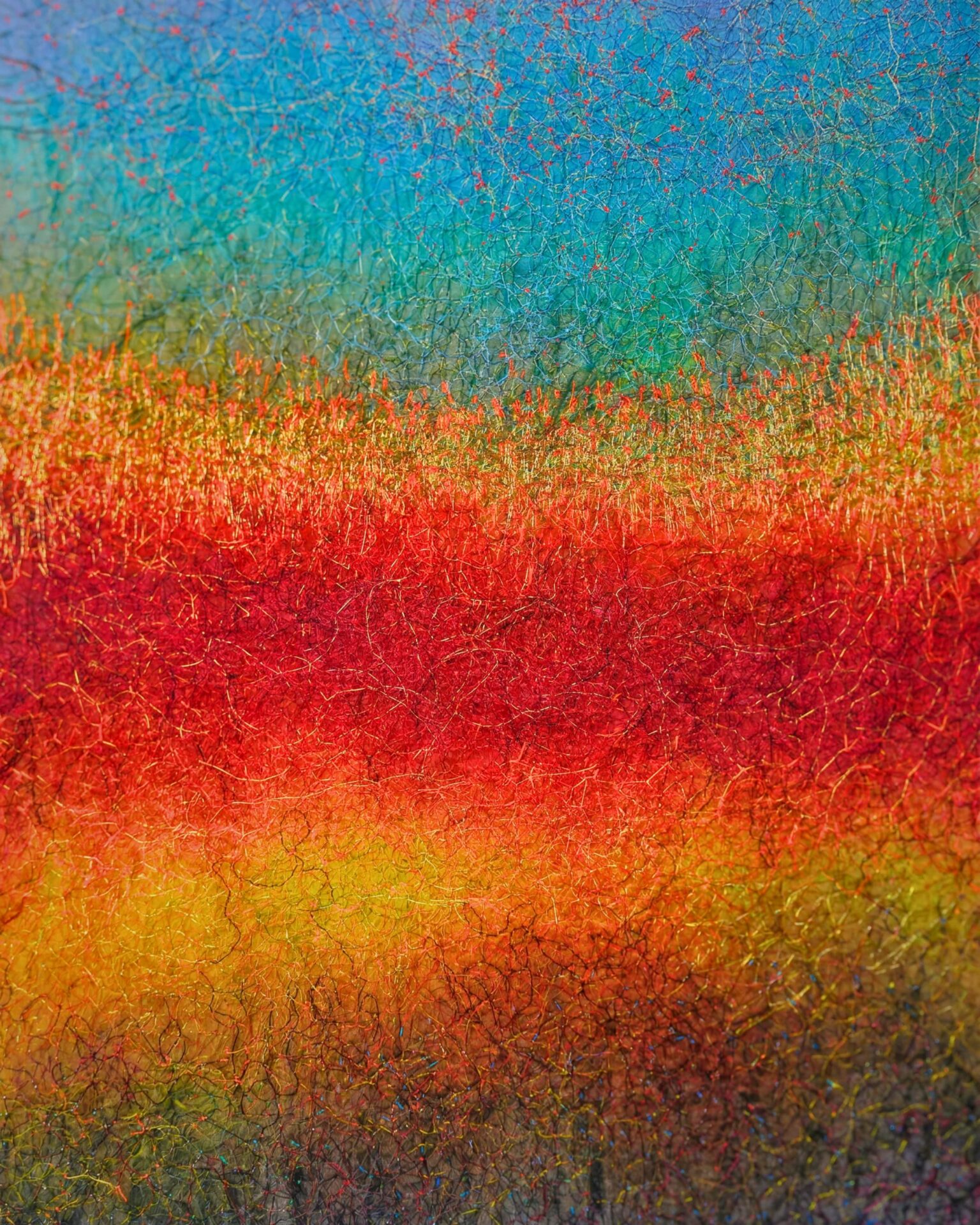
My Fired Earth series is inspired by sunsets, especially the last flare of colour before the sun disappears below the horizon. I’ve observed and photographed many sunsets, and sometimes they’re particularly beautiful experiences.
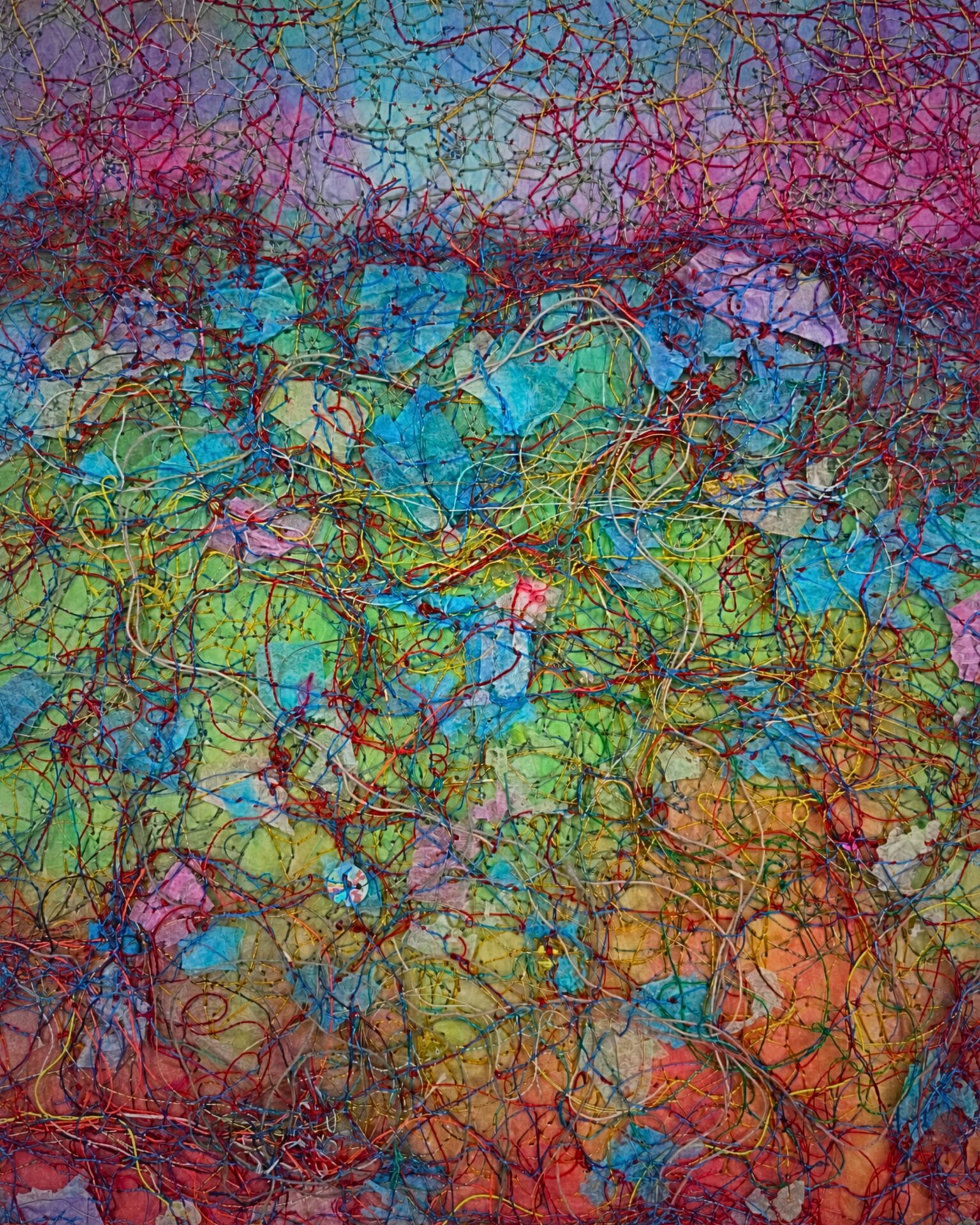
The work features multiple papers stitched together. I layered and collaged the top piece of paper and painted the back of some pieces with gesso. The bottom layer was made using soluble fabric, and then both bits were stitched together, with more paper added behind to change the colour. Fluorescent stitching suggests the last rays of sun at sunset.
I have a passion for colour, and I use a complementary colour palette. With any paints or dyes, I mix using the three primary colours. I allow the colours to mix randomly on the paper and use the dried paper colours to guide my thread colour choices.
Glorious sunsets
Dusk was inspired by watching the sun go down over water near my home. I used white acid-free tissue paper painted with cold water dye and watercolour. Painting the two directly on paper allowed the colours to bleed.
When dry, the papers were torn and layered to make a collage. They were pinned onto a piece of Lokta paper from Nepal.
I started stitching from the left across the sheet to hold the papers in place, then added more stitching to enhance certain areas. The final stitches are the metallic threads, where I have used tension techniques to pull the red thread up from the bottom.
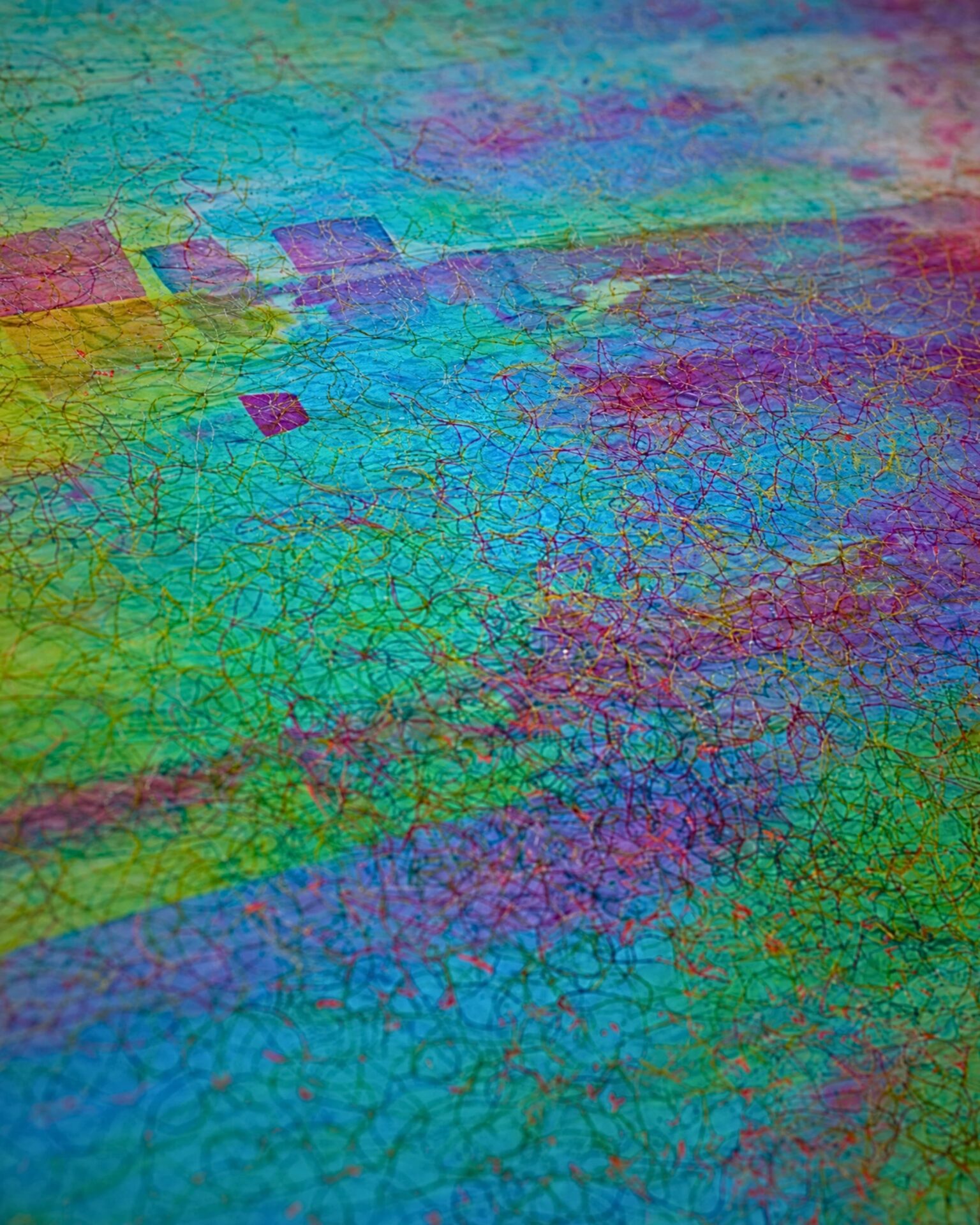
“In my sunset works, I am trying to represent something that does not actually exist, as the sky is just infinite space.”
Anita Bell, Textile artist
9 comments
Anita
Thank you Holly. Such lovely comments. I’m glad you enjoyed the work. 😊
Holly Coburn
Some artwork is so powerful that it is not easy to describe. Beautiful and deeply moving come to mind. Thank you for sharing this work with us.
Siân Goff
Thank you for reading and commenting – we are so glad that Anita’s work has inspired and moved you – what a gift!
Victoria Mirabello
I have downloaded the list of material for Anita Bell’s work will she also be holding a stitch club workshop?
Siân Goff
Yes, we are very excited. Anita’s workshop begins this Saturday. See you there!
Anita
Thank you Siân. Looking forward to seeing the work. 🙂
Victoria Mirabello
I am absolutely in awe of this extraordinary beautiful creations especially the vibrant colors inspired by the natural world! Thank you!
Anita
Thank you Victoria so much for your lovely comments. So glad you enjoyed the work. Hope you can join the workshop!
Siân Goff
I’m so glad you’ve enjoyed the article and found Anita’s work inspiring! Thank you for your comment.