
It’s all about the details. That’s what makes Suzette Smart’s textile tales so very special.
Her intricately collaged surfaces are filled with life’s small moments. Bits of landscape, shifting seasons and familiar wildlife merge seamlessly to tell stories inspired by her daily walks and travel.
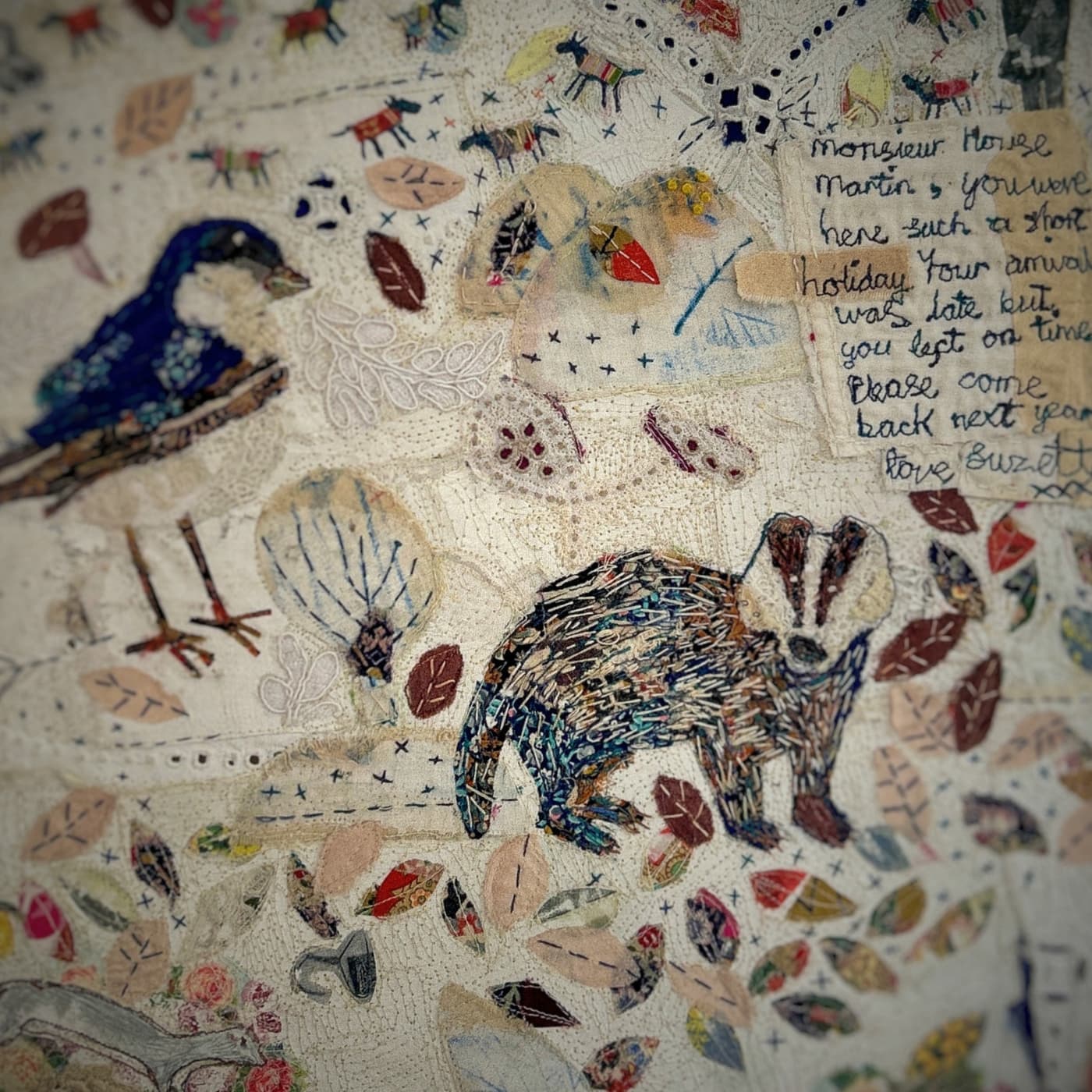
There’s always a playful twist or two with stitch, paint, paper and image transfers. Cheeky animals often take centre stage. Wonky text meanders across the cloth. Even an inherited badge tells part of a story.
Thrifted fabrics and found notions bring extra charm, while machine and hand stitching build rich, textural surfaces.
Suzette’s art is packed with delicious small touches, and we can’t get enough of it. Look once and you enjoy it. Look again and you’ll likely see something new.
Narratives & memories
What is it about storytelling that captures your interest?
Suzette Smart: My work is rooted in narrative and memory, drawing on the landscape, wildlife and lived experiences that shape my everyday life.
I get excited when there’s something new in the landscape to portray. I’m looking for connections and a way of bringing that something new into a piece of work. I carry motifs and themes into the next piece which creates a seamless story.
“For me, storytelling feels instinctive.”
Suzette Smart, Textile artist
What is one of the first textile artworks you remember creating?
My paternal grandparents lived on the island of Ynys Môn in North Wales, and I’d stay with them during the holidays. I always remember sitting at my grandmother’s feet, sewing or making something. She bought me a concertina sewing box.
My grandfather had worked in textiles manufacturing at Courtaulds, and his father had been a cotton mill director in Oldham, Lancashire. I wish I could go back and find out more, but I think this is where my textile journey must have begun.
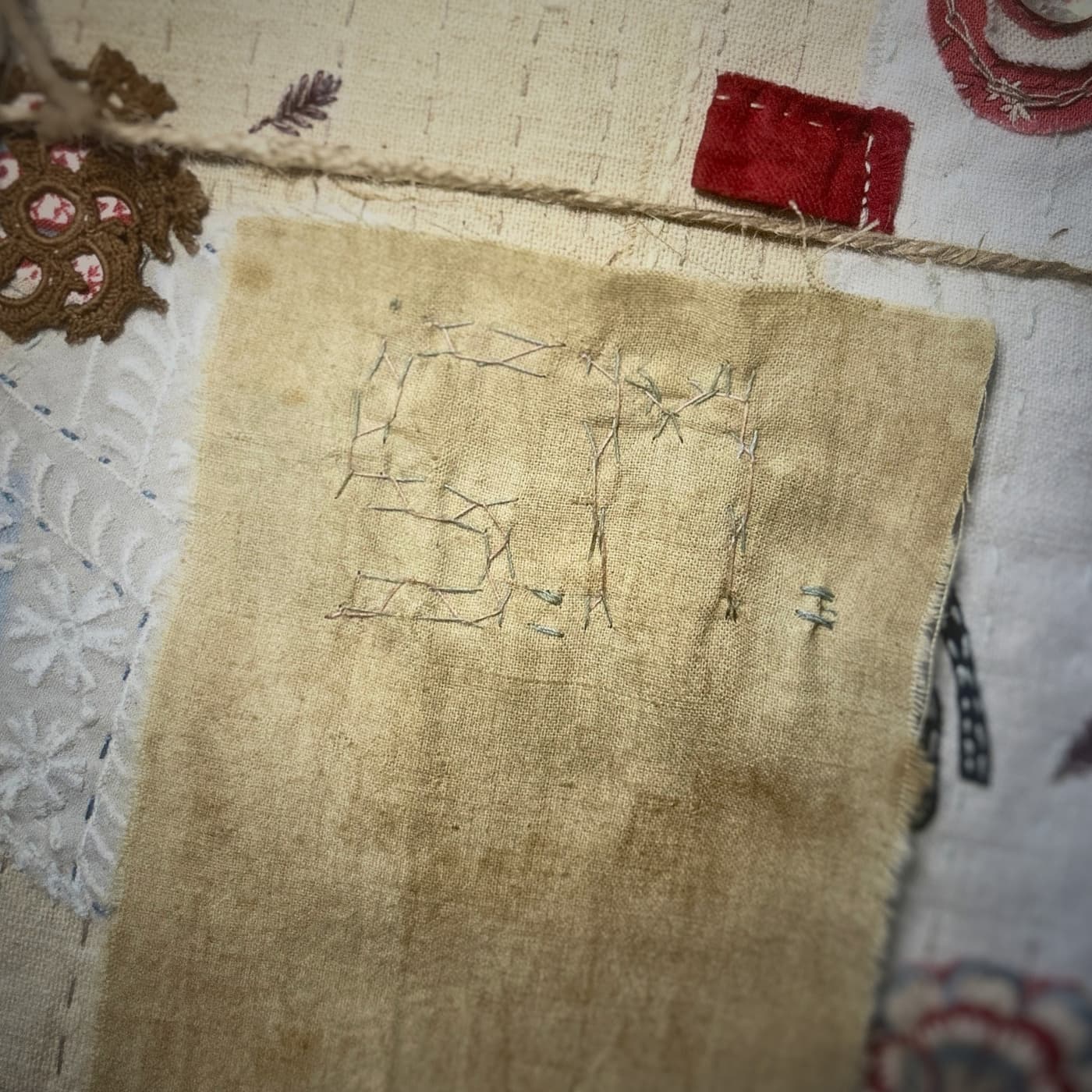
I’ve kept a small piece of embroidery I made when I was six or seven; I stitched my initials onto my marble bag. It reminds me of sitting and creating with my grandmother.
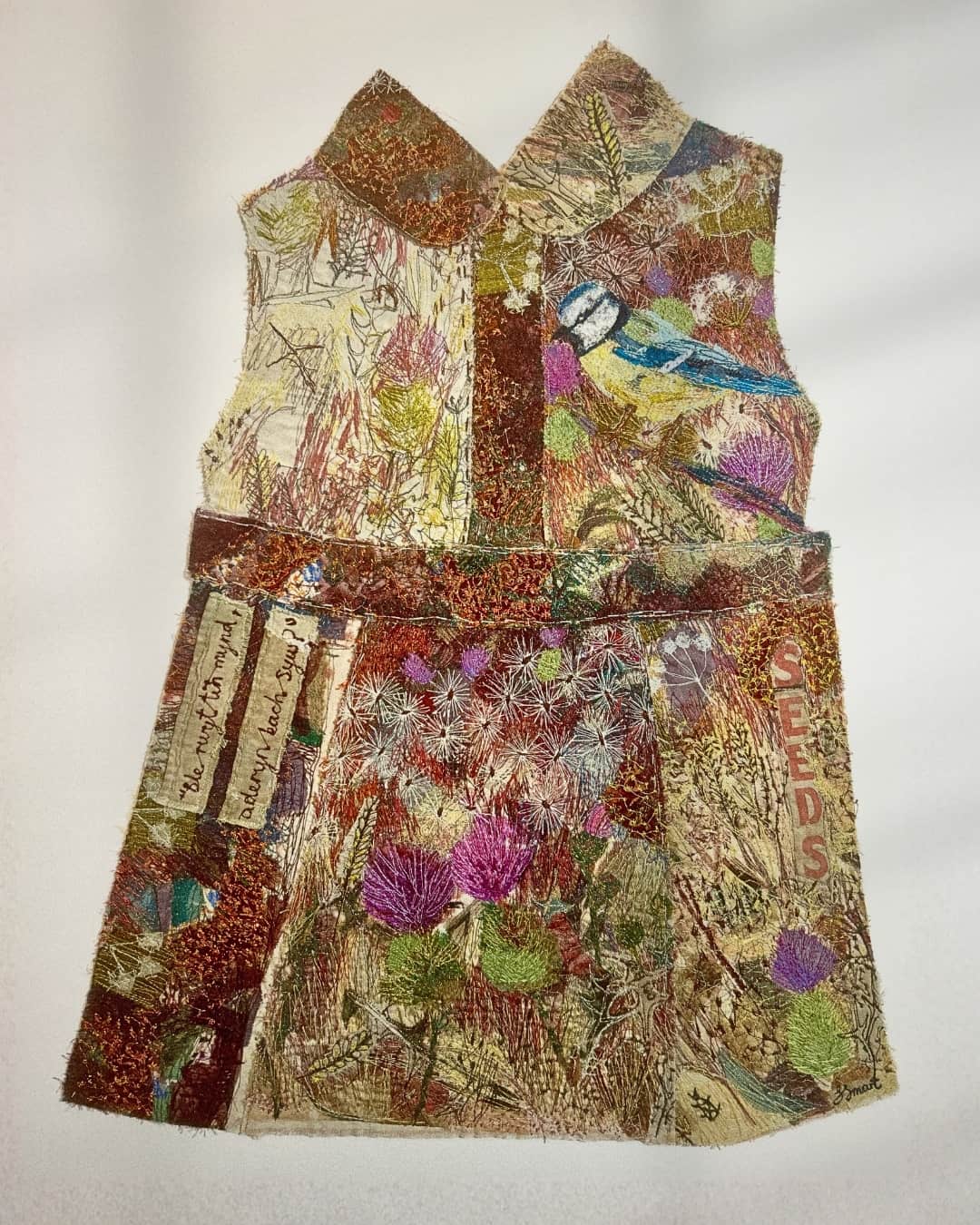
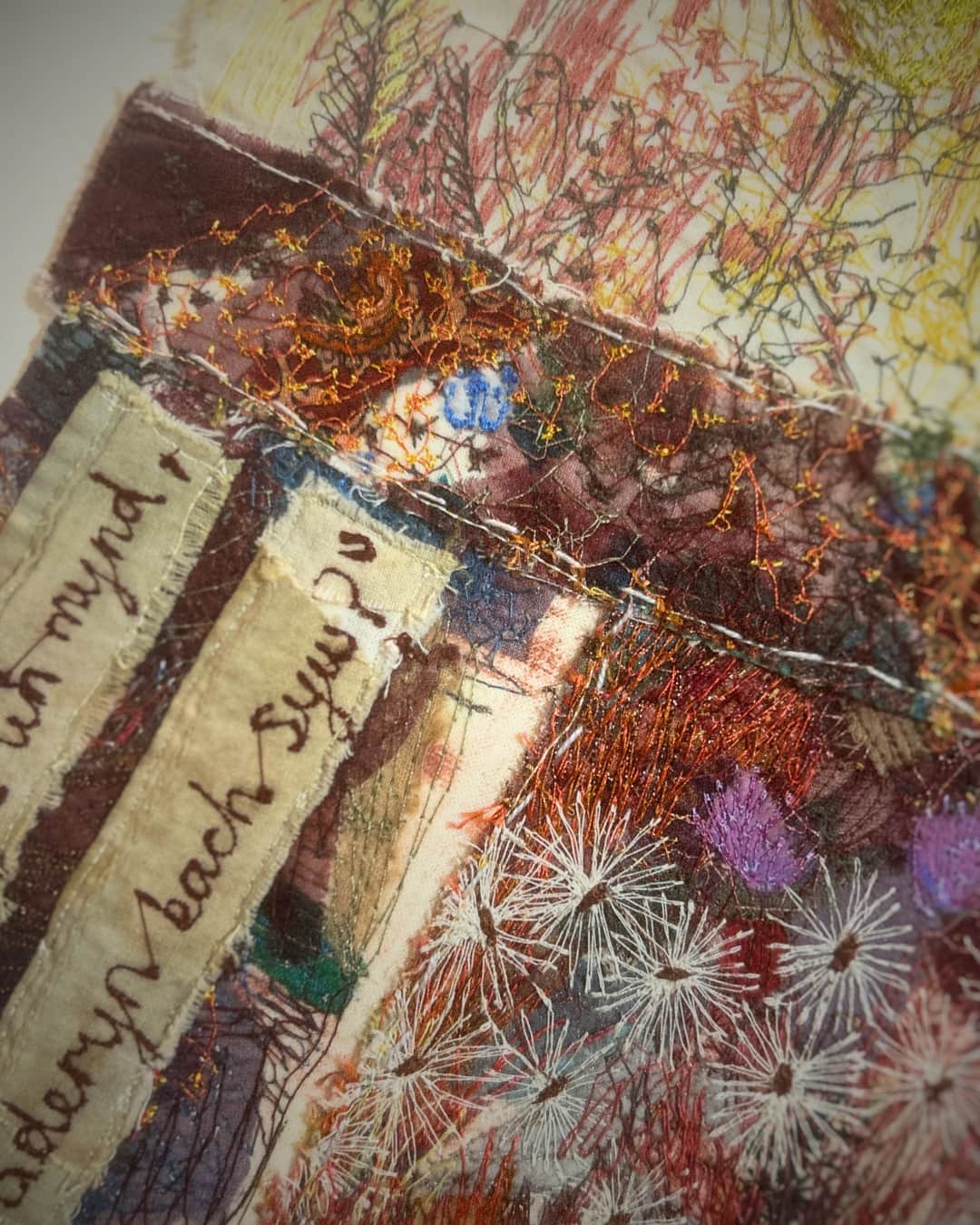
Years later, I included some of that marble bag in a child’s dress piece I made. It’s called Ble rwyt ti’n mynd, aderyn bach syw?, which means ‘where are you going to, little laden bird’? It comes from a traditional Welsh nursery rhyme.
What was your route to becoming a textile artist?
I took a vocational qualification (BTEC) in General Art & Design, where I had some fantastic tutors. They widened my viewpoint of how I could draw with collage. That stayed with me and is now a significant part of my process.
From there, I went to the University of Ulster in Belfast and studied for a BA (Hons) in fashion and textile design. I had every intention of swapping courses to embroidery, but it never happened.
It took another few years and probably a bit of life experience before I started stitching again. Thankfully, the stories had been waiting to be made. I joined a network of local artists, which I’m still part of, and I’ve been a practising artist and tutor for the last 20 years.
Embracing imperfections
Tell us about your favourite fabrics and threads.
I’m drawn to older fabrics, which may be a little worn or have a social history. I’ve always enjoyed the imperfections, as it gives me something to work with. It’s harder to work with new cloth, as it doesn’t blend so easily when I’m stitching.
The free machine threads I use must be reliable and are the workhorse of a piece. I have a whole selection of light colours for blending and some favourite darks for drawn lines.
My hand stitching threads are my pleasure and reward! They’re chosen for colour, texture and thickness for the line I want. I’m always open to using new ones too.
What are some of your signature motifs or themes?
Most of my work focuses on landscapes, wildlife and lived experiences. Birds became quite significant in my work when I was part of an exhibition called Birds of Wales at Oriel Ynys Môn in 2016. They’re often the storyteller of a piece, and I can take them back to a time and place.
My husband and I are keen walkers, and I’m often picking up motifs along the way which then reappear in a couple more pieces.
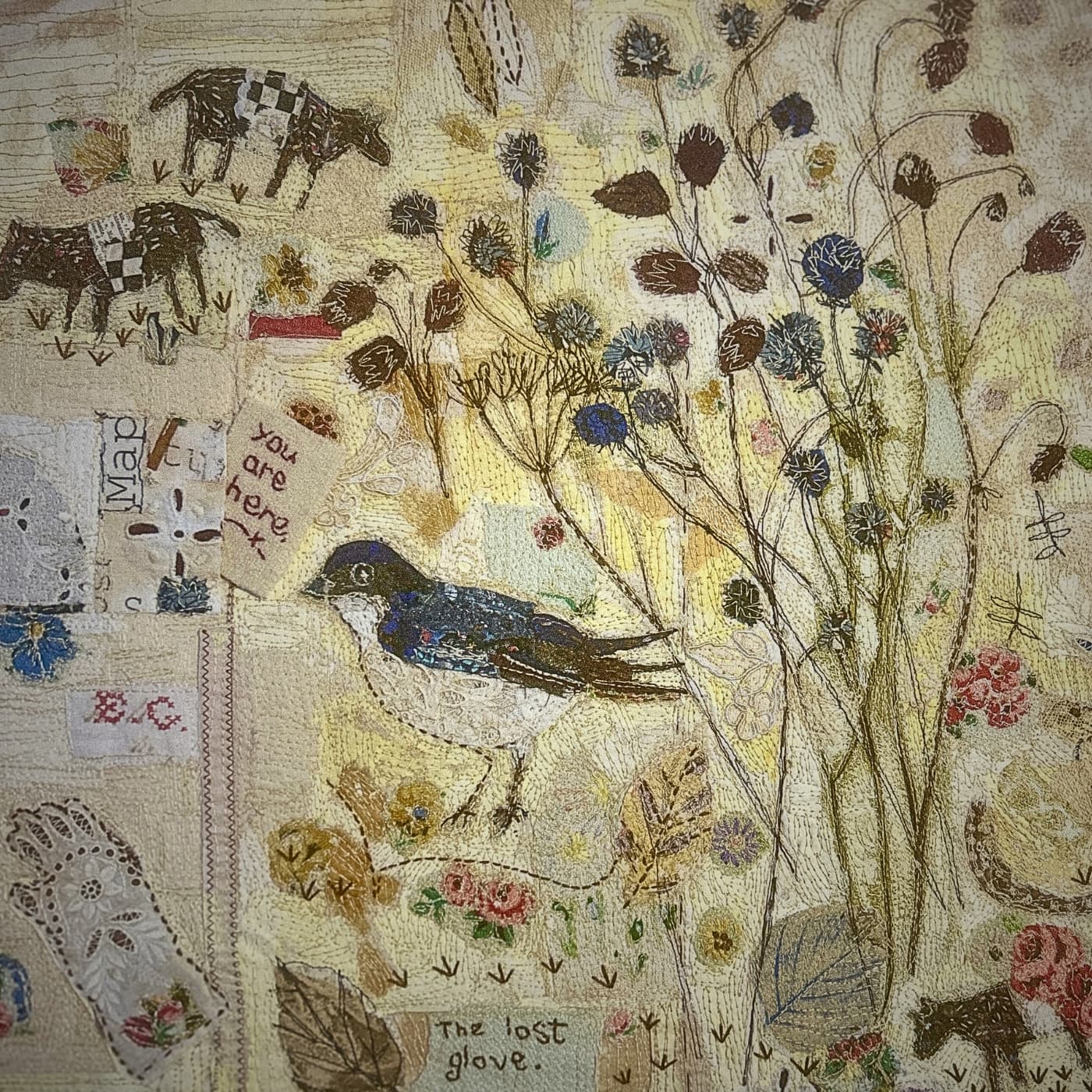
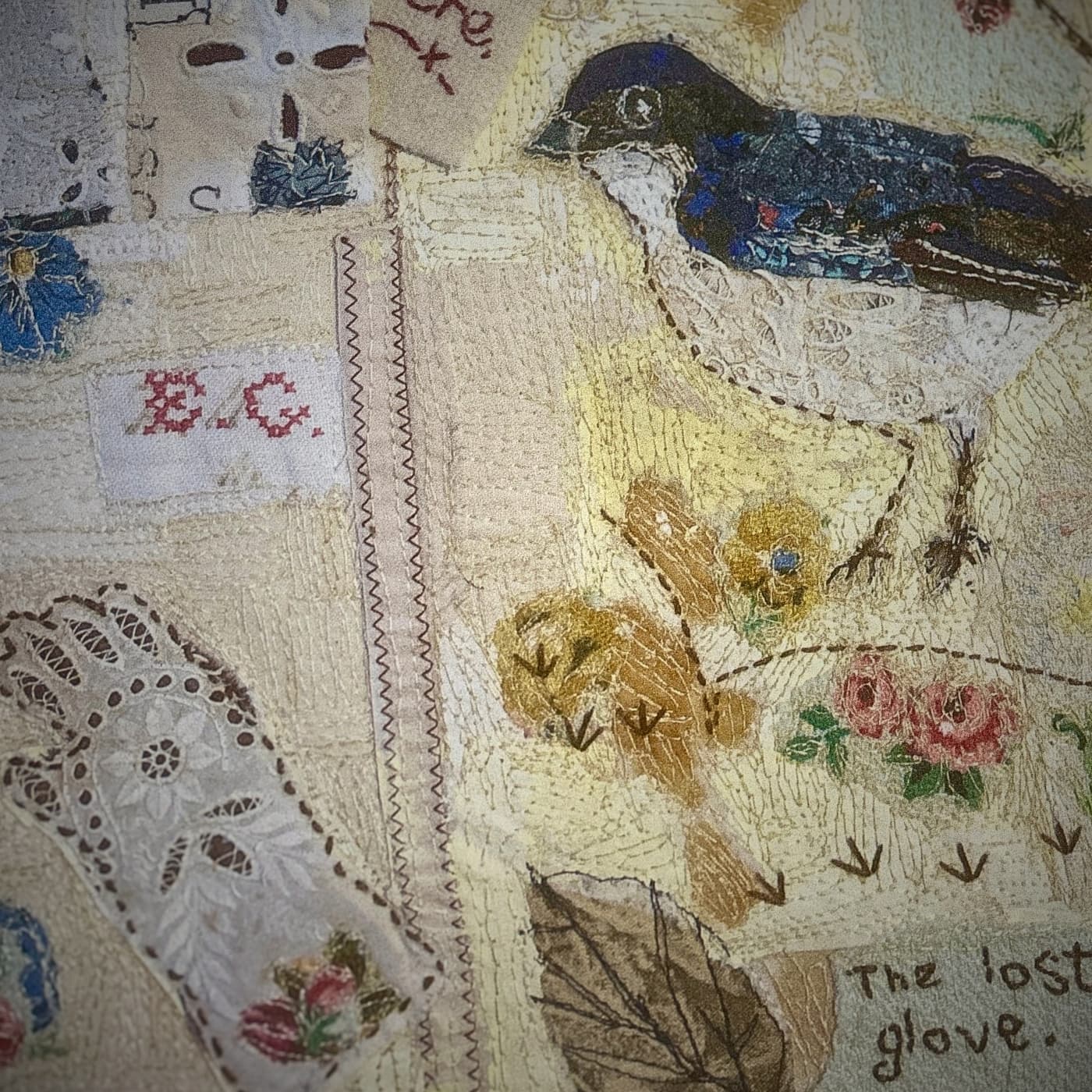
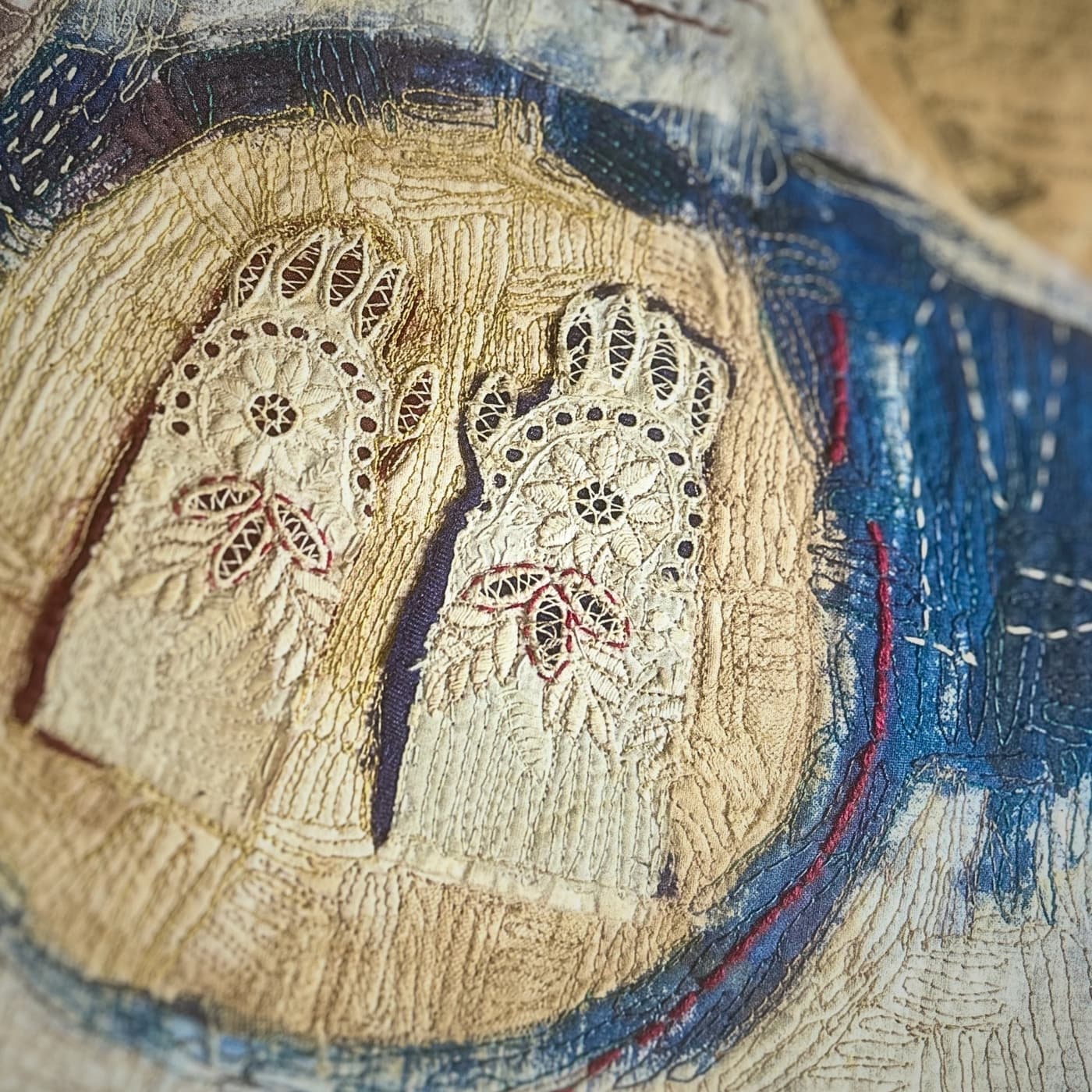
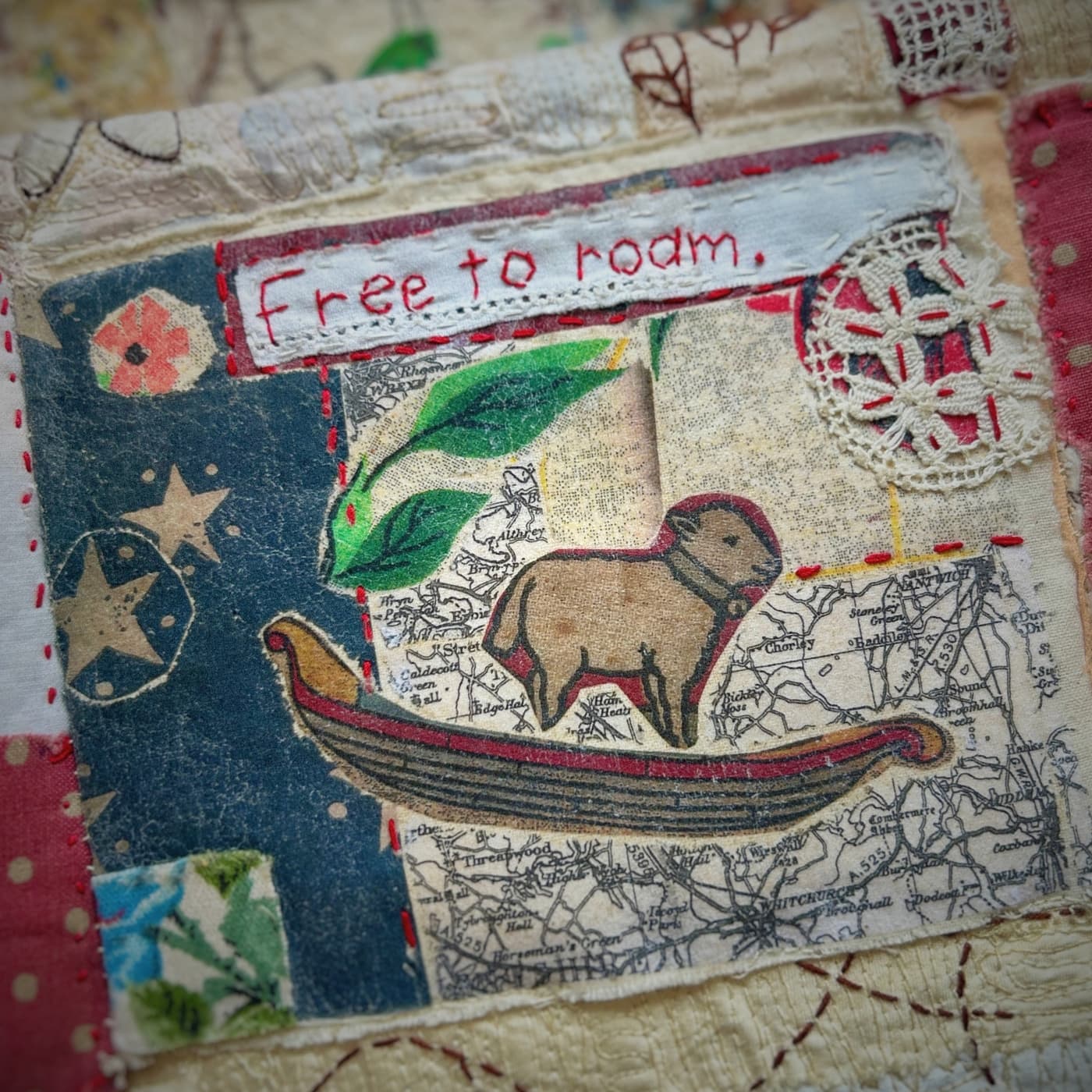
A single glove on a post became central to my work called The Lost Glove, and then it became a pair again in Free to Roam.
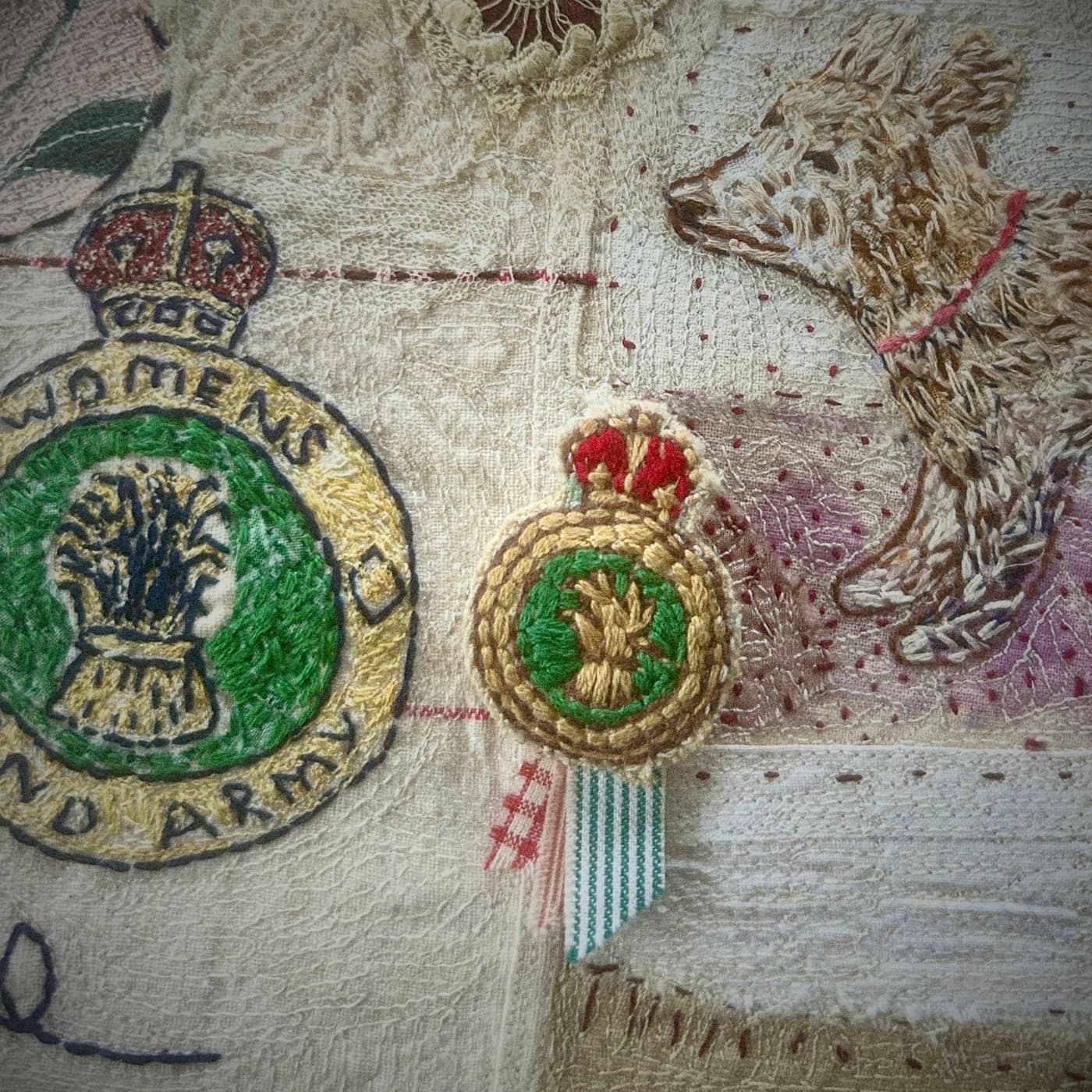
A Women’s Land Army badge from the Second World War has also made an appearance in a few pieces, and I’ve recreated it as a stitched brooch. It belonged to someone in the family, so there’s that connection too. The war led to shortages of workers on farms in the UK, so women stepped in to help grow more food and keep people fed.
Are your pieces carefully planned or is it a more intuitive process?
It’s probably something in between. I don’t tend to sample before working on a piece, but I will refer to previous works. The main components of a composition might be decided before I begin, but there are always new things to discover along the way.
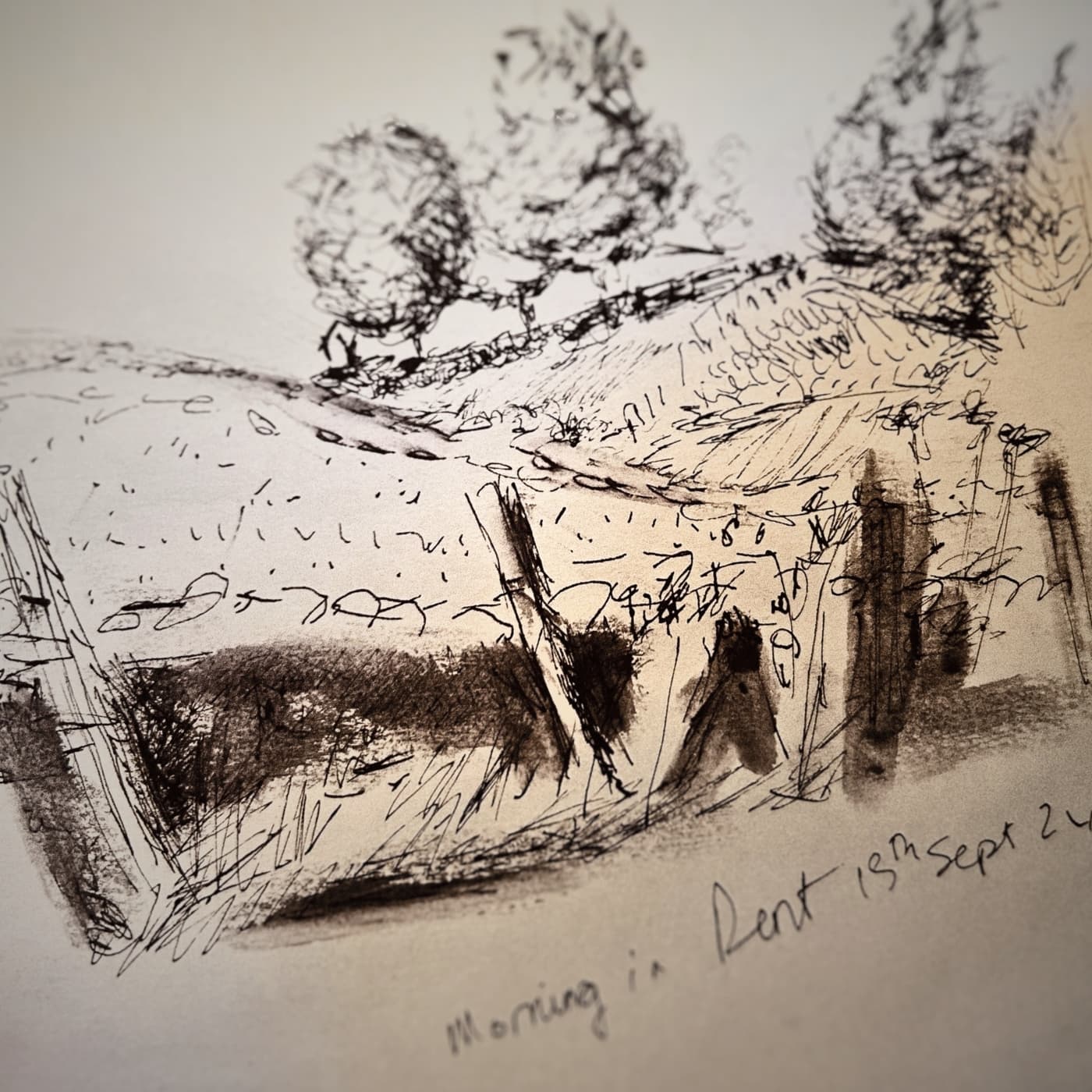
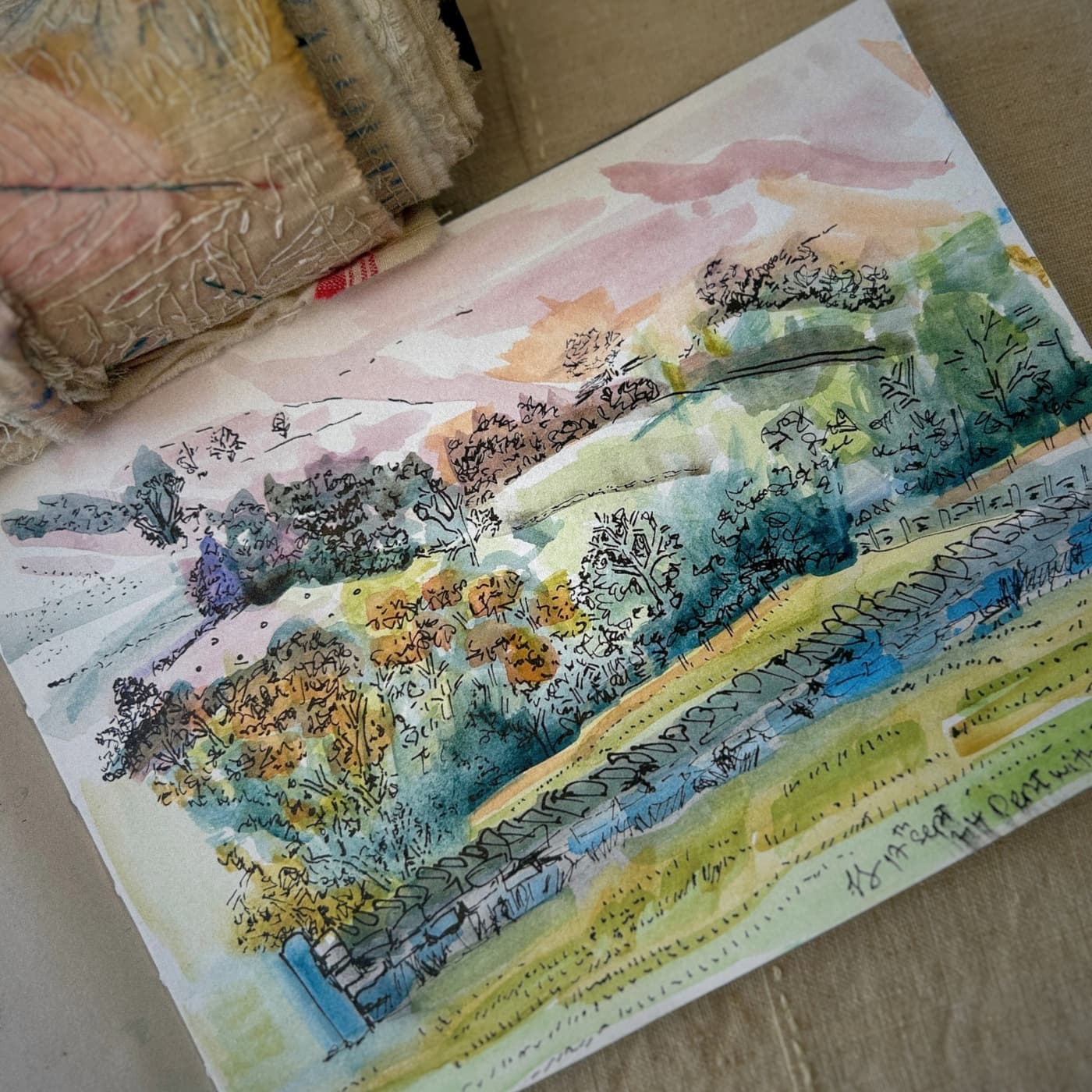
I do keep sketchbooks, which also serve as my walking and gardening diary. If I’m working on a piece, I might go wandering around the garden for inspiration and something seasonal to include.
We’ve undertaken several long-distance walks in recent years, and I’ve recorded some of the places we visited. We stay in our camper van, so there’s a lot of time spent outdoors. I might get a quick line drawing and a few notes in over a sandwich, but I can lose a couple of hours sitting out sketching when we return from a day’s walking.
I also have a few fabric scrolls on which I’ve begun stitching my walks. They’re an extension of my sketchbooks and another form of recording and mark making.
“My two favourite months for garden inspiration are spring and autumn, beginnings and endings.”
Suzette Smart, Textile artist
Repurposed materials
How would you describe your creative process?
I keep a basket of light-coloured fabric scraps to use for the background. I might paint onto some of them with gesso or tea stain to alter them. I prefer using thrifted and gifted fabrics, including linen, lace and fabric scraps.
When I collect enough fabrics from which to choose, I start moving them around to create a size I’m happy with. I then tack them together.
I start building a composition with fabric and sometimes paper. I’ll use Bondaweb fusible webbing where necessary, glue stick, pins and tacking stitches. Whatever works at the time.
Once I’m satisfied with the overall design of the collage, I’ll swap back and forth between hand and machine stitching, adding extra fabric scraps as needed along the way. I love all aspects of my process, but there’s something quite satisfying about those final stitches.
“I embrace reusing materials as both a creative and environmentally considerate practice.”
Suzette Smart, Textile artist
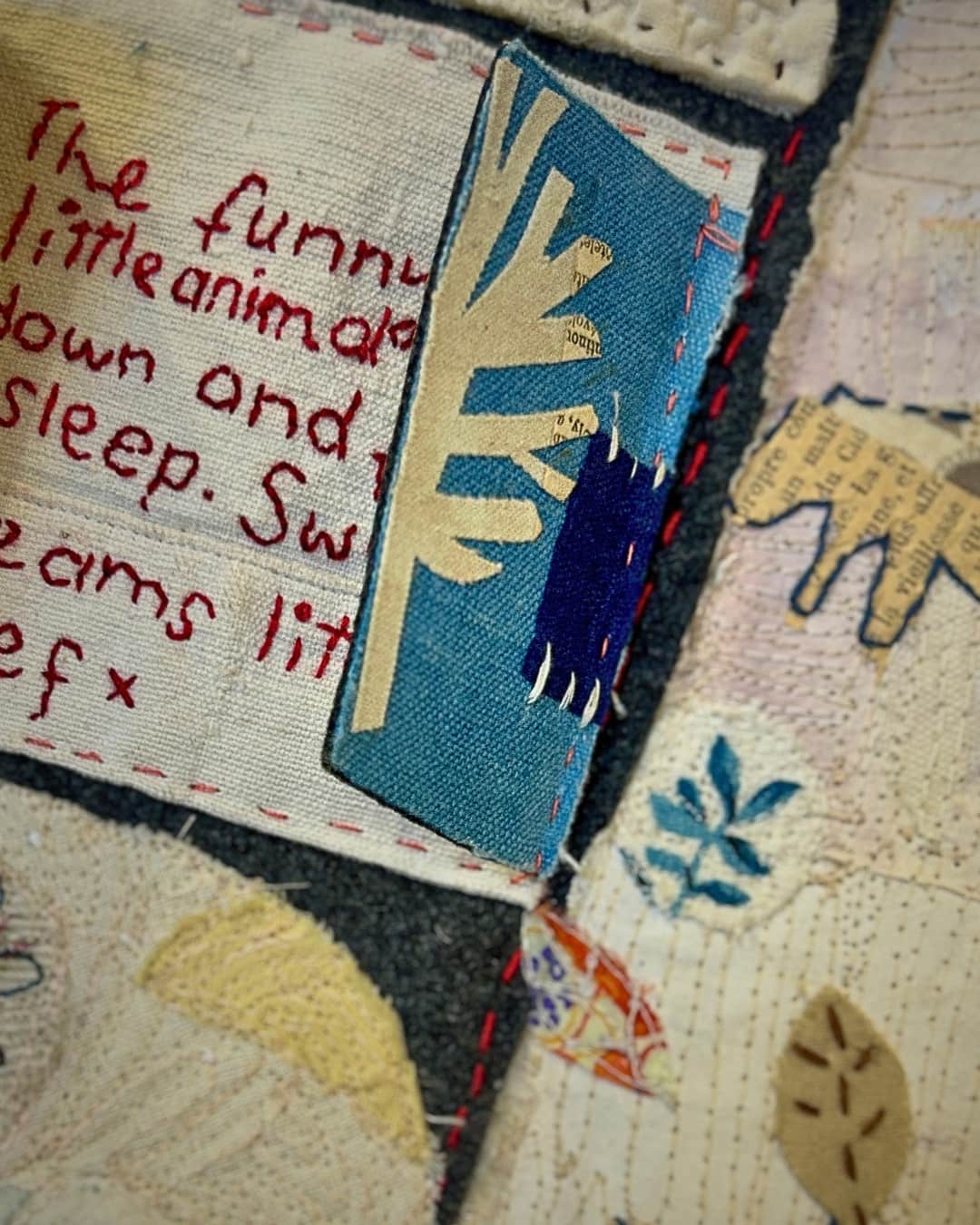
Each of your works is packed with many wonderful points of interest. How do you know when to stop?
I mostly know when I’m finished with a piece, but to make sure, I’ll take a picture and crop it. This either reaffirms my thinking or exposes something I hadn’t noticed. If this happens, I might leave it for a week before changing anything.
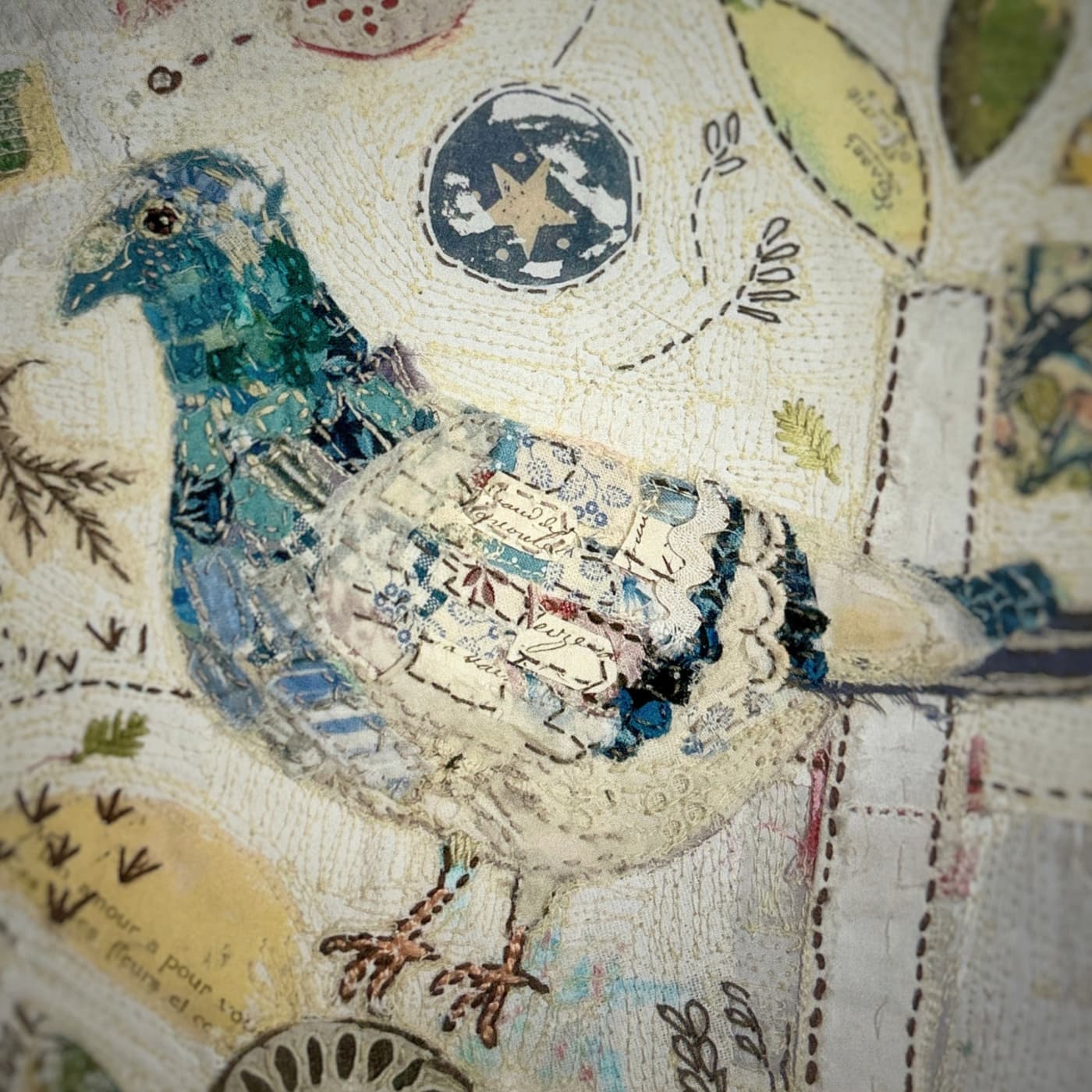
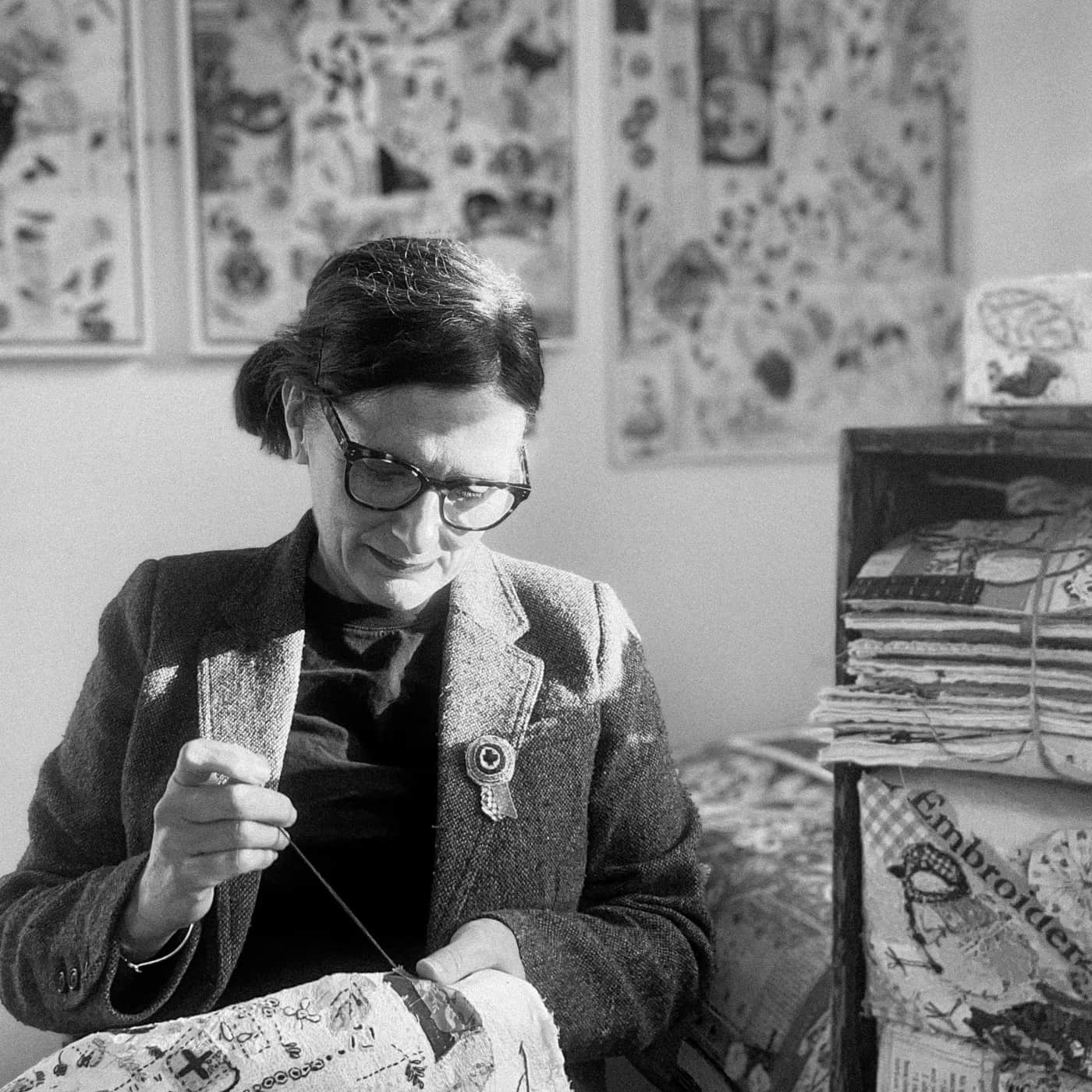
Typography & stitching
How do you choose what words to include, and how do you incorporate the text into your work?
The words I feature come to mind when I’m working on a piece, but then sometimes they don’t come at all.
I use a variety of methods to incorporate text and choose the one that best suits the work. I might use free machine stitching, but I also print various type sets to cut up and piece back together. Those manipulated letters are then transferred onto my chosen fabric by painting with gesso and then pushing the printed letter into the wet paint. After it dries, I sponge the paper away.
If a letter somehow ends up being placed upside down or back to front, I might let it go. But if it’s jarring to the work, I’ll correct it.
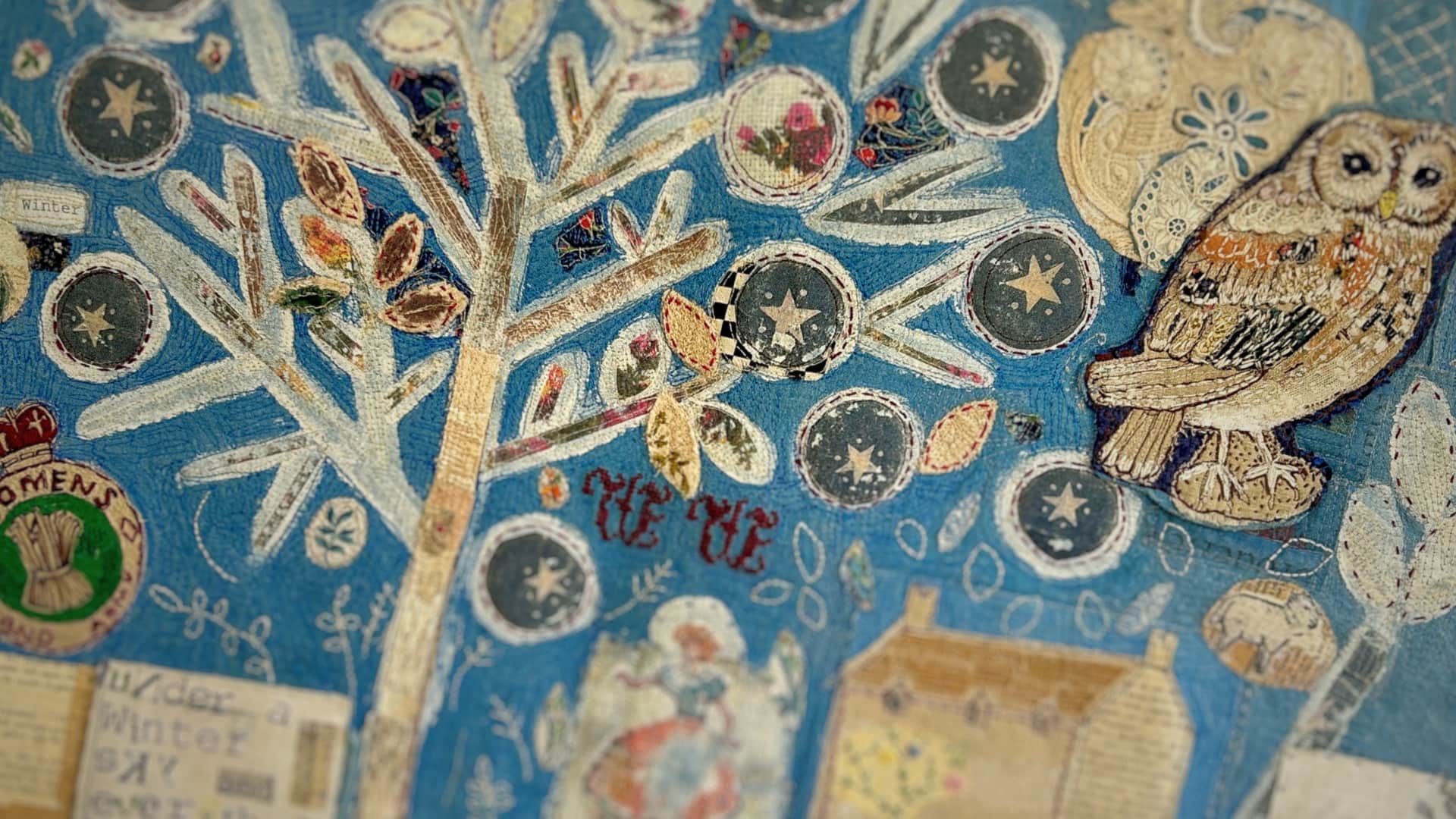
When including paper elements in your work, how do you attach them without damaging them?
I use Bondaweb fusible webbing to give stability to the paper and then attach it like I would a piece of fabric. If it’s a sample that gets handled at a workshop, the paper may tear. I don’t mind that, though, and I make the repair part of the story.
I also liberally rub on clear furniture wax to add a little more patina to the paper and help it better blend into the work.
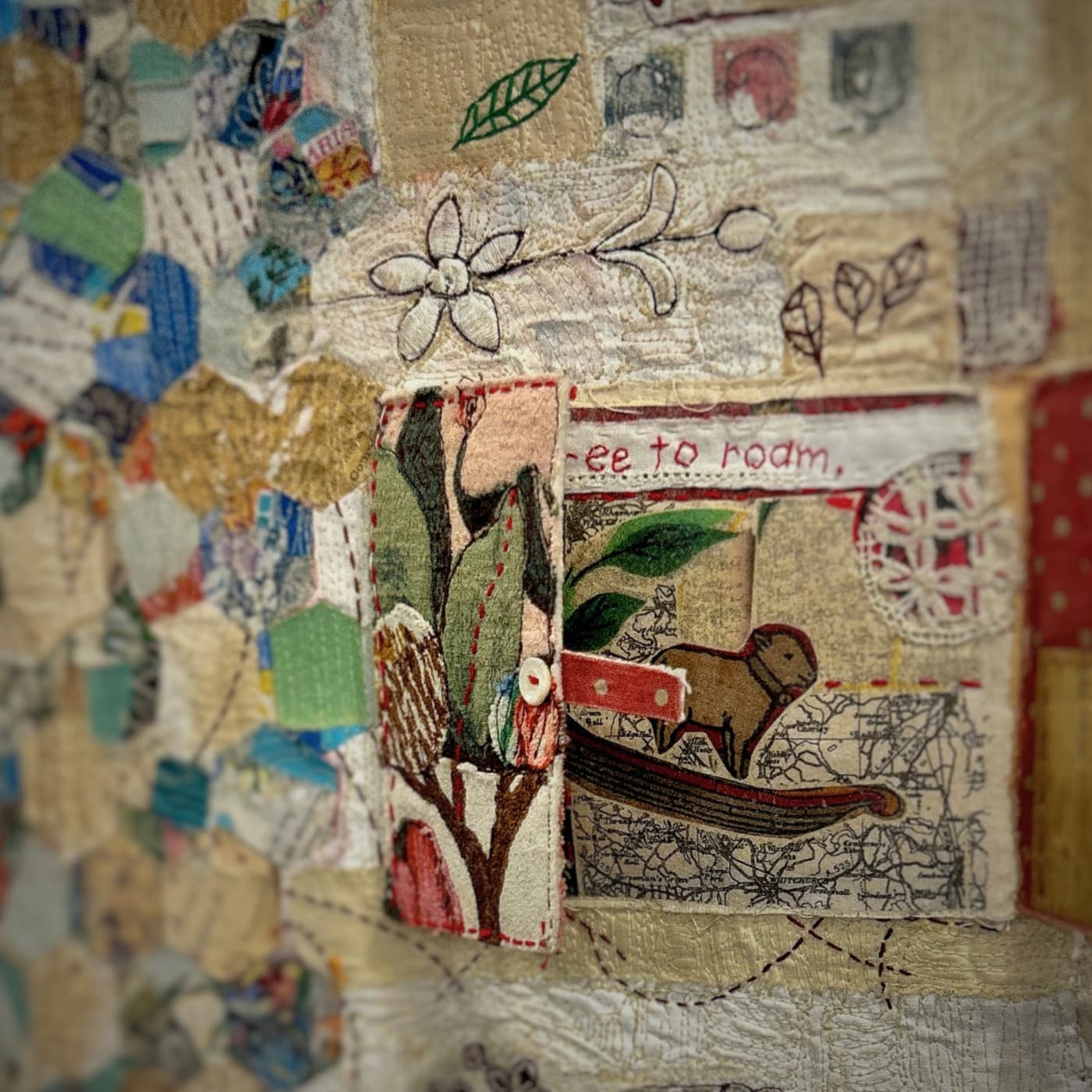
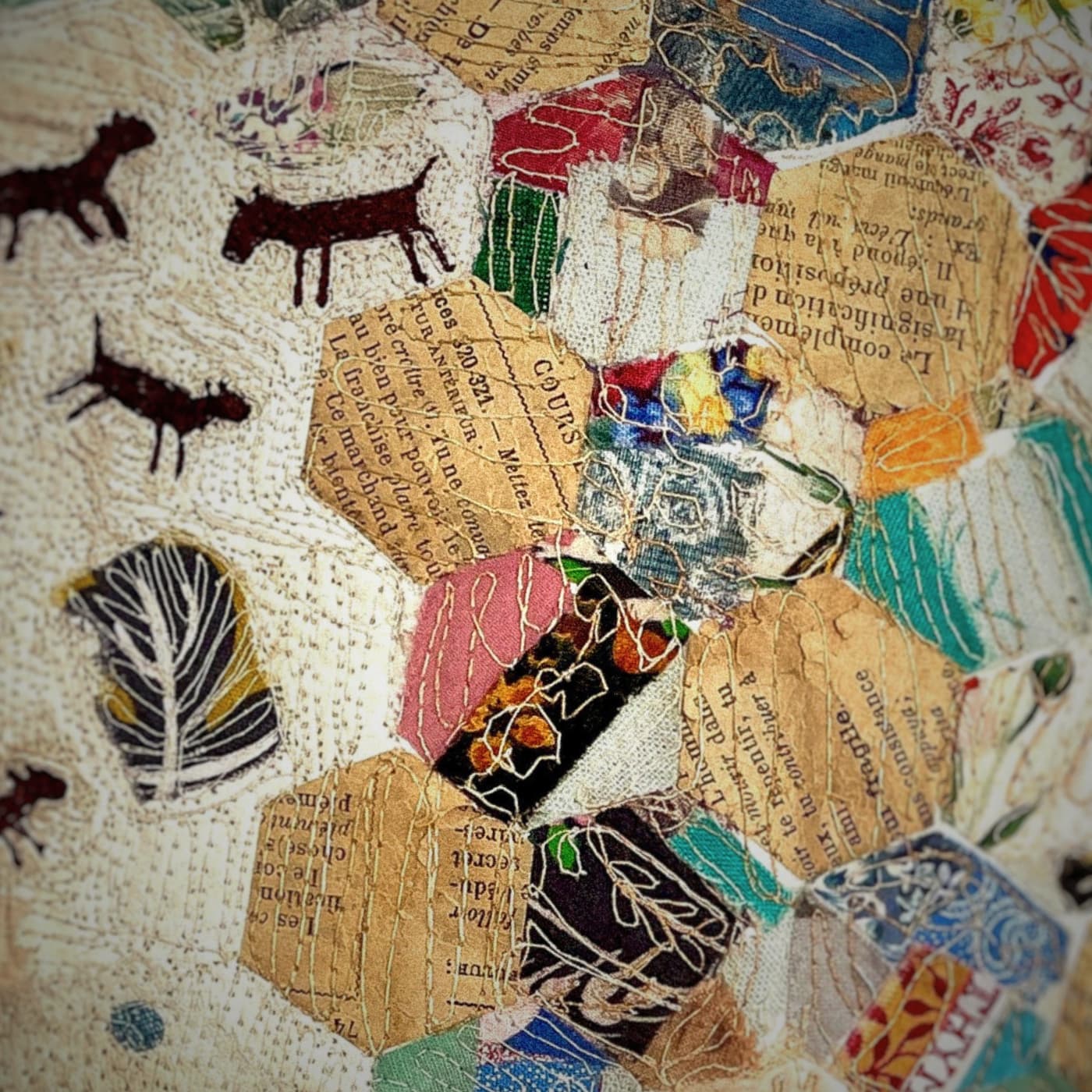
When it comes to hand stitching, do you have any preferred stitches?
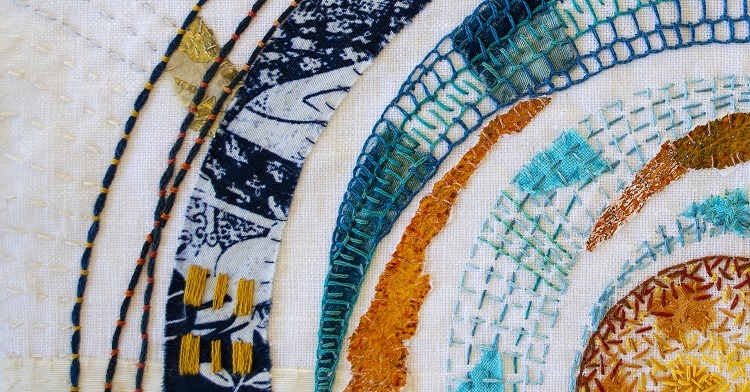
I like mixing up running, back and stem stitch to alter a line as if I were using a pencil. Sometimes a new stitch comes along, like the fishbone stitch, and I can’t get enough of it.
I’ll go down to a single strand if I have some fine detailing.
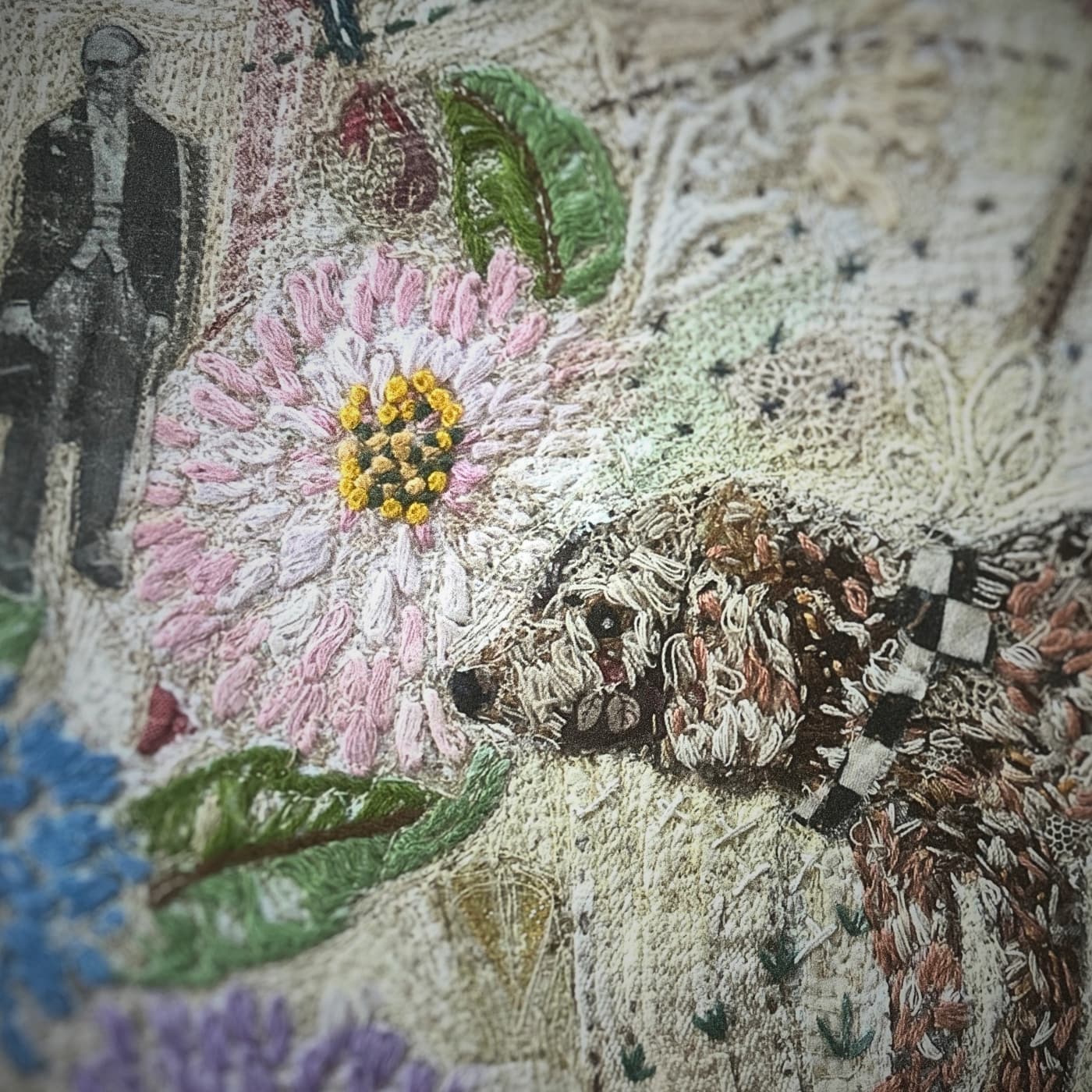
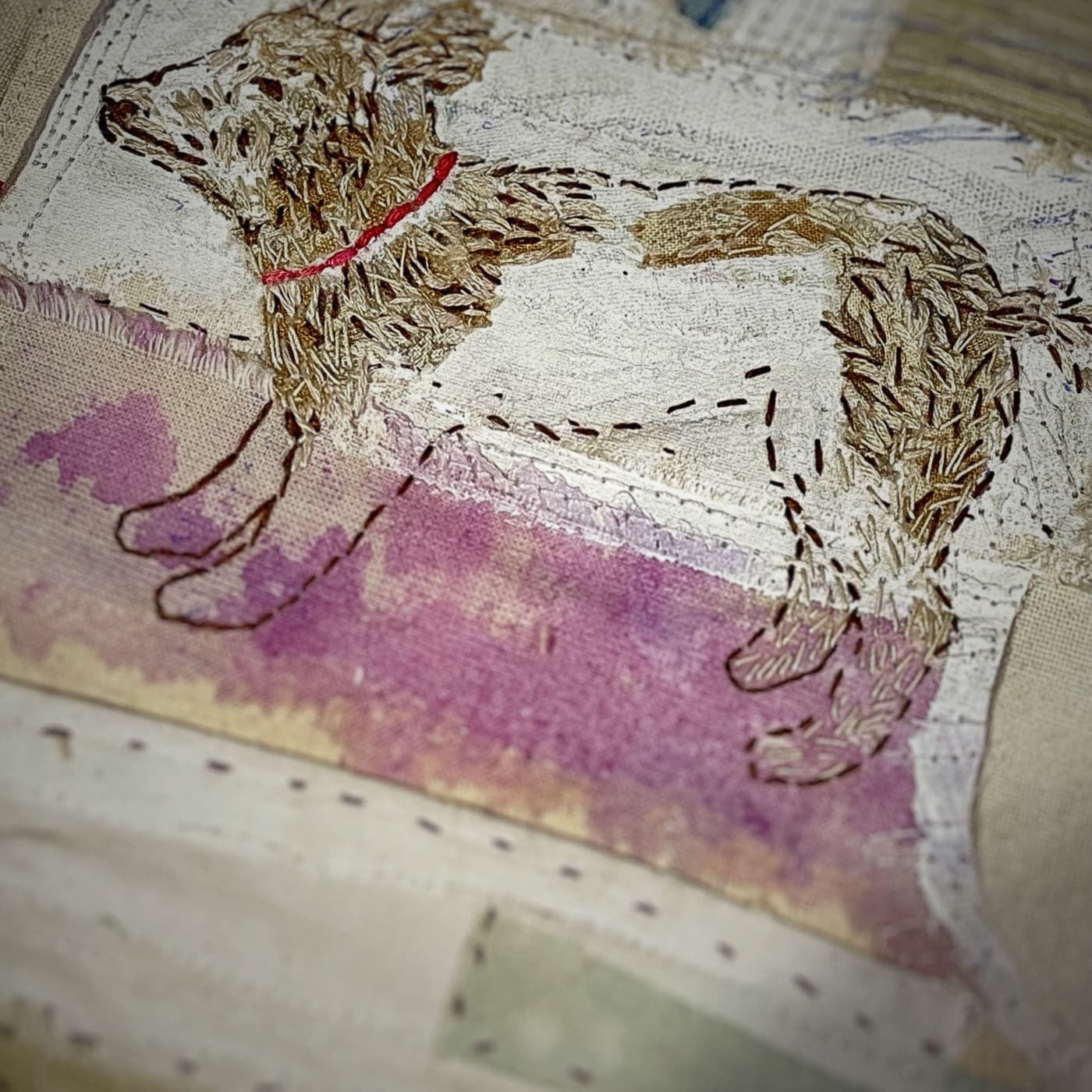
In this detailed image from A Turn in the Road, I’ve used long and short stitches for the dog and then running and back stitches to outline.
The threads were chosen for their various thickness, texture and colour. The old crochet thread I’ve used adds depth to the dog’s coat with its thickness and the way it sits on the surface.
“I have threads I like at the moment, but I’m happy to mix up perlé, linen, wool, stranded, old and new.”
Suzette Smart, Textile artist
Inventive titles
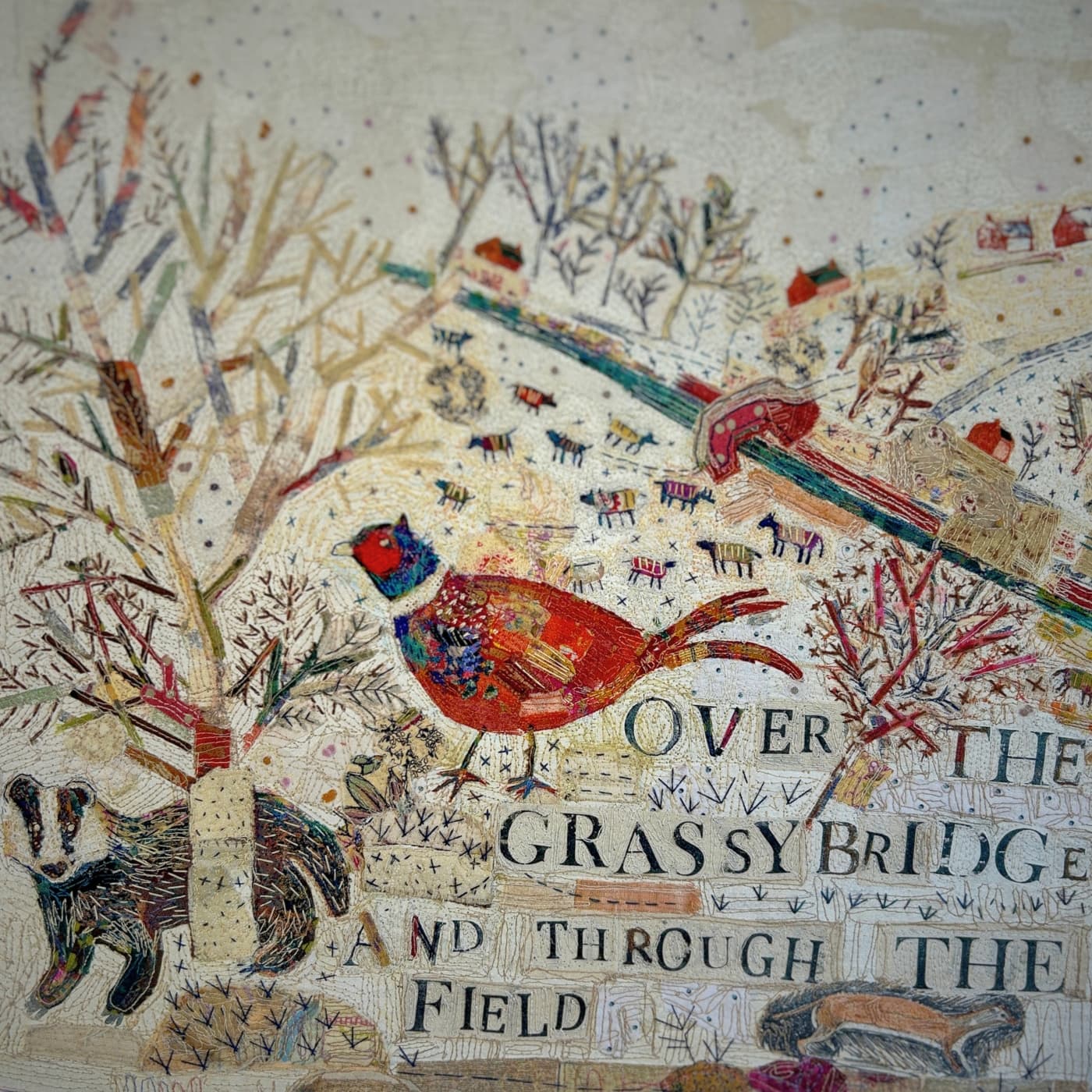
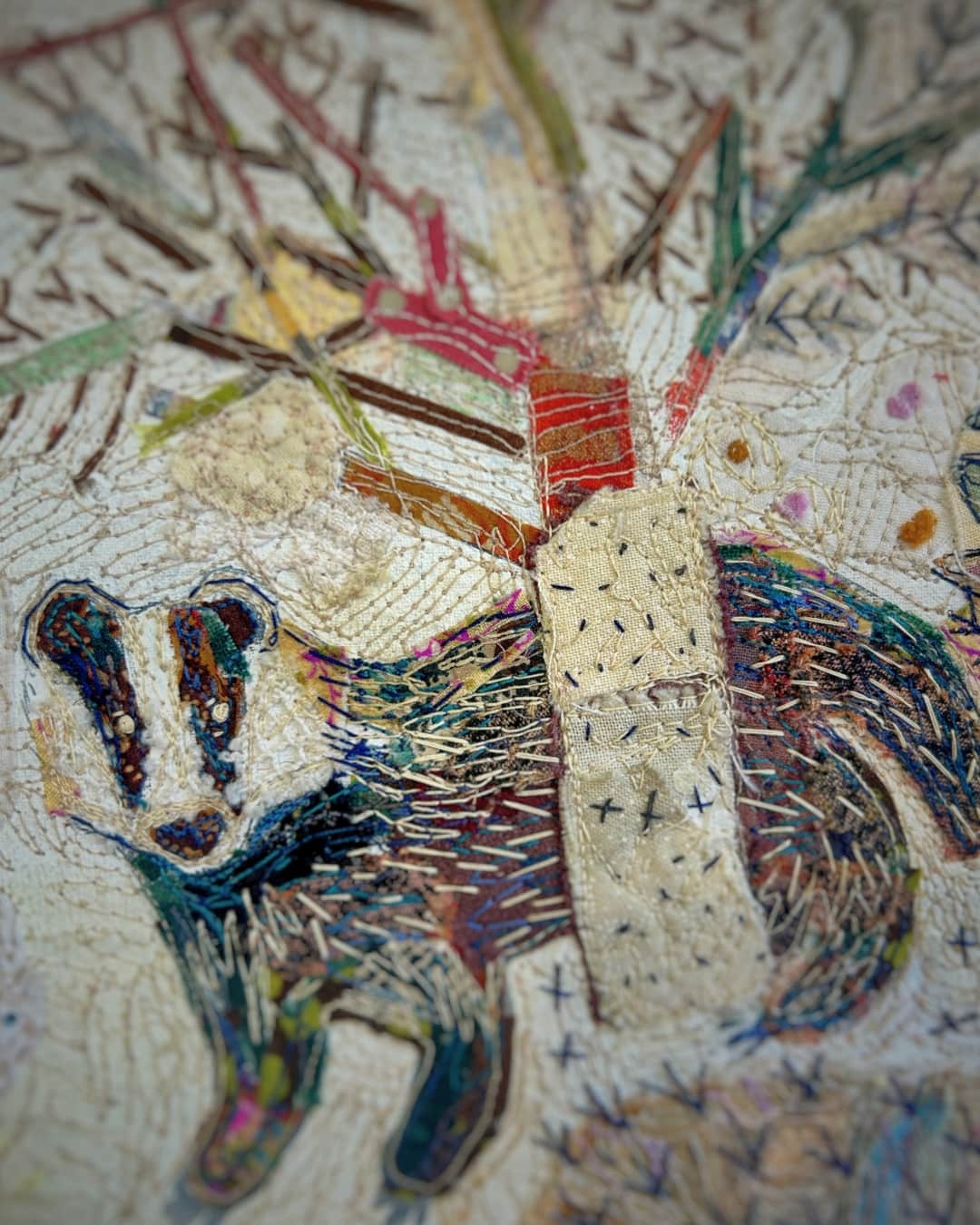
What was the inspiration for Over the Grassy Bridge?
This work features one of my favourite walks from home, and the grassy bridge takes me across the canal and through the field.
There’s a badger in the story because we pass badger’s door on our towpath walk. Someone has carved the door and name into the bark of an old tree.
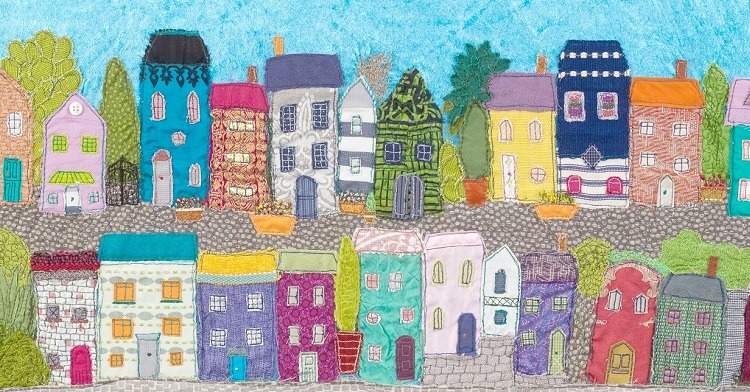
The reds of the little cottages are a nod to the colour of the traditional brickwork in this area on the Welsh/Shropshire border.
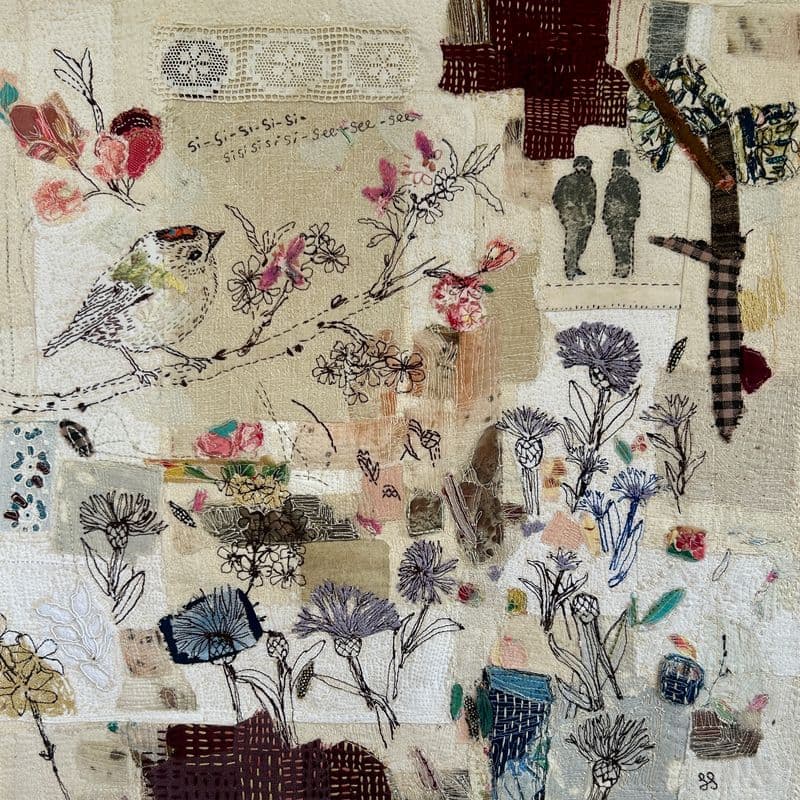
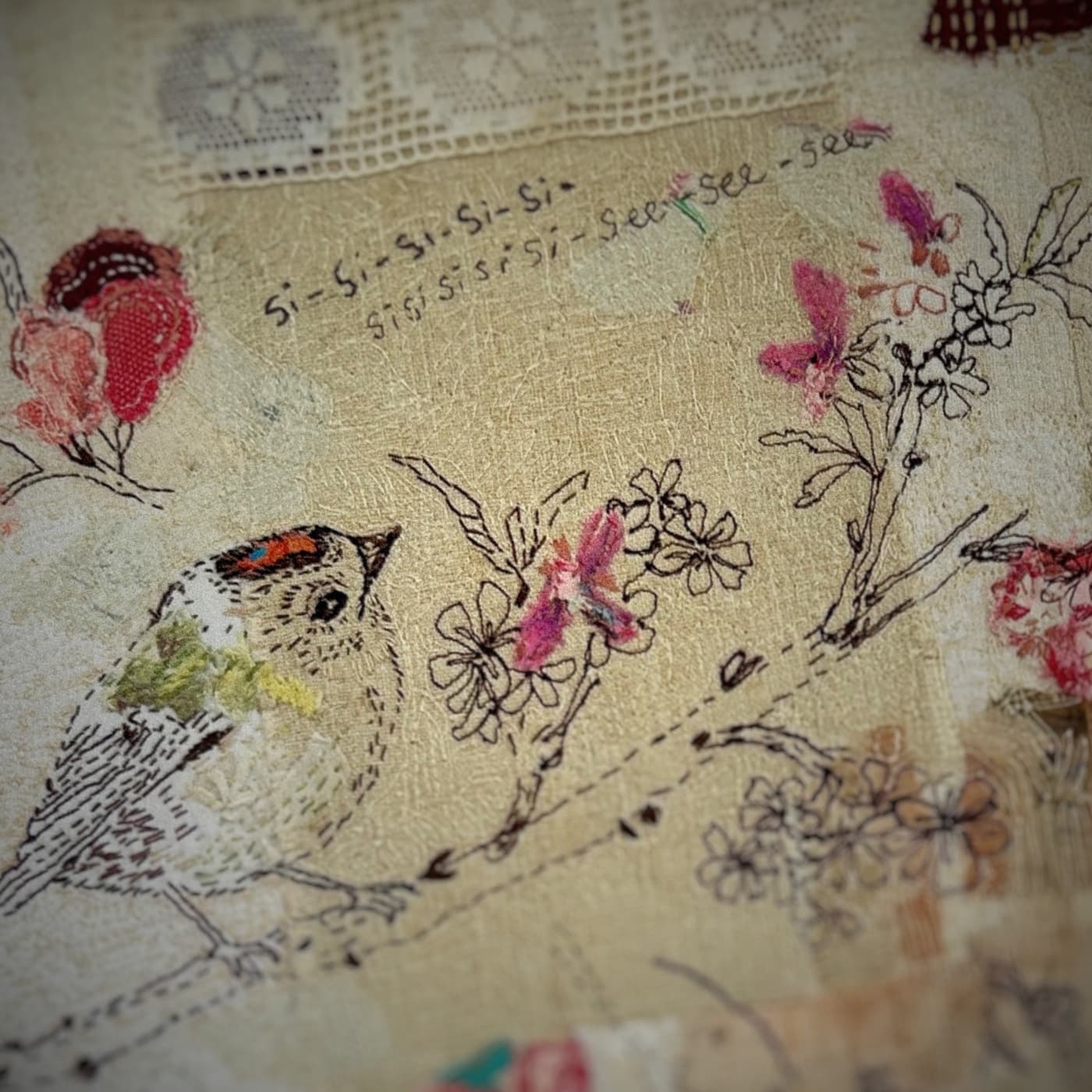
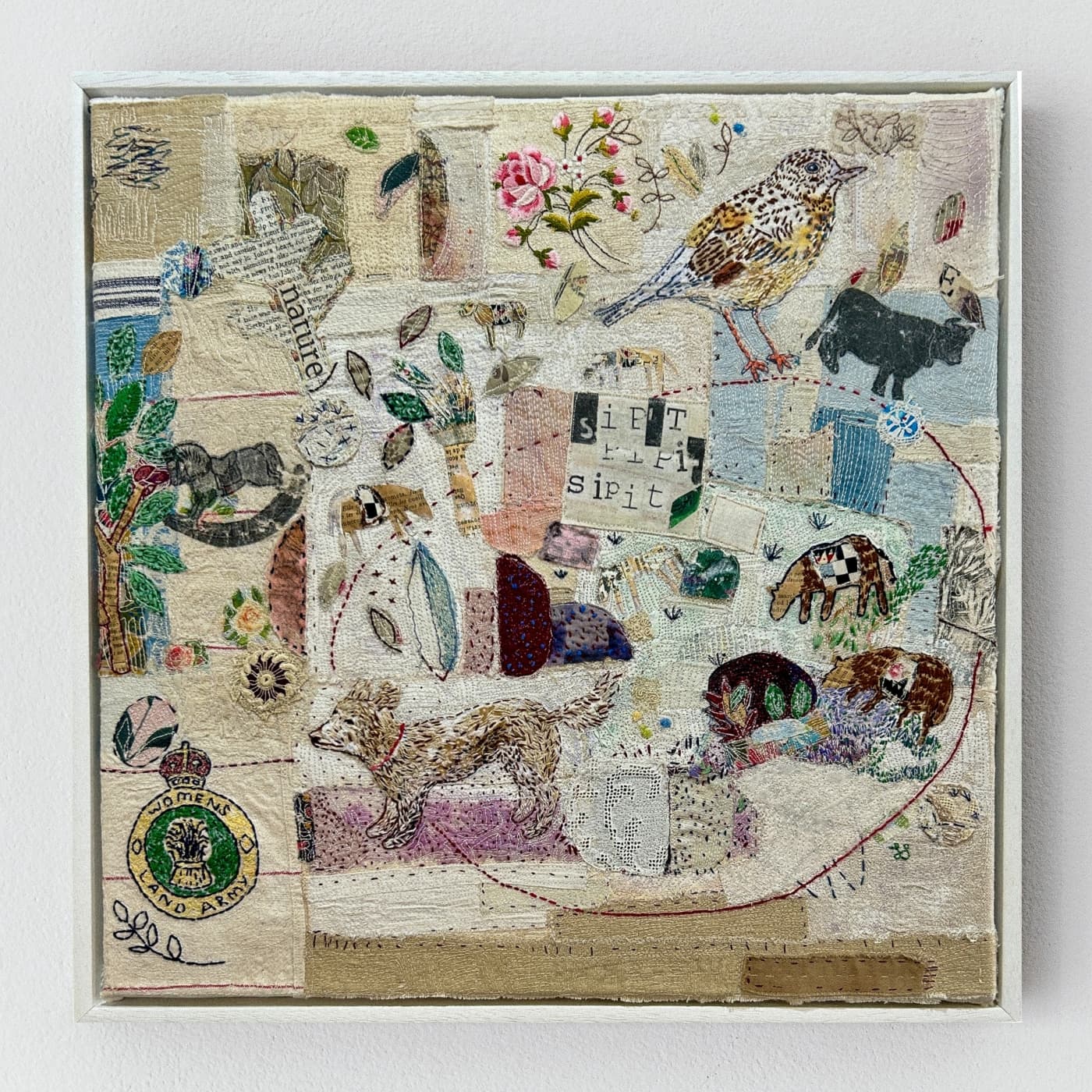
Tell us about the lyrical name of your work Springtime Conversation: Sipit…Pipit…Sipit…
The bird featured in this work is a Meadow Pipit, and the title is his song. We would see them perched on top of the heather when walking coast to coast in Yorkshire.
A path stitched with backstitch and running stitch creates a focus within the work. We had a backpack for our little dog, and when we let her out, she would run along the path with happiness.
The paper and fabric animals are a reference to the distinctive Belted Galloway cattle we’d seen on this part of the walk.
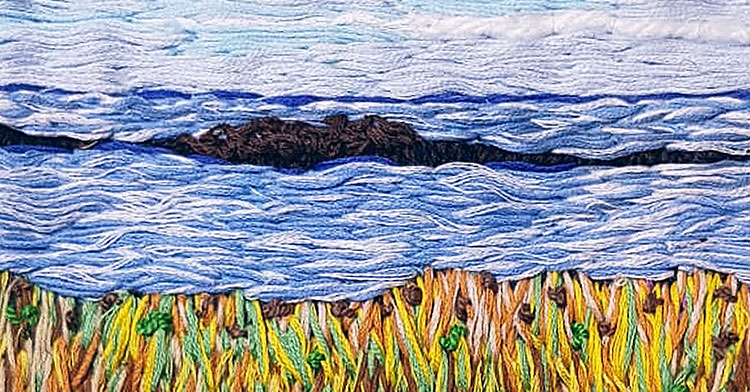
The blues in this piece take me straight back to when the heather-coloured moors met with a perfect blue sky.
Developing personal narratives
Will you be sharing some of your storytelling techniques in your upcoming Stitch Club workshop?
Students will create a layered collage drawing on different elements from within my work. I’ll be presenting different ideas for collage, including how to create a new fabric from fusing special fabric scraps. I’ll also show how to elevate keepsakes into small treasures on a platform of layered fabrics.
I hope students will take away practical ideas for creating their own stitched collage. More importantly, though, I hope they find some ideas that lead to identifying their own motifs for creating narratives that are personal to them.
Tell us a bit about your maker space…
My home studio has two windows that provide wonderful light in which to work. I’ve thought about getting a studio away from home, but if I’m working on a project, I’ll quite happily stay up until one in the morning, which wouldn’t work anywhere else.
I also have so many things around me that can serve as reference or are simply just waiting to be included.
We’ve lived here for 21 years, and I have all the familiar of the outside space too. I head for the canal around the corner if I need thinking time during the day.
What are your must-have tools, supplies or materials?
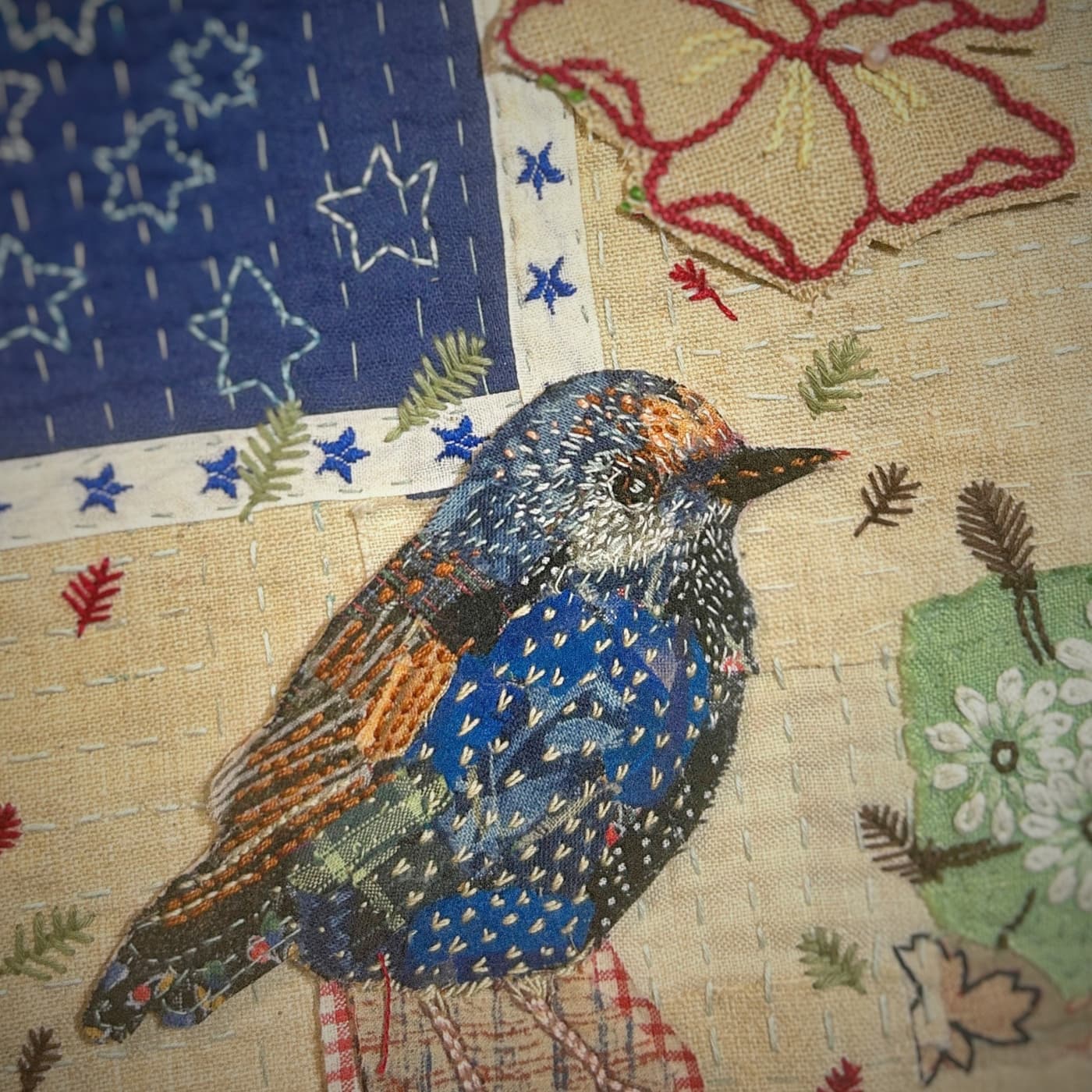
I love gifted fabrics, as they bring something new and unexpected to my work. They often take me on a new journey of discovery. I also have favourite dark and light threads for hand and machine stitching. I use them to draw, blend and highlight.
I work on a Bernina 1008. It’s a real workhorse, and I’m always apologetic when taking it in for service!
You have a vibrant Instagram feed. What are your thoughts about using social media?
Instagram has given me incredible opportunities to grow my business, but I’m grateful I found my creative style when I did. Following your own creative journey can be challenging when there’s so much out there. It’s easy to absorb other people’s work without realising it.
That said, social media is fantastic for networking and connecting with an audience. It’s also a great way to document your development as an artist.
What excites you most about teaching, and what are some of the challenges students bring to your workshops?
My workshops are inspired by whatever I’m working on at the time. I love sharing the excitement of discovering a new material, technique or idea and then seeing students’ personal spin. Everyone brings different skills, materials and colour preferences, and that individuality really shapes the work that comes out of the sessions.
A challenge is that experience levels vary a lot, so I design workshops that can be accessed at different stages. I provide a starting point but leave plenty of space for personal interpretation.
I also always bring a wide range of samples and ideas, so students can work at a level that feels right for them. And I bring practical resources like motif templates, as drawing can sometimes be a barrier. I try to remove as many obstacles as possible so that students are free to focus on creating art with fabric and thread.
Comments